Four NASA astronauts have returned safely to Earth after their historic 10-day mission around the Moon, splashing down in the Pacific Ocean off the coast of California. The crew—commander Reid Wiseman, pilot Victor Glover, mission specialist Christina Koch, and Canadian astronaut Jeremy Hansen—completed the farthest journey from Earth ever undertaken by humans aboard the Orion capsule.
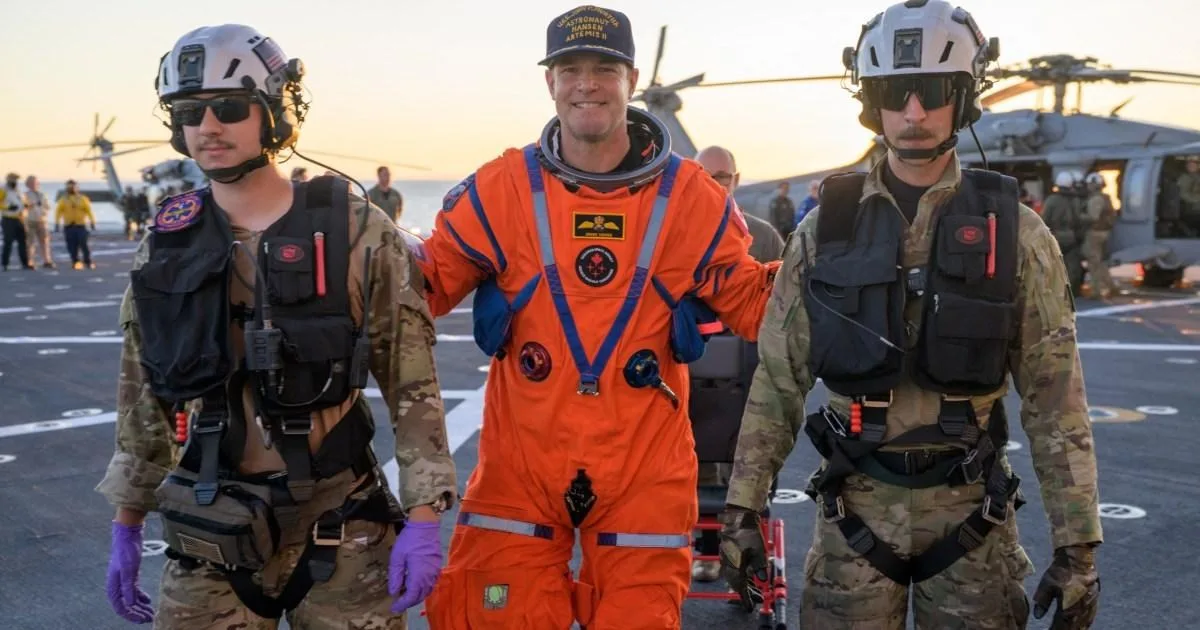
Upon landing, the astronauts were extracted from the capsule by US military helicopters and taken to the deck of the USS John P Murtha. Several required physical support to walk after spending ten days in microgravity, which can weaken muscles and bones. They were then taken for mandatory medical checks.
NASA described the splashdown as a 'textbook touchdown'. The most perilous phase of the mission occurred when Orion re-entered Earth's atmosphere at speeds exceeding 23,000 mph, generating intense heat and causing a radio blackout lasting six minutes. Despite some technical glitches, including issues with the spacecraft's toilet, the mission was deemed a success.

Administrator Jared Isaacman praised the crew as 'ambassadors from humanity to the stars'. The astronauts carried a mascot named Rise, designed by eight-year-old Lucas Ye, which served as a zero-gravity indicator. The toy featured the Carroll Crater, named after Wiseman's late wife.
The Artemis II mission did not land on the Moon but conducted scientific observations, including a total solar eclipse. The crew will now undergo further medical evaluations before reuniting with their families.