Artemis II Astronauts Reflect on Mission Highlights During Return to Earth
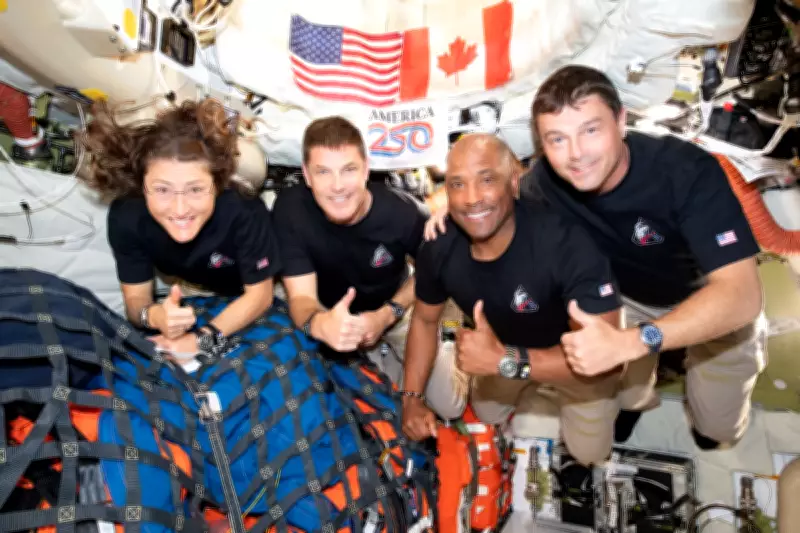
The crew of NASA's Artemis II mission has provided an intimate look into their experiences aboard the Orion spacecraft after completing a historic lunar flyby. In a live broadcast, the astronauts described the mission as a "relay race" and shared their awe at witnessing a rare solar eclipse near the Moon's far side, an event that left them utterly captivated.
Life in Microgravity Aboard Orion
Living inside the Orion spacecraft in microgravity has made the capsule feel more spacious than its actual dimensions, according to the crew. NASA astronaut Christina Koch noted that while the environment feels larger, it remains a tight space where crew members frequently bump into each other. "We have loved living in Orion, and in fact, we've all said that sometimes you can forget where you really are because we're in this small space that just gives us everything we need," Koch explained. She added that daily activities, from eating to taking photos, are collaborative efforts involving all four astronauts, making the experience both challenging and enjoyable.
The Breathtaking Lunar Eclipse
During the broadcast, the astronauts recounted the rare moment they observed a solar eclipse from the far side of the Moon. Despite extensive training and simulations, the real event surpassed all expectations. "The thing that we saw that really surprised me the most is we trained to view the eclipse from the far side of the moon, but when that actually happened, it just blew us all away," one crew member said. The eclipse, described as a "consolation" and a "great gift," highlighted the mission's unexpected wonders.

Mission as a Relay Race
The Artemis II crew emphasized their role in a broader context, viewing the mission as part of a relay race aimed at benefiting future teams. They carried physical batons to symbolize this ethos, focusing on improvements for subsequent crews. Koch stated, "We're always thinking from the perspective of: what is the next crew going to think about this? How will this help them to succeed?" This mindset extends to all mission teams, including flight control and engineering personnel.
Scientific Observations and Human Insights
NASA highlighted the value of human observations during the mission, with astronauts studying 30 lunar targets, including the Orientale basin, a massive crater spanning nearly 600 miles. Mission commander Reid Wiseman described its features in detail, noting its circular appearance. The crew also named two craters: "Integrity" after their spacecraft and "Carroll" in honor of Wiseman's late wife. These efforts underscore the unique insights astronauts provide beyond satellite data.
Return Journey and Ongoing Activities
As the Orion spacecraft begins its return to Earth, with a splashdown in the Pacific scheduled for Friday, the crew remains in high spirits. NASA conducted a thruster burn to correct the spacecraft's path, and scientific work continues, including testing an orthostatic intolerance garment to aid circulation upon re-entry. The mission's livestream has captured lighter moments, such as a Nutella jar floating in zero gravity, which went viral online.
Cultural and Social Elements
The mission also featured cultural touches, including a playlist of wake-up songs chosen by NASA and a mascot named "Rise," designed by a California elementary student. These elements add a human dimension to the high-stakes expedition, engaging the public and showcasing the mission's broader appeal.
Overall, the Artemis II mission blends scientific rigor with personal reflections, offering a comprehensive view of human space exploration as the crew prepares for their final descent to Earth.