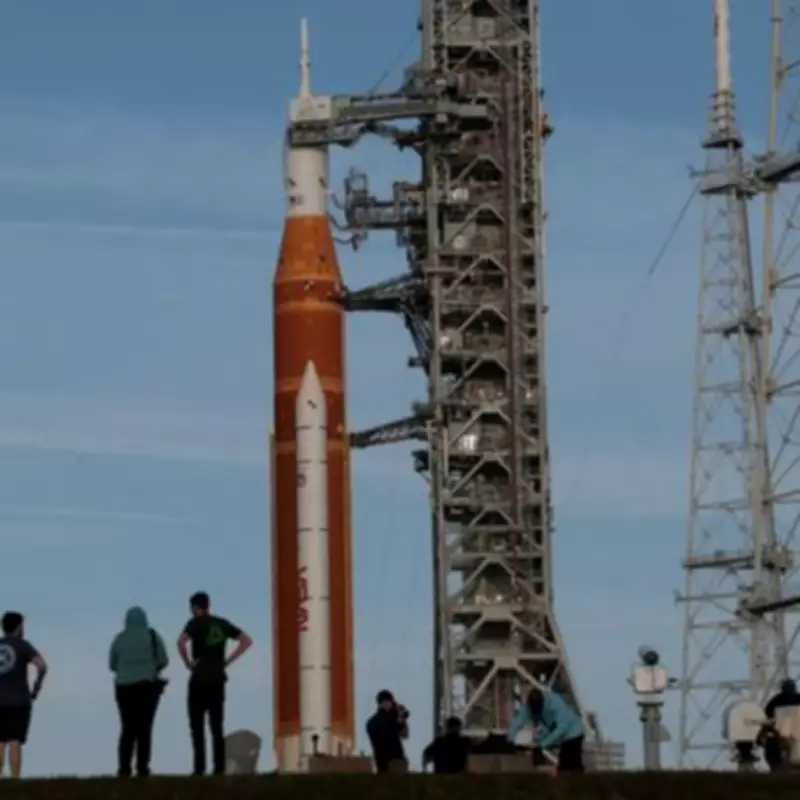
Artemis 2 Launch Imminent: NASA Prepares for Historic Moon Mission
NASA is on the brink of launching its Artemis 2 mission, marking humanity's first crewed journey to the Moon in over 50 years. The Space Launch System rocket and Orion spacecraft are scheduled to lift off from Kennedy Space Center in Cape Canaveral, Florida, at approximately 6:24 PM local time (11:24 PM UK time) tonight, weather permitting.
Crew and Mission Details
The mission features a diverse crew of four astronauts: NASA's Reid Wiseman, Victor Glover, and Christina Koch, alongside Jeremy Hansen from the Canadian Space Agency. They will embark on a 10-day mission to circle the Moon, traveling up to 250,000 miles from Earth—surpassing the distance record set by Apollo 13 in 1970.
This flight includes several historic milestones: Christina Koch will become the first woman to fly to the Moon, Victor Glover the first Black astronaut to travel into deep space, and Jeremy Hansen the first Canadian to venture to the lunar vicinity.

Launch Timing and Preparations
Timing is critical for the mission's success. NASA has emphasized that the trajectory must ensure the Orion spacecraft is not in darkness for more than 90 minutes at a time to maintain solar power and optimal temperatures. The launch window opens this evening, following months of delays due to technical issues such as hydrogen leaks.
Fueling operations are underway, with liquid hydrogen and liquid oxygen being loaded into the rocket's core stage. The process includes slow and fast fill phases to acclimate the systems to cryogenic conditions.
Life Onboard and Crowd Expectations
During the mission, the astronauts will live in the Orion capsule, roughly the size of a garden shed. They have selected personalized meals, including a variety of hot sauces and beverages, with enough coffee for about 43 cups over the journey. The crew underwent two weeks of isolation pre-launch to prevent illness.
Anticipation is high, with an estimated 400,000 spectators expected to gather on Florida beaches to witness the launch, weather permitting. This event marks the first time humans will leave lower Earth orbit since Apollo 17 in 1972.
Mission Trajectory and Technical Specs
After liftoff, the astronauts will spend the first 25 hours in a high Earth orbit, practicing docking maneuvers. The Orion capsule will then journey to the Moon, reaching a point 5,000 miles beyond it on flight day six, setting a new distance record. The return will utilize a free-return trajectory, relying on gravitational forces to minimize fuel use.
The Space Launch System rocket, standing 322 feet tall and weighing 2.6 million kilograms when fueled, is more powerful than the Saturn V used in the Apollo program, despite being shorter. It incorporates salvaged space shuttle engines and other components, using liquid hydrogen as fuel.
Artemis 2 aims to test Orion's life support systems and capabilities, paving the way for future lunar exploration. If successful, it will redefine human space travel and inspire a new generation of explorers.