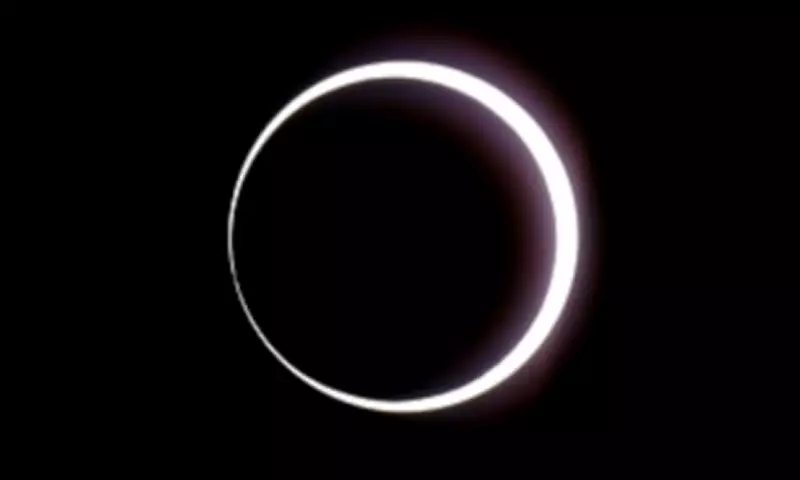
Antarctic 'Ring of Fire' Eclipse: A Rare Celestial Spectacle for a Select Few
Today, a breathtaking annular solar eclipse, famously known as a 'Ring of Fire', will illuminate the sky, but the opportunity to witness this full celestial display is astronomically limited. From 09:56 GMT until 14:28 GMT, the moon will pass directly in front of the sun, casting a perfect shadow over Earth. However, the catch is that the total eclipse will only be visible from the most remote and inhospitable regions of Antarctica.
Exclusive Viewing for Antarctic Researchers
The only humans positioned to experience this stunning event are approximately 100 exceptionally fortunate scientists spending the Antarctic summer at the Concordia and Mirny research stations. These researchers are in for a special treat, as today's solar phenomenon is an annular eclipse, where the moon aligns with the sun to leave a perfect glowing ring of light in the darkened sky.
At precisely 12:12 GMT, the shadow of the moon will align with the sun, creating the iconic 'Ring of Fire' effect. Dr Shyam Balaji, an expert from King's College London, explained to the Daily Mail: 'An annular solar eclipse occurs when the Moon passes directly in front of the Sun but is slightly farther from Earth in its elliptical orbit. At maximum eclipse, the Moon blocks the central part of the Sun, leaving a bright ring of sunlight visible around its silhouette.'

Partial Eclipse Visibility for Millions
While the full 'Ring of Fire' will be exclusive to Antarctica, a partial eclipse will be observable across a much broader area. According to TimeAndDate.com, an estimated 176 million people could have a chance to see at least some level of eclipse. This includes regions in South Africa, Argentina, Chile, Madagascar, Mauritius, and other parts of Southern Africa.
However, many of these viewers may only witness a small portion of the sun obscured by the moon. Outside of Antarctica and the uninhabited French Southern Territories, Mauritius offers the best partial view, with the sun appearing up to 32 percent obscured. This is followed by Port Elizabeth in South Africa, where the sun will be 14 percent obscured.
Safety Precautions for Eclipse Viewers
For those lucky enough to be in the path of today's eclipse, it is crucial to remember that the sun can still cause severe eye damage during occlusion. Dr Balaji warns: 'It is not safe to look at the eclipse with the naked eye. At no stage of an annular eclipse is it safe to look at the Sun without proper solar filters.'
This means that special eclipse glasses, which block out the majority of harmful solar light, are essential. Even the researchers in Antarctica must keep their eclipse glasses on during totality, as the bright rim of the 'Ring of Fire' can still damage their eyes.
The Science Behind the 'Ring of Fire'
The 'Ring of Fire' eclipse occurs when the sun and moon align while the moon is at its furthest point from Earth, preventing it from covering the entire sun. Dr Balaji notes: 'Because it appears a little smaller in the sky, it does not completely cover the Sun’s disk. In a total eclipse, by contrast, the Moon is close enough to obscure the Sun entirely.'
Interestingly, the sun is 400 times larger than the moon but also 400 times further away, making them appear the same size in the sky and allowing for total solar eclipses. However, this alignment rarely happens when the moon is farther from Earth, resulting in the annular effect.
Upcoming Celestial Events
If you miss today's Antarctic eclipse, there is no need to despair. In a fortnight, on March 2, stargazers in the Southern Hemisphere will be treated to a full lunar eclipse. Solar and lunar eclipses often come in pairs due to the moon's orbit, so this is not a mere coincidence.
While the moon passes in front of the sun every 28 days, it doesn't always produce a solar eclipse because the sun and moon don't orbit on the exact same plane. When they do align perfectly, it typically triggers a lunar eclipse as the moon moves to the other side. The March lunar eclipse will be visible from North and South America, parts of Asia, Australia, and New Zealand.

Looking ahead, the next solar eclipse is scheduled for August 12 this year and will be visible in Greenland, western Iceland, and northern Spain, offering another chance to witness these awe-inspiring celestial events.