Viral Photo Creates Mass Confusion Over Body Part Identification
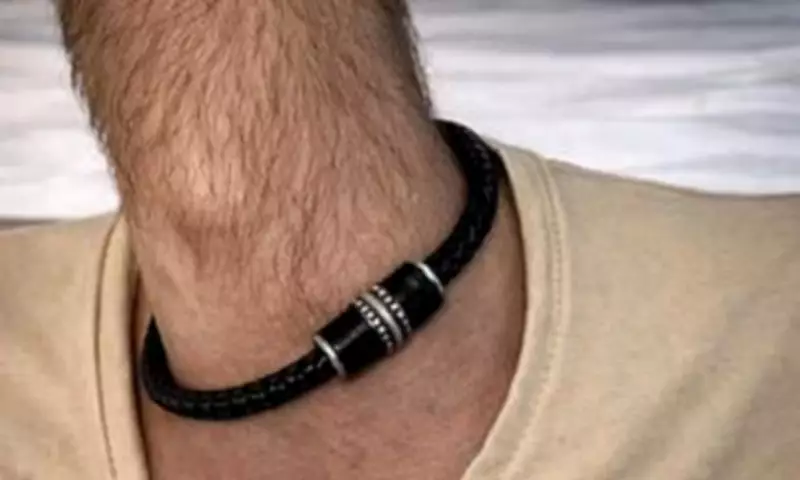
A deceptively simple photograph has taken social media platform X by storm, generating widespread bewilderment as users engage in heated debates about which human body part the image actually depicts. The close-up shot features a person wearing black leather jewelry around what appears to be a hairy body part, with two distinct fabric colors visible in the background. This visual puzzle has captivated thousands of online observers who remain divided in their interpretations.
The Viral Journey of a Perceptual Puzzle
The intriguing image first appeared on February 22nd when user @doxie_gay initially shared it, before gaining significant traction through a repost by @ilyasroza that propelled it to viral status. The accompanying caption, "Thought this was a scarily skinny and hairy neck," set the stage for the widespread confusion that would follow. Social media responses ranged from genuine bafflement to humorous frustration, with one user exclaiming "WHAT IS IT" while another admitted "Bro i still have no idea what i'm looking at." A third participant humorously pleaded for assistance, stating "I still have a hard time knowing what this is! Can anyone help?"
The Revealing Truth Behind the Visual Mystery
At first glance, most viewers perceive a man with an unusually thin, hairy neck adorned with a beige V-neck top and what appears to be a black necklace. However, the reality proves dramatically different. The photograph actually captures the man's right arm, with his hand comfortably resting in the pocket of beige trousers. The jewelry item is not a necklace but rather a bracelet worn on the wrist. X user @popeikue successfully located the original, unzoomed version of the image, which clearly shows the complete context of a man with his hand in his pocket, resolving the visual ambiguity.

The revelation has astonished countless viewers across the platform. One user responded with amazement, writing "Wait. This is a hand in a pocket. Took me hours," while another admitted "Ohhhh that's a pocket. It took me a minute too." A particularly humorous reaction came from a user who stated "I've been told its a hand in a pocket. I know its a hand in a pocket. I've seen the illustrations showing it is a hand in a pocket. My eyes refuse to believe it is anything but a long, thin, hairy neck." Some curious participants even employed artificial intelligence to generate potential full images based on the neck interpretation, further demonstrating the power of the visual deception.
The Science of Bistable Perception Explained
This captivating image represents a classic example of what psychologists term "ambiguous" or "bistable" imagery, where a single visual stimulus can be interpreted in two distinct ways by the human brain. Similar well-known examples include the famous Rubin's Vase illusion, which alternately appears as either a vase or two facing profiles, and the duck-rabbit drawing that can be perceived as either animal. These illusions exploit fundamental processes of human visual perception.
When we observe our surroundings, our brain's perceptual systems continuously work to distinguish important objects from background elements. Bistable images deliberately disrupt these cognitive processes by removing contextual cues that normally help differentiate foreground from background. In this specific photograph, the unusual perspective creates competing interpretations: either a thin, hairy neck or an arm inserted into a pocket. The most fascinating aspect of bistable perception is that viewers cannot simultaneously experience both interpretations; the brain must select one perceptual framework at a time. This neurological limitation explains why people experience sudden perceptual "flips" between interpretations and often struggle to return to their initial perception once they've recognized the more accurate version.

Historical Context of Visual Illusions
The scientific study of optical illusions has a rich history, with one particularly famous example being the café wall illusion first formally described by Professor Richard Gregory of Bristol University in 1979. This phenomenon occurs when alternating columns of dark and light tiles are vertically offset, creating the illusion that horizontal lines appear tapered. The effect depends critically on visible gray mortar lines between tiles and was originally observed on the wall of a café near the university campus.
Professor Gregory's groundbreaking research revealed that diagonal lines are perceived due to complex interactions between neurons in the visual cortex. Different neuronal types respond to dark and light colors differently, and the specific arrangement of tiles causes varying parts of grout lines to appear brighter or dimmer on the retina. Where brightness contrasts occur across grout lines, small asymmetries form that the brain integrates into longer, sloping lines. These findings, first published in the journal Perception, have significantly advanced our understanding of visual information processing and have found practical applications in graphic design, art, and architecture worldwide.