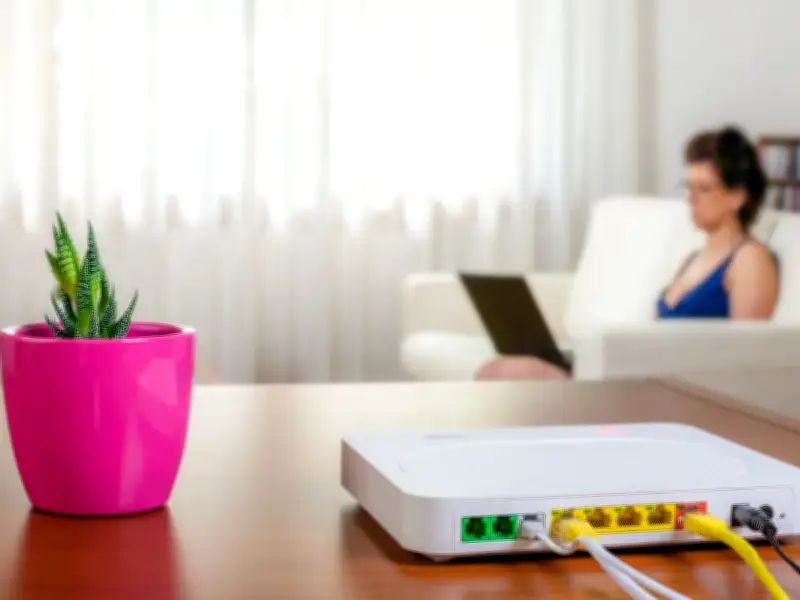
Slow Wi-Fi in parts of the home may not require a more expensive broadband package, according to an expert who says simple fixes such as router placement can often solve the problem.
Fast broadband is considered vital by most households, whether for work, managing bills and finances, or leisure activities such as gaming and streaming TV. The government is working to make gigabit-capable broadband available to 99% of homes by 2032, with the latest Project Gigabit figures showing this is now achieved in 88% of UK homes and businesses.
Router position can be the issue
Despite this, many households may still struggle to get a reliable Wi-Fi signal in every room, with experts warning that a super-fast connection to the property does not necessarily guarantee reliable Wi-Fi throughout. Catherine Hiley, managing editor for broadband, energy and mobile at Go.Compare, said: “For many users, the broadband itself is not always the issue. It could be the property layout or a poorly placed router that’s causing the signal to drop. Before spending money on a faster package, it’s worth ruling out other causes first.”
She added: “Project Gigabit is helping bring faster broadband to more homes, but a good connection at the front door is only the start. If WiFi drops out in the back bedroom, loft, office or garage, upgrading to a faster deal may not always be the answer. Test the signal room by room. Start with the simple fixes such as moving the router into an open, central position. Then compare the right option for your home, whether that is a better router, an extender, mesh WiFi or a new broadband package.”
Rooms where Wi-Fi often fails
The expert has shared the rooms where Wi-Fi frequently fails to reach and how to remedy it. In a back bedroom or box room, if the router is at the opposite end of the property, the signal may be weak. Moving the router to a central location and placing it off the floor, rather than in a cupboard or behind a TV, can help.
A converted loft can be one of the hardest places for the Wi-Fi signal to reach. An extender placed halfway between the router and the loft may help, but the router should not be positioned inside the dead zone itself. In the kitchen, keeping the router away from electrical equipment where possible and testing whether moving it a few metres improves coverage is recommended before buying new equipment.
Solutions for larger layouts and fixed devices
For a garden room or outdoor home office, a mesh Wi-Fi system may be more effective than a basic extender. These use connected units around the home to create a broader network, making them useful for larger layouts and several weak rooms. For a fixed TV, console or desk, a wired Ethernet connection can be the most effective solution, as it removes the need for Wi-Fi altogether and is usually more stable.
A garage is often separated from the house by an exterior wall or metal door, which are difficult obstacles for Wi-Fi. If it is used for a gym, workshop or EV charger, a mesh point in the room nearest the garage may help. For a detached garage or a connection that is relied on, a wired Ethernet cable is the most reliable fix. If the connection works well beside the router but fails elsewhere, the problem is most likely coverage within the home rather than the broadband coming into the property.