Have you ever stubbornly refused to lower a game's difficulty setting, or spent hours chasing a seemingly meaningless digital trophy? If so, you might be experiencing the peculiar and pervasive phenomenon known as 'gamer brain'. This psychological quirk drives players to pursue objectively pointless in-game goals, and it's a fascinating window into the modern gaming mindset.
Beyond Aggression and Benefits: The Gamer Brain Phenomenon
For years, studies on gaming's impact have focused on two extremes: potential links to aggression or the cognitive benefits of play. The former has largely been debunked, with over a decade of research failing to prove any causative connection between video games and real-world violence. Conversely, studies highlighting gaming's positive effects show that performing complex tasks can be beneficial for cognitive function, emotional wellbeing, and stress management.
But 'gamer brain' occupies a different, more curious space. It's the part of a player that is inexplicably drawn to mastering a pointless mini-game for a higher score, or meticulously clicking along the invisible boundaries of a level just in case something happens. It's the stubborn refusal to lower a game's difficulty during a punishing boss fight, viewing it as 'letting the game win'. It's the compulsion to stay with a title long after the story concludes, driven solely by the need to unlock that last achievement.

It's unclear whether games cultivate this specific flavour of obstinacy, or whether people with such tendencies are naturally drawn to gaming. However, it's a near-universal experience among dedicated players. It represents the part of you determined to bend a game's rules to your will. The extreme manifestation includes feats like learning to play impossible DragonForce songs on Guitar Hero at double speed, simply because it's possible.
Baby Steps: A Game That Mirrors and Mocks the Player
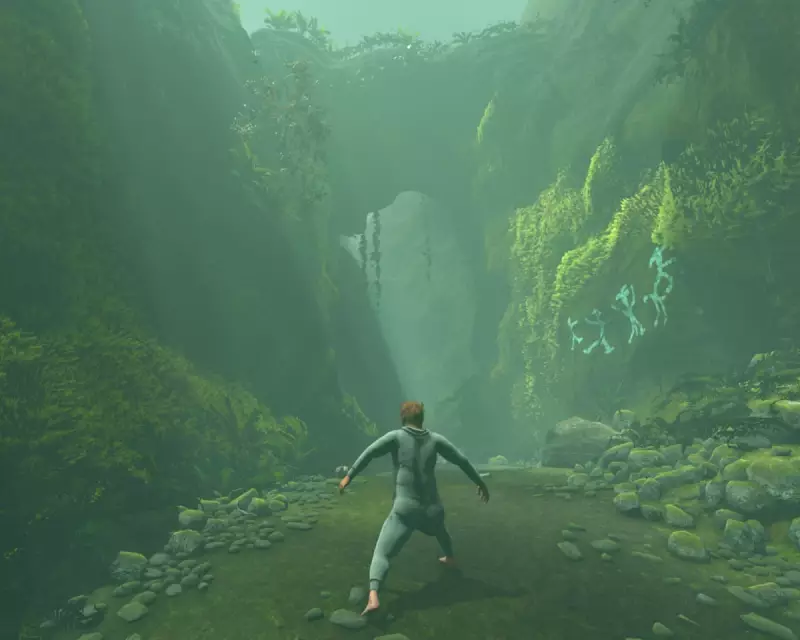
This concept was brought into sharp focus for many by the 2023 game Baby Steps, from developers Gabe Cuzillo and Bennett Foddy. The game, featuring the perpetually struggling protagonist Nate, both embraces and gently mocks 'gamer brain'. It's filled with moments designed to tease players into attempting ridiculous, often unrewarding, feats.
Players encounter large holes they can choose to fall into, a tower they're explicitly told holds nothing at the top, and a waterfall hiding only a crudely drawn image behind it. One of the game's creators, Bennett Foddy, explained the design philosophy. "There is a normal dirt path by a cliff that you can walk up perfectly safely, and then along the cliff is a series of wooden pegs that you could walk up instead, if you wanted to risk losing 20 minutes of progress," Foddy says. "That's a joke that you're making with the player, because for them to find that funny, they have to know that they're tempted to walk on the pegs."
The game's most exquisite joke involves a pair of glasses that reveal invisible steps leading to an invisible trophy. Nate's triumphant celebration in front of this unseen prize, while a confused onlooker sees him dancing before empty space, perfectly encapsulates the absurdity of the pursuit. "You're seeing yourself reflected in this loser," Foddy notes. "That's the deep joke: this guy, this couch potato, he's actually you in this moment."
The Culture of Pointless Pursuit and Its Meaning
Gamer brain is often viewed through a gendered lens, associated with a kind of dogged, toxic masculine play embodied by characters like Nathan Drake from the Uncharted series. However, as the article's author attests, you don't have to be a man to experience it. The drive manifests in events like the Awesome Games Done Quick (AGDQ) marathons, where players undertake esoteric challenges such as completing The Legend of Zelda: Majora's Mask blindfolded.

Ultimately, Baby Steps is a game that can only be fully appreciated by those who possess a bit of 'gamer brain'. Its humour stems from a shared understanding of the strange compulsion and even transcendence found in pursuing digital objectives that, to an outsider, seem utterly pointless. Yet, herein lies the key insight: these pursuits are not pointless if they hold meaning for the player. The value is intrinsically tied to personal challenge, mastery, and the unique satisfaction found within the rules of a virtual world.
Gabe Cuzillo, who voices Nate and admits to a chronic case of gamer brain, summarises the game's introspective aim. "Over time, we came around to this idea that a lot of the level design is an opportunity for introspection about why you're playing the game at all... You're asked as a player: What do you care about? Who are you as a person?" In the end, 'gamer brain' is less about the trophy and more about the person determined to earn it.