India Faces Backlash for Hosting Myanmar Junta Leader in State Visit
India Criticised for Hosting Myanmar Junta Leader

India is facing mounting criticism over its decision to roll out the red carpet for Myanmar’s junta leader Min Aung Hlaing, becoming the first country to host the general since he declared himself president.

Min Aung Hlaing concludes a five-day state visit on Wednesday that began with a military guard of honour and included meetings with Prime Minister Narendra Modi and India’s President Droupadi Murmu.

The junta leader has faced years of international sanctions and condemnation over his military’s overthrow of Aung San Suu Kyi’s democratically elected government in 2021. He claims to have formed his own civilian administration after elections this year, which were widely condemned as a sham exercise to maintain the military’s grip on power.

Wide Pickt banner — collaborative shopping lists app for Telegram, phone mockup with grocery list

India defended the state visit as a necessary step to maintain dialogue with an important neighbour, but analysts and rights groups criticised the decision as short-sighted and serving the interests of neither the people of Myanmar nor India itself.

“Min Aung Hlaing is not Myanmar’s legitimate president. He is the architect of a brutal coup that overthrew a democratically elected government, and has since presided over a campaign of mass atrocities against his own people,” said Mercy Chriesty Barends, chair for the Asean Parliamentarians for Human Rights organisation.

The main event of the visit was a bilateral meeting between Min Aung Hlaing and Modi on Monday. Neither leader addressed the media following the talks. A statement said the two leaders “underscored the importance of strengthening bilateral cooperation” and discussed trade, defence, and security cooperation, border management, and “bilateral, regional and global issues of mutual interest”.

Later in the day the junta leader was received at the Indian presidential residence by Murmu, who told him that India and Myanmar share deep cultural, civilisational, and spiritual ties that go back centuries.

On Tuesday, he visited India’s commercial capital Mumbai for talks with business and industry leaders and to visit infrastructure projects, before he was due to fly out on Wednesday. New Delhi has long argued that geography leaves it little choice but to maintain relations with whichever government controls its eastern neighbour. The two countries share a 1,600km border, leading to common challenges involving security, migration and cross-border trade.

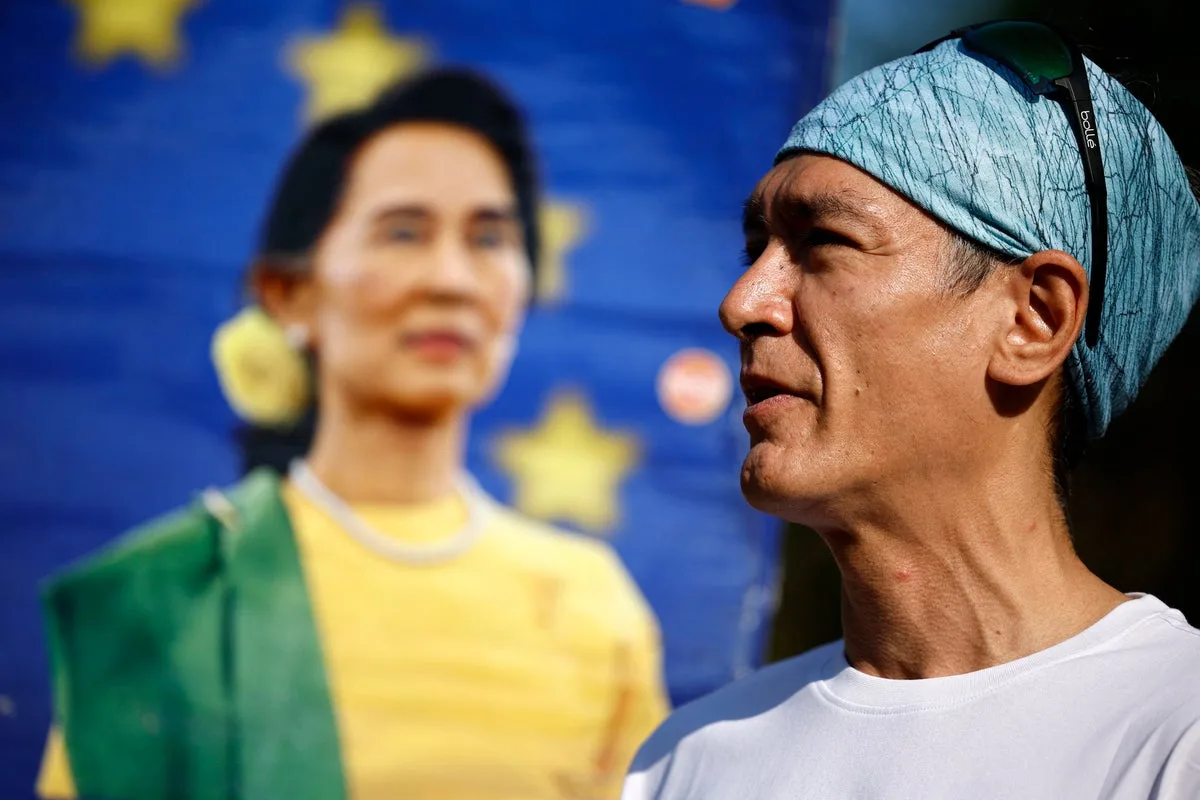
But it is nonetheless significant that India has hosted Min Aung Hlaing at a time when Myanmar is still engulfed in a civil war triggered by his military’s brutal crackdown on pro-democracy protesters – a conflict that has killed thousands of people and displaced millions. Nobel Peace Prize laureate Aung San Suu Kyi remains in house arrest on charges widely condemned as politically motivated, with no access to lawyers or visits from family members. She has spent much of the past five years in solitary confinement while resistance groups across the country continue to control large swathes of territory in their fight against the junta.

Min Aung Hlaing was a powerful figure in the military long before leading the 2021 coup and has been sanctioned for his role in the military’s attacks on ethnic Rohingya minorities, described by the UN human rights chief as a genocide. Tun Khin, a prominent Rohingya activist who was born in Myanmar's Rakhine (Arakan) State and moved to the UK, said: “Instead of rolling out the red carpet [for Min Aung Hlaing] India should be slapping on the handcuffs. The Myanmar military has caused problems for India for decades, creating instability on India's borders, refugees, scam centres and damaging economic opportunities. India would be better off supporting a democratic Myanmar rather than legitimising a general responsible for genocide,” he told The Independent.

The US first sanctioned Min Aung Hlaing in 2019 over alleged human rights abuses against the Rohingya, including the military operations that drove hundreds of thousands of Rohingya into Bangladesh. Additional sanctions followed the 2021 military coup.

In July 2020, the UK also imposed sanctions on him, while the European Union has also maintained and repeatedly extended its sanctions regime against Myanmar's military leadership.

Pickt after-article banner — collaborative shopping lists app with family illustration

Earlier this year, the UN’s top court, the International Court of Justice (ICJ), heard a genocide case filed against Myanmar’s military by the Gambia. The case centres on operations between 2016 and 2017 that forced more than 700,000 Rohingya to flee into Bangladesh.

In 2025, an Argentinian court issued an arrest warrant against Min Aung Hlaing for alleged genocide and crimes against humanity committed against the Rohingya minority.

Mark Farmaner, the director of the Burma Campaign UK, told The Independent that Modi’s policy right now is driven by a desire to counter China’s influence, but that New Delhi would be better served in the long run by supporting a democratic Myanmar which might be less dependent on Beijing.

“Modi will be calculating that being the first to invite general Min Aung Hlaing since he appointed himself president will buy more goodwill and influence for India,” he said. “India’s current approach to Myanmar has doomed them to play second fiddle to China, as India can’t compete economically or politically with China and its UN Security Council seat and global clout,” he added.

The group of Asean Parliamentarians for Human Rights, a regional body involving current and former lawmakers in southeast Asia, said India's “Neighbourhood First” and “Act East” foreign policies were built on stability, trust and a rules-based regional order – all values it argues have been undermined by Myanmar's military. Ahead of the visit, an open letter signed by 122 civil society organisations, humanitarian networks and ethnic community groups urged India to rescind the invitation and avoid conferring legitimacy on a leader they described as the “architect of the Myanmar polycrisis”.

It said hosting Min Aung Hlaing “would inadvertently legitimise an illegal junta responsible for systematic violations of human rights and atrocity crimes against Myanmar’s peoples.”

At a briefing during the visit, Indian foreign secretary Vikram Misri said engagement with the regime in Naypyidaw does not mean endorsement of the country's political system. He said Modi raised the issues of Suu Kyi’s detention and the return of democracy in the country as part of a “free-wheeling” discussion.

“History has shown that disengagement doesn't give us any results that are better than engagement, and it certainly doesn't produce democratic change if that is what we are interested in,” he said. “On the other hand, disengagement only produces a vacuum that others go on to fill then to our detriment. And those others have no interest in democracy, I can assure you about that,” he said, an apparent reference to China.

Ophelia Yumlembam, Research Associate at the Organisation for Research on China and Asia (ORCA), told The Independent that developments in Myanmar’s border regions like Chin State were of critical importance to India. “For New Delhi, the crisis in Myanmar is not a distant political issue but an immediate neighbourhood challenge with direct implications for border security, regional stability, connectivity projects, and refugee flows,” she said.




