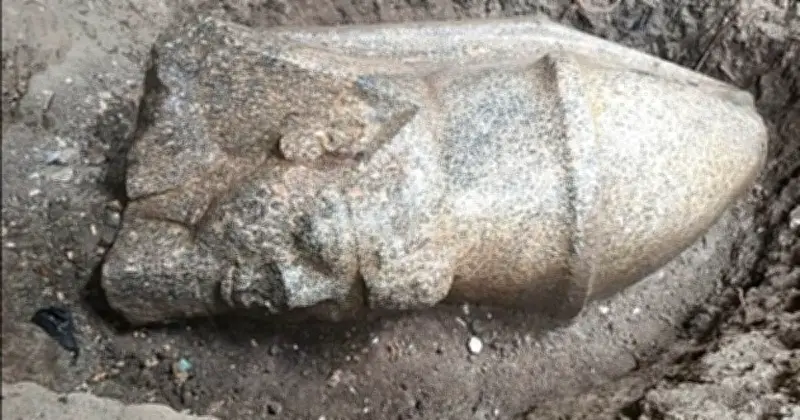
Archaeologists have unearthed the remains of two colossal statues believed to represent one of ancient Egypt's most celebrated pharaohs. The discovery was made in Behbeit el-Hagar, a village in Egypt's Nile Delta about 60 miles (100km) north of Cairo, after a farmer spotted a mysterious stone block in his field.
Farmer's alert triggers emergency excavation
Believing the object could be of ancient origin, the resident alerted local authorities, who promptly sent a team of archaeologists to investigate the site. Emergency excavations uncovered the remains of two enormous royal statues buried beneath the ground, with one conclusively identified as depicting King Ramses II, one of ancient Egypt's most powerful rulers.
Experts believe the second statue may also represent the famed pharaoh, whose reign is widely regarded as one of the most influential in Egyptian history. The statues had lain beneath the quiet Egyptian village for 3,000 years.
Ministry confirms royal statues
Egypt's Ministry of Tourism and Antiquities said: "The Egyptian archaeological mission succeeded in the rescue operations carried out in the village of Behebat al-Hijara in Gharbia Governorate, in uncovering the remains of two massive royal statues. One of them [is] King Ramses II, while the other is [also] likely to belong to the king."
Researchers believe the discovery could offer important new insights into the ancient temple complex that once occupied the area and its significance during the reign of Ramses II.
Temple of Isis site significance
The statues were uncovered at Behbeit el-Hagar, one of the Nile Delta's most notable archaeological sites. The location is best known for the impressive remains of the Temple of Isis, a major religious sanctuary in ancient Egypt.
Constructed largely from huge granite blocks, the temple served as an important centre of worship during the Late Period and later under the Ptolemaic dynasty. Archaeologists hope the latest findings will help shed further light on the site's history, development and religious importance over the centuries.