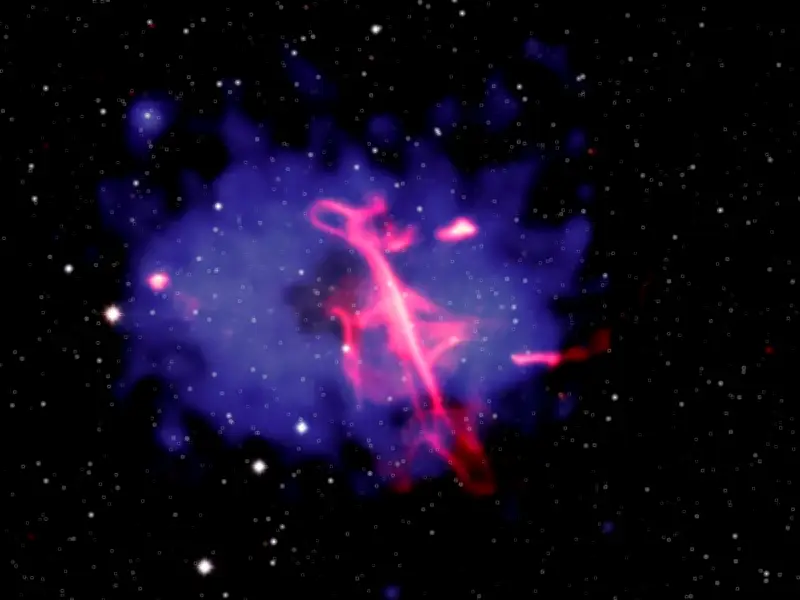
Astronomers using NASA's Chandra X-ray Observatory have identified what likely created a cosmic radio-wave structure dubbed the space "Treble Clef" because of its resemblance to the musical symbol. The nickname also echoes the famous symbol used by the musician Prince.
Black hole outburst and merging clusters
Researchers determined the remarkable formation was probably caused by an outburst from a supermassive black hole, followed by a collision of two galaxy clusters. A paper describing the findings, led by Andrea Botteon of the National Institute for Astrophysics (INAF) in Italy, was published on Wednesday 14 October in the Astronomy & Astrophysics journal.
NASA said an explanation has been particularly difficult to find because the formation lies almost directly behind the plane of the Milky Way, meaning that stars, gas and dust from our home galaxy largely block the view from Earth. By using telescopes that can peer through the intervening material, the team identified what is responsible for this uncommon structure.
Galaxy clusters in the process of merging
NASA's Chandra and the German Extended Röntgen Survey with an Imaging Telescope Array (eROSITA) X-ray telescope found diffuse, hot gas at the location of the Treble Clef, showing that a galaxy cluster hosts the object. The researchers also determined the galaxy cluster is, in fact, two clusters in the process of merging. Galaxy clusters are some of the largest structures in the universe, containing hundreds of individual galaxies and huge reservoirs of superheated gas.
Pareidolia and a dragon interpretation
NASA said the resemblance to a treble clef is a case of pareidolia, the phenomenon when people see familiar shapes in random data, since there is no scientific connection to the musical notation. The agency added: "A second interpretation of pareidolia for this radio emission structure is a dragon that is being viewed from the side."