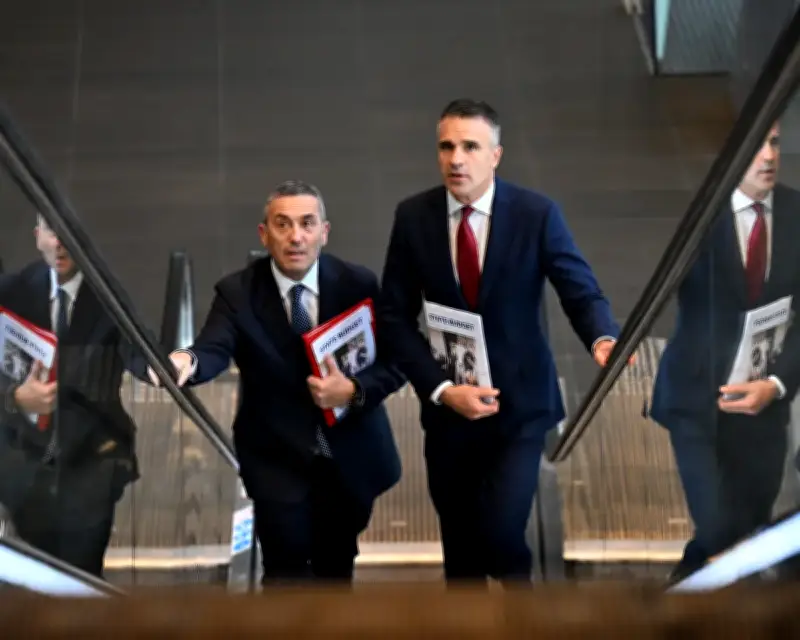
South Australian Premier Peter Malinauskas has announced a royal commission into artificial intelligence, the latest in a series of "nation-leading" initiatives that he says are powered by the need to turn the state's smaller size into agility.
The 45-year-old premier's move prompted ABC state political reporter Thomas Kelsall to find more than 50 government media releases using the phrase "nation-leading" in the past year and a half. Being constantly "nation-leading" is not a specific strategy, the premier says, but a function of being a more nimble state.
Turning size into strength
"We have to turn our smaller size, our relative size, into a source of agility, which we can make a strength," Malinauskas says. "The state's always had a bit of a history in trying to seize a first-mover advantage where we can … and if we can translate that into economic opportunity and better living standards, then that's the main game."
Labor kingmaker Don Farrell, an SA senator, says Malinauskas is "the standout politician of his generation." The praise also comes from industry organisations and former Liberal leader Peter Dutton, who once described him on Sky News before the last federal election as "the most honest of the Labor premiers." Podcast hosts Alastair Campbell and Rory Stewart have also sung his praises multiple times, particularly for his role in Australia's social media ban.
AI royal commission details
In June, Malinauskas released a plan to cash in on the datacentre boom. This month he made a flying visit to the United States, where he met with Apple's chief executive, Tim Cook, and Anthropic co-founder Tom Brown and signed a memorandum of understanding with OpenAI's president, Greg Brockman. He announced the royal commission upon his return, saying the two-day trip merely confirmed his thinking that there are "pretty essential questions that AI raises that no one seems to be answering."
The inquiry will be tasked with examining the risks and benefits of AI in health, the public service, the workplace and the energy grid. But it is the use of AI in education that is front of the premier's mind, and the wicked problem of how to teach children to use AI without letting them use it to do their homework. However, the commission won't look at the role of datacentres, which the premier describes as the "mines of the future."
Malinauskas says it's also because they're a "physical manifestation" of AI. But he also says he sees them as a ready-made "customer" for the state's prolific renewable energy generation. "By the end of next year, we're going to be 100% net renewables," he says. "The only reason a lot more renewables aren't being developed in SA is because there's no customer, there's no demand. Datacentres provide our source of demand."
Track record and controversies
It is the third time Malinauskas has called a "forward-looking" royal commission to propose policy rather than investigate specific incidents, following on from the royal commission into early childhood education and care – led by former prime minister Julia Gillard – in 2023 and the royal commission into domestic, family and sexual violence – led by former Democrats leader Natasha Stott Despoja – in 2024. The royal commission framework allows them to appoint expert commissioners, rather than having parliamentarians interview witnesses; allocates extra resources to the inquiry; and gives them the power to potentially compel witnesses such as tech companies.
Malinauskas has not got where he is now without some scuffles. He faced strident backlash for his commentary on the Adelaide Writers' Week plans to include author Randa Abdel-Fattah. In June, Malinauskas voted alongside the opposition leader, Ashton Hurn, and four One Nation MPs to restrict abortion access. The move was defeated by 36 votes to nine. His government has also come under fire for its handling of the devastating algal bloom, an ecological crisis that is set to be exacerbated by the arrival of bird flu that has begun rapidly spreading among SA's coastal colonies. And an election promise to "fix" the hospital ramping crisis has not eventuated. Plans to redevelop a public golf course in Adelaide's famous parklands and to host the MotoGP, which would require the removal of hundreds of trees, sparked furious "stop the chop" protests.
His popularity has led critics to accuse him of arrogance. At a leaders' debate before the March state election, Hurn asked: "Do you even think you need to try at this election?"
Economic credentials and future plans
In all these cases, Malinauskas says he thinks "ad nauseam" about the right thing to do. He adds that he "overwhelmingly" votes on what would be considered the progressive side, and laments that the nuance in so many issues is lost in the increasingly polarised world.
Rob Manwaring, a political scientist at Flinders University, says criticism over issues like the MotoGP is unlikely to take off too much paint. Much of Labor's core constituency is in favour of these sorts of sporting events, Manwaring says, while describing Malinauskas as both thoughtful and "genuinely concerned about populism and democracy." "He's got that Hawke thing where he can do highbrow and lowbrow at the same time," he says.
The government's enormous majority helps keep the peace between Labor's left and right factions, Manwaring says, which in turn tends to plug up any damaging leaks. "There's a sort of 'Teflon-ness' to him," he says. Another key part of his success – and of some progressives' disquiet – is that the business sector likes him. In November last year, the Business Council of Australia named SA as the best place to do business for the third time running.
The SA economy is the fastest-growing in the nation, Malinauskas says – though critics point to the burgeoning state debt. In 2014, the then defence minister, David Johnston, said he would not trust shipbuilder ASC to build a canoe. But thanks to Aukus and other defence projects, development at the Osborne shipyard is continuing apace. Renewable energy, advanced technologies including in the space sector, major events and a booming copper industry are all playing a part in bolstering Malinauskas's economic credentials – even if he can't claim all the credit.
In February, on the cusp of the state election that gave Labor a whopping 34-seat majority in the lower house (the Liberal party won five, One Nation four, and independents four), the Australian Financial Review described the "cult of Malinauskas" and referred to "the rampant speculation of his eventual move to federal politics." He has consistently said he has no intention of going to Canberra. "Everyone always assumes that the main game is in federal parliament," Malinauskas says. "But that discounts or misunderstands the amount of things that you can do at a state level."
It's also personal. The premier has four children – the oldest is 11 and the youngest is just two – and his wife, Annabel West, works full-time as a lawyer. Canberra would mean more than 20 weeks a year away from home. "This is enough," he says.