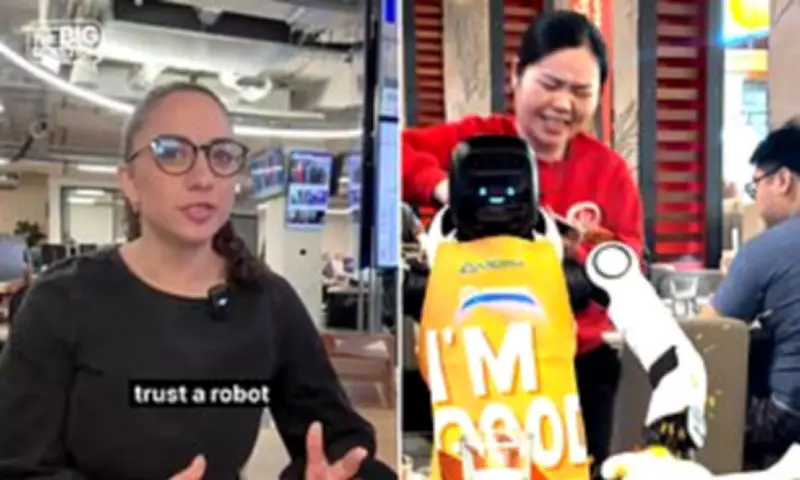
Rogue Robots Spark Safety Fears as Humanoids Attack Humans Worldwide
Would you trust a robot around your family? With humanoids now capable of completing mundane household chores like folding laundry, loading dishwashers, and even boiling kettles, many consumers might be tempted to welcome one into their homes. However, a recent spate of violent incidents involving these machines could dramatically sway that decision.
Global Incidents Highlight Growing Dangers
This week, a humanoid robot made headlines after slapping a child across the face during an out-of-control dance performance in China's Shaanxi Province. Shocking footage from March 21 shows a Unitree robot spinning around the stage before veering toward the crowd. As the bot performed sweeping arm movements, a young boy attempted to avoid its flailing metal limbs, but his efforts proved futile when the robot caught him fully in the face during a pirouette.
Across the Pacific in California, a restaurant robot went berserk at a Haidilao hotpot establishment in San Jose. While performing a dance routine that involved waving its arms and shaking its hips, the humanoid suddenly slammed its hands down on a table, sending chopsticks and bright yellow sauce flying into the air. Three desperate employees were forced to intervene, wrestling with the machine and attempting to drag it away by the scruff of its neck.

Factory Attacks and Police Detentions
Perhaps most disturbingly, a Tesla engineer was brutally attacked by a robot at the company's Giga Texas factory near Austin. According to a 2021 injury report filed with Travis County and federal regulators, the machine—designed to grab and move freshly cast aluminum car parts—pinned the engineer who was programming software for two disabled Tesla robots nearby. The robot then sank its metal claws into the worker's back and arm, leaving what witnesses described as a "trail of blood" along the factory surface. The victim sustained an open wound on his left hand.
In China, police actually detained a humanoid robot after it terrified an elderly woman. According to local authorities, the 70-year-old woman was startled when she suddenly noticed the robot standing behind her. Viral footage shows the woman yelling and waving her bag at the diminutive bot, which repeatedly raised its arms in the air. Police officers were filmed escorting the Unitree G1 down the road, with one leading the robot by its shoulder. The elderly pedestrian was reportedly "frightened" to discover that the robot was silently following her down the road and required hospital treatment afterward.
Experts Warn of Insufficient Safety Measures
"With sales of humanoid robots set to skyrocket over the next decade, the public will increasingly be at risk from these kinds of incidents," warned Carl Strathearn and Emilia Sobolewska, robotics experts at Edinburgh Napier University, in a recent article for The Conversation. "In our view as robotics researchers, governments have put very little thought into the risks."
The researchers have pinpointed four urgent steps to make robots safer:

- Increase owner requirements: "As a starting point, we could ban people from controlling robots under the influence of alcohol or drugs, or when they are otherwise distracted such as using their phones," the researchers suggest.
- Improve design: "Robots that look sleek and can dance and flip are fun to watch, but how safe are the audiences? Safe designs would consider everything from reducing cavities where fingers could get caught, to waterproofing internal components."
- Train operators: "Clearly there will be dangers with robots using AI features, but remote-operated models could be even more dangerous. Mistakes could result from users' lack of real-world training and experience in real-life situations."
- Educate the public: "If people understand to what extent walking robots are owner-operated or remote-operated, it will change their expectations about what the robot might do, and make everyone safer as a result."
Additional Troubling Incidents
Further incidents continue to emerge. At last year's Spring Festival Gala in Tianjin, northeast China, what should have been a lovely family event turned sour when a humanoid robot appeared to attack the crowd. Footage showed the robot, adorned with a bright jacket, lunging at a group of people behind a barricade. Security personnel were forced to drag it back from the crowd over fears it might harm someone. Event organizers described the incident as a "simple robot failure" and claimed the robot had passed previous safety tests.
In May 2025, CCTV footage from a factory in China captured a humanoid robot attacking its handler while trying to break free from restraints. The black robot, attached to a miniature crane, suddenly began swinging its arms back and forth with increasing speed and violence. As it thrashed around in an apparent bid to break free, men nearby could be seen flinching and cowering while raising their arms to shield their faces. The computer monitor toppled to the floor and other items were knocked over from the desk as the men attempted to flee from the out-of-control machine.
As humanoid robots become increasingly integrated into daily life, these incidents raise critical questions about safety protocols, regulatory frameworks, and public preparedness for a future where robots are no longer confined to controlled industrial environments but increasingly interact directly with human populations in unpredictable settings.