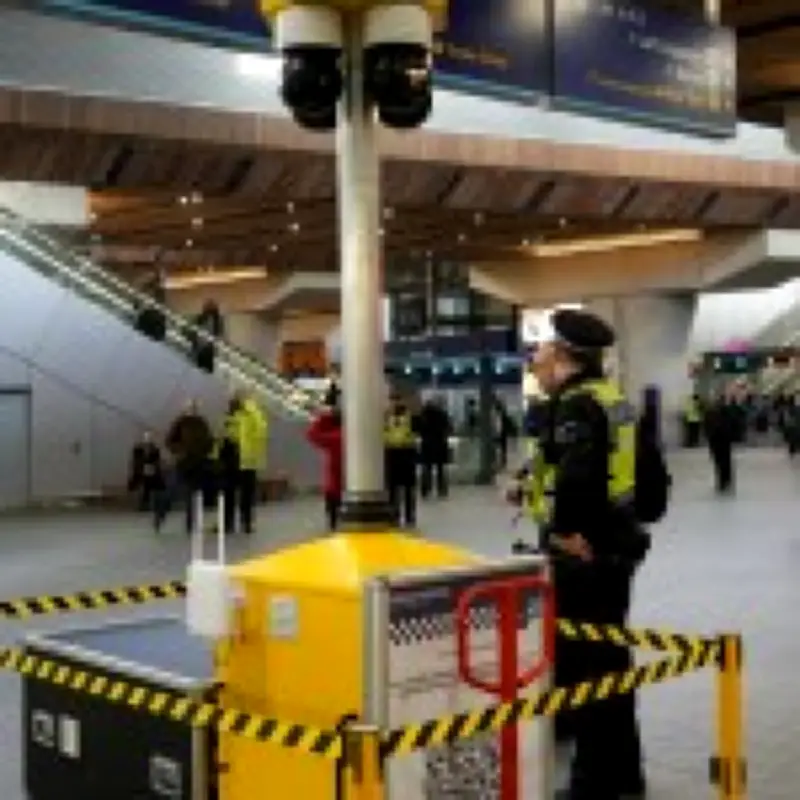
British Transport Police's live facial recognition (LFR) cameras have scanned approximately 330,000 commuters across London's busiest railway stations since February without identifying a single wanted criminal. The only alert generated by the system, at King's Cross Station in February, turned out to be a false alarm.
Deployment and results
The force has carried out 13 deployments of the controversial technology, amounting to around 50 hours of officer time. The cameras were positioned at what police describe as 'crime hotspots' in six major stations. The estimated number of faces scanned at each location is as follows: 92,784 at Waterloo, 71,945 at Euston, 51,948 at Victoria, 45,332 at King's Cross, 17,478 at St Pancras, 17,219 at Liverpool Street, and 16,156 at London Bridge.
Despite the extensive scanning, no alerts have resulted in a confirmed match. A British Transport Police spokesperson stated: 'To date, no alerts have resulted in a confirmed match. We have set a deliberately high threshold to prioritise accuracy and reduce the likelihood of misidentification, with all alerts subject to officer review before any engagement.'

Criticism from privacy advocates
Big Brother Watch criticised the pilot's effectiveness. The group said: 'The figures from the British Transport Police's live facial recognition pilot would be laughable, if they didn't have such troubling implications for our rights and freedoms. Millions of Londoners use the city's stations every day and may have already found themselves caught in a digital police line-up, likely without even realising. It's not fair to subject innocent people to intrusive identity checks during their commute.'
Broader policing context
The British Transport Police spokesperson noted that during LFR deployments, officers made thirteen arrests for offences including breach of Criminal Behaviour Orders, theft, and public order offences. Four people were arrested after being identified as wanted by other forces. However, these arrests were not a direct result of facial recognition matches and are therefore excluded from the LFR performance data. The force added that a reduction in crime was observed during deployment periods, attributed to broader policing activity and increased officer presence.
LFR technology is also used in private settings. Facewatch, a private operator, scans faces of people entering shops. Despite claiming 99.98% accuracy, errors have occurred. In one incident, a mother named Anamaria was wrongly accused of theft at Sports Direct in Woolwich after being misidentified by Facewatch. In another case, Sainsbury's shopper Warren Rajah was escorted out of a branch in Elephant and Castle after being mistakenly flagged as a thief.
Metropolitan Police expansion
The Metropolitan Police, the first force to install permanent LFR cameras, announced an expansion of their programme. Cameras will be deployed in the West End and Soho following a six-month trial in Croydon that led to 173 arrests, including a woman wanted for over 20 years. During a visit by Metro to Croydon, most residents expressed support for the cameras, citing concerns about rising crime. Shannon Kirwin, 20, who helps run her family's food van Old Skool Food, said: 'I have sat in this food van, and I have seen gangs just pull out weapons on each other right in front of me – the place has gone down massively over the last decade. But all the ones who are committing crimes are wearing balaclavas and face coverings, is there even any point to the cameras if they can't see through that.' Local musician Christian added: 'I think it's a good thing. This place is no longer a nice place. If you haven't done anything wrong, there's no need to be worried.'
What is Live Facial Recognition?
The Metropolitan Police describe LFR as technology used to prevent and detect crime and find wanted criminals. When people pass through an area with a camera, their images are streamed directly to the LFR system and compared to a watchlist. It can also help identify individuals who are unable to communicate who they are. LFR is often deployed at large events or in busy areas, typically mounted on police vans. It was first used in England and Wales at the 2017 UEFA Champions League final in Cardiff.