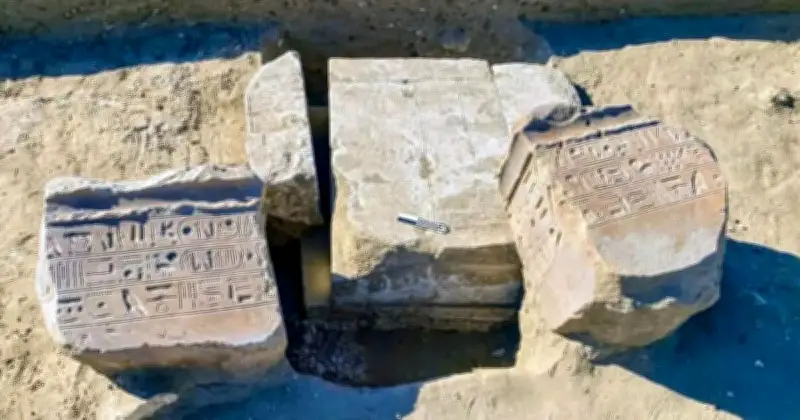
Archaeologists believe they have uncovered compelling new evidence that could shed light on the ancient Egyptian world associated with the biblical story of Moses. Excavations at Tell Abu Seifi, around 90 miles north-east of Cairo in the northern Sinai, have uncovered ancient remains that researchers say strengthen the case for identifying the site with the long-lost Egyptian city of Mesen.
Discovery of the Ramses II Inscription
Among the discoveries is a 3,000-year-old stone bearing the name of King Ramses II, one of ancient Egypt's most powerful rulers and a pharaoh often associated by some historians with the ruler described in the Book of Exodus. The findings do not prove that Moses or the Israelites passed through Mesen, and the ancient city itself is not named in the Bible.
However, Egyptian officials say the inscriptions provide a strong archaeological and historical basis linking Tell Abu Seifi to the ancient city. The key discovery is an inscribed stone beam, or lintel, which was found broken into two pieces. Hieroglyphic inscriptions are carved into three sides of the stone, bearing the titles of Ramses II and referring to restoration work carried out on a statue of Horus, described as the "Lord of the City of Mesen".

Significance of the Site and Biblical Connections
Egyptian officials said the inscriptions "present a strong archaeological and historical hypothesis linking the site to the ancient Egyptian city of Mesen". They said further excavations and scientific studies would continue as researchers attempt to establish the identity and history of the ancient settlement. The discovery is particularly significant because of the site's location along the ancient Military Road, which connected Egypt with the Sinai Peninsula and Canaan.
While Mesen is not mentioned in the Bible, a city known as Raamses appears several times in the Old Testament, including in Genesis, Exodus and Numbers. In the Book of Exodus, Raamses is described as one of the cities built by the Israelites while they were enslaved in Egypt. Historically, the city is associated with the reign of Ramses II, who ruled during the 13th century BCE. The ancient route running through the region also has a connection to the biblical account of the Israelites' escape from Egypt. According to Exodus, God deliberately led the Israelites away from the shorter route known as the "way of the land of the Philistines". The Bible says they were taken by another route because encountering warfare could have caused them to turn back towards Egypt. Some scholars have associated the route with the ancient military road running through the region.
Further Excavation Findings
The latest excavation has also uncovered the remains of a fortified temple complex surrounded by a mudbrick wall and gates. Archaeologists found storage rooms, along with two stone roads leading towards the temple. Fragments of falcon statues and other sculptures were also recovered. The team discovered the torso of a royal figure carved from basalt, as well as a Late Period statue missing its head and feet. Pieces of limestone and basalt falcon sculptures were also found at the site.
Mohamed Abdel Badie, head of the Supreme Council of Antiquities, said: "The archaeological evidence shows that the site underwent several phases of development." Mahmoud Galal, director general of Sinai Antiquities and leader of the excavation, said the artefacts reflected the military and administrative activity that once took place at the site. Another fragment recovered during the excavation is believed to depict Ramses II, adding to the growing body of evidence about the site's importance during Ancient Egypt's history.
The discoveries do not establish that the biblical Exodus took place exactly as described in scripture. But archaeologists say the finds could help fill in gaps in the history of the region and provide new clues about the settlements, rulers and military routes that existed in the area during the period traditionally associated with the biblical account.