Sony's AI Robot Ace Triumphs Over Elite Table Tennis Players in Milestone
AI Robot Ace Beats Elite Table Tennis Players in Milestone

Sony's AI Robot Ace Achieves Milestone by Defeating Elite Table Tennis Players

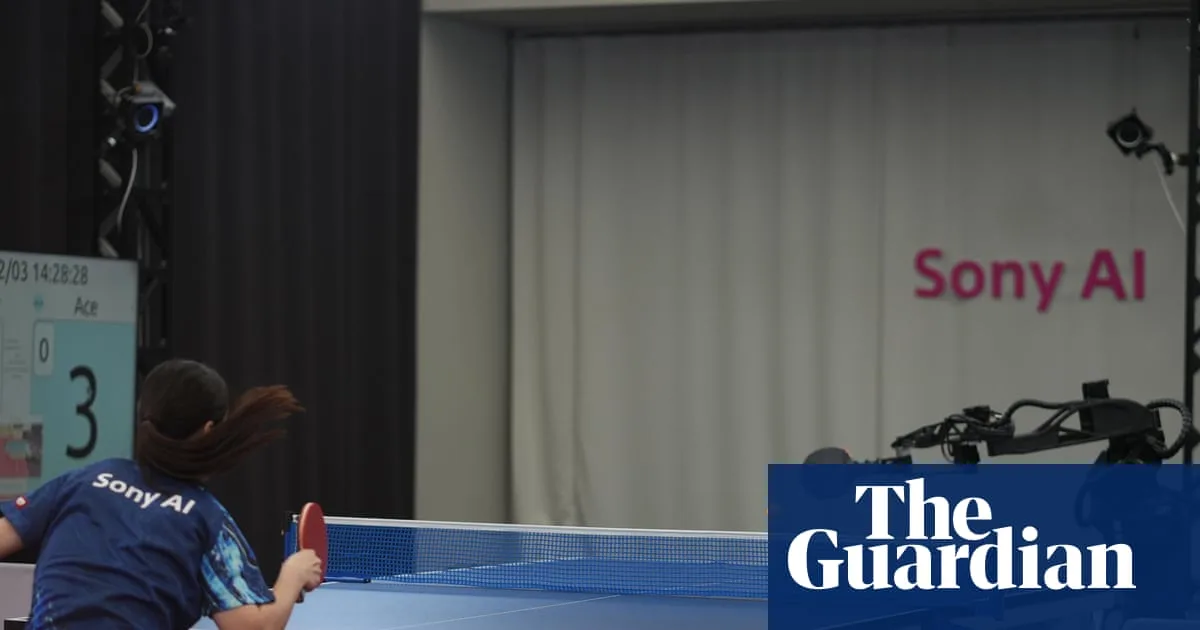
In a landmark achievement for robotics and artificial intelligence, Sony AI's robot, named Ace, has triumphed over elite table tennis players in official matches. This feat marks a significant step forward for machines competing in real-world sports, where human athletes have long held dominance.

Impressive Performance Under Official Rules

Ace secured victories in three out of five matches against elite players, though it faced setbacks against professionals, managing to win only one game in seven contests. The matches were conducted under strict official competition rules, highlighting the robot's advanced capabilities in a demanding environment.

The robot demonstrated exceptional skills, including mastery of spin, handling difficult shots such as balls catching on the net, and executing a rapid backspin shot that a professional player deemed impossible. This performance has been widely praised as a milestone in robotics, a field that views table tennis as one of the toughest tests due to its requirement for lightning-fast reactions, precise perception, and high skill levels.

Wide Pickt banner — collaborative shopping lists app for Telegram, phone mockup with grocery list

Advanced Technology and Learning Process

A research paper detailing Ace's development was published in Nature on Wednesday, but scientists involved in the project noted that the robot has improved since the report was submitted. Peter Dürr, director of Sony AI in Zurich and project lead for Ace, stated, "We played stronger and stronger players and we beat stronger and stronger players."

AI researchers often use games like chess, go, poker, and Breakout to teach programs decision-making in complex scenarios. Building an intelligent robot like Ace elevates this challenge by requiring the machine to effectively enact decisions in physical space.

Ace utilizes an eight-jointed arm mounted on a movable base, avoiding the complexities of bipedal movement. Instead of relying on two eyes, it employs multiple cameras positioned around the court to track the ball's position and spin from various angles.

How Ace Operates and Overcomes Challenges

The camera system zooms in on the ball's logo to estimate spin and rotation axis within milliseconds as the ball travels to Ace's end of the table. Skills such as dealing with spin and selecting shots were refined during 3,000 hours of simulated games, while serves were modeled after those used by expert players.

Initially, Ace struggled with slow balls that had minimal spin, often returning them weakly and facing penalties. However, it excelled at handling tricky situations, such as when the ball catches on the net, responding with extreme speed to altered trajectories.

Rui Takenaka, an elite player, commented, "If I used a serve with complex spin, Ace also returned the ball with complex spin, which made it difficult for me. But when I used a simple serve – what we call a knuckle serve – Ace returned a simpler ball. That made it easier for me to attack on the third shot, and I think that was the key reason why I was able to win."

When Ace performed an unusual shot by intercepting the ball early and imparting backspin, former Olympic table tennis player Kinjiro Nakamura expressed surprise, noting that he initially thought it impossible but now believes humans could learn the technique.

Unique Challenges and Future Implications

Playing against Ace presents unique difficulties, as the robot lacks eyes for opponents to read, shows no body language, and remains unaffected by pressure, even in tense situations like a game tied at 10-10. Dürr explained, "The players want to see the eyes of their opponent. And the eyes of Ace are all around the court and they don't show any intention or feeling."

Jan Peters, a professor of intelligent autonomous systems at the Technical University of Darmstadt in Germany, who has worked on table tennis robots, described the project as "truly impressive." However, he cautioned that research on table tennis may not address all significant challenges in robotics, such as object manipulation.

Pickt after-article banner — collaborative shopping lists app with family illustration

Peters added, "To be useful for the general public, a lot of good old-fashioned engineering is needed. There will be a moment in the next decade which will change the world as much as ChatGPT did in 2022. That moment may be closer to now than to 2036."