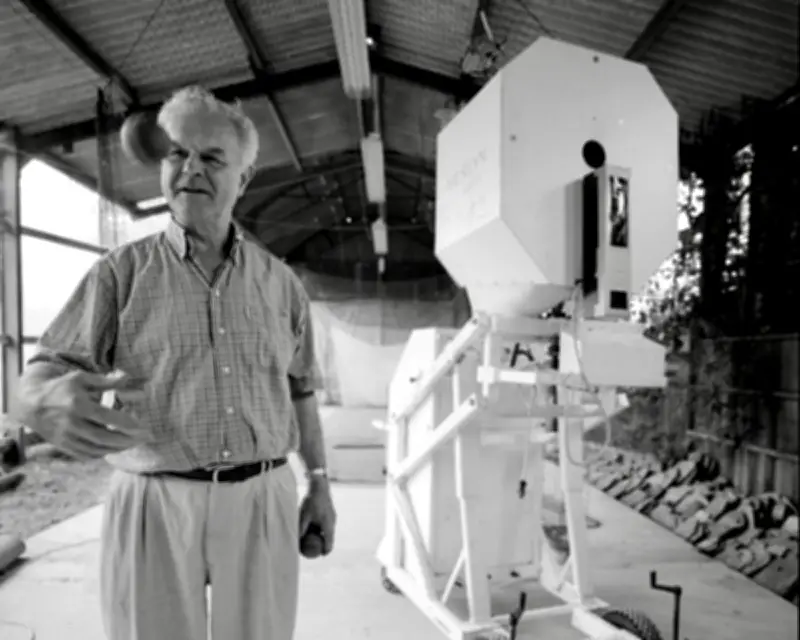
Henry Pryor, the inventor of the Merlyn bowling machine that played a part in England's 2005 Ashes victory, has died aged 92. The machine was revolutionary in how it made the ball torque and helped England win the Ashes for the first time in 18 years.
A life in cricket coaching
Pryor became a cricket coach in his 50s, when his daughter started playing as a child. He joined the Association of Cricket Coaches and began coaching primary schoolchildren in inner-city areas.
Dissatisfied with available bowling machines, Pryor began building Merlyn models. After moving to Llowes in the Welsh Borders, he met Gordon Rye, a retired GPO electronics engineer, who put the first brain in Merlyn, allowing sets of overs, for example 'from Shane Warne', to be programmed in. The next transportable prototype was built by Dave Cross, and Pryor's wife Anna managed the project financially.
Role in the 2005 Ashes
In 2003, John Abrahams, then the ECB National Academy assistant coach, viewed the Merlyn prototype and asked for it to live at the academy in Loughborough. Two years later, Pryor was manoeuvring Merlyn around Ashes Test venues in a horse box. England used the machine on all practice days before the Tests as they worked out Warne's angles. Players began asking for early starts and private sessions with Merlyn during the comeback second Test at Edgbaston, and England went on to a historic win over Australia.
Andrew Strauss wrote in his 2007 autobiography, Coming Into Play: 'We were fortunate to have a prototype bowling machine travelling with us around the country called Merlyn. It had taken its inventor a decade to get it fizzing out balls with a similar spin and trajectory to Warne, and it became increasingly invaluable to us as the series progressed.'
Early life and career
Born in Knockholt, Kent, Pryor was one of four children of Olive (nee Woodall) and Charles Pryor, a tea merchant. The family moved to Framlingham in Suffolk after a bomb blew out their windows during the second world war. Pryor was educated at Eton College and did national service with the navy for two years before studying history at Trinity College, Cambridge, graduating in 1957.
He joined the family tea business, Pryor and Tindall, in 1960 for six years, after which he worked as an estate agent and went into property management. He then worked for the Innisfail Laundry (1985-92) before moving to Wales in 1995, working on Merlyn full-time and coaching in schools.
Later life and legacy
After the 2005 Ashes, Pryor designed a lighter Merlyn to focus on spin bowling. He licensed the technology to Bola, a company in Bristol, and the first official machines were delivered in 2009.
Pryor's first marriage, to Deirdre, with whom he had three daughters, Georgina, Lucinda, and Henrietta, ended in divorce. In 1979 he married Anna Harcourt-Cooze (nee Radburn). Anna, his children, and five stepchildren, Arabella, Sein, Willie, Sophia, and Jessie, survive him.