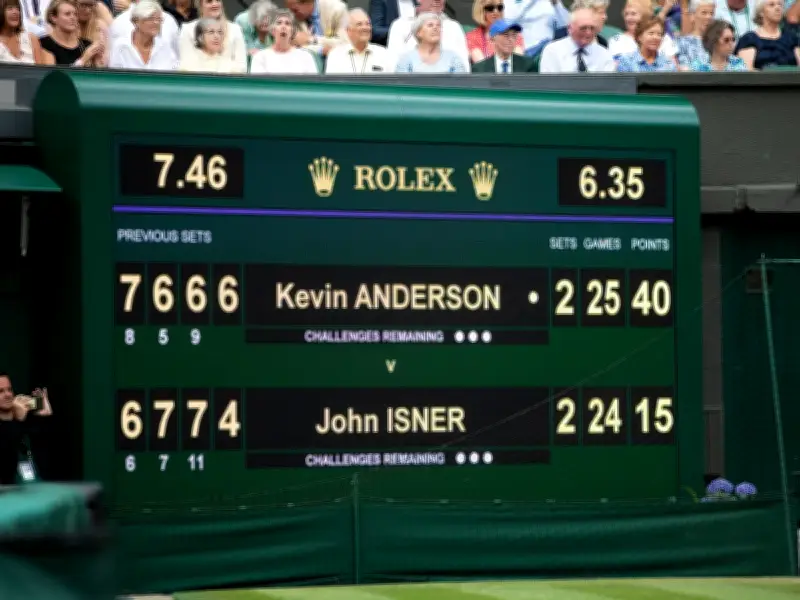
The tennis scoring system, famously using 15, 30, and 40, has long puzzled fans and players alike. Its origins date back to medieval France, with the most widely accepted theory involving a clock face. Early players reportedly used large clocks to track points, moving the minute hand a quarter turn for each point: 15, 30, 45, and 60 for a game win.
Why 45 Became 40
The shift from 45 to 40 is attributed to linguistic convenience. In French, 45 is 'quarante-cinq' (three syllables), while 40 is 'quarante' (two syllables). Referees and players likely shortened it to 40 for quicker, easier communication across the court. This change also helped with the deuce system, as a tie at 45 would push the clock past 60. By using 40, a tied game could sit at 40, the advantage point at 50, and the winning point at 60.
The Meaning of 'Love' and 'Deuce'
The term 'love' for a zero score likely comes from the French word 'l'oeuf' (egg), which resembles a zero. Another theory suggests it derives from the English phrase 'playing for love,' meaning playing for no money. 'Deuce' originates from the French 'à deux le jeu' (the game is tied) or simply 'deux,' indicating two points in a row are needed to win.
As Wimbledon 2026 approaches, understanding this quirky scoring system adds to the appreciation of the sport's rich history.