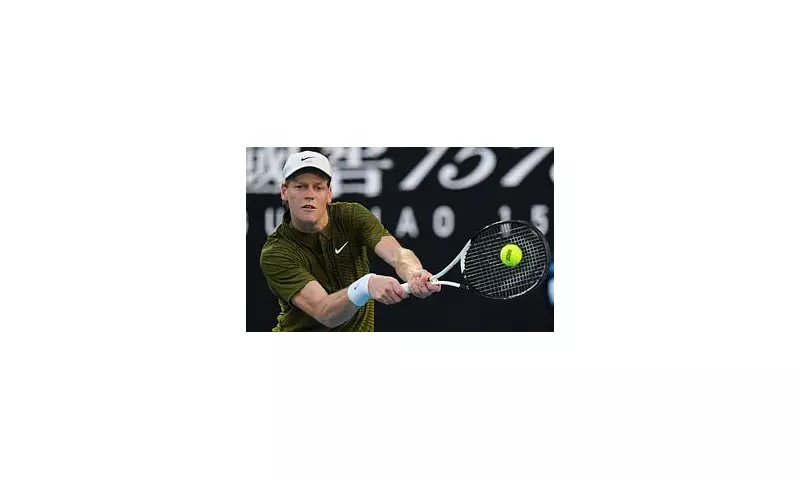
Jannik Sinner's WHOOP Band Revelation Ignites Tennis Technology Discussion
Italian tennis star Jannik Sinner has admitted he was completely unaware that WHOOP fitness tracking bands were prohibited at Grand Slam tournaments, following a dramatic incident where an umpire ordered him to remove the wearable device moments before his Australian Open third-round match against compatriot Luciano Darreri. The world number two complied immediately with the official's request, putting the pre-match drama behind him to secure a commanding 6-1 6-3 7-6 (2) victory and progress smoothly to the quarter-finals.
Grand Slam Wearable Ban Catches Top Players Off Guard
Sinner's experience forms part of a growing pattern at Melbourne Park, where world number ones Carlos Alcaraz and Aryna Sabalenka have also been instructed by officials to remove their WHOOP devices during matches over the past week. This consistent enforcement has ignited substantial online debate regarding whether elite tennis professionals should be permitted to wear the health monitoring technology, particularly given that the International Tennis Federation has already approved such devices for competitive use.
Tennis Australia confirmed unequivocally on Monday that the bands remain strictly forbidden at all four Grand Slam tournaments, despite their growing popularity among athletes across multiple sports. Cristiano Ronaldo serves as a global ambassador for the American brand, while sporting icons including Rory McIlroy and LeBron James regularly utilise the fitness trackers to monitor their physiological metrics.

Sinner's Philosophical Response to Technology Restriction
The Italian champion responded with characteristic professionalism when questioned about the incident, stating plainly: 'Rules are rules, I understand and I won't use it again.' He elaborated on the exchange with the umpire, explaining: 'The umpire asked me straight away if this was a tracker. I said: 'Yes.' He said: 'Remove'. It's fine. There are other things we could use.'
Sinner did acknowledge the practical challenges of alternatives, noting: 'You know it's the vest but it's a bit uncomfortable for me. You feel like you have something on your shoulders and it's a bit different.' WHOOP bands are specifically designed to track crucial health metrics including heart rate variability, blood oxygen levels, and recovery status, providing athletes with detailed insights into their physiological responses during competition and training.
The Data Debate: Performance Advantage or Essential Monitoring?
Speaking about his utilisation of wearable technology, Sinner revealed: 'There is certain data that we would like to track on court, it's not for the live thing but it's more about what you can see after the match.' He emphasised the importance of this information for training optimisation, adding: 'You know this is data that we would also like to see in practice sessions because from that you can practice on with your heart rate and how much calories you burn and all those kind of things.'
Tennis Australia has indicated that their position on wearable health technology might evolve in future seasons, stating: 'Wearables are currently not permitted at grand slams. The Australian Open is involved in ongoing discussions on how this situation could change.' The organisation highlighted the potential benefits, explaining: 'Some wearables provide athletes with an indication of internal load (measures like heart rate), which can give them a 360-degree view of the work they're doing and how their bodies respond.'
Competitive Equality Concerns Underpin Ban
While no official explanation has been provided for the Grand Slam prohibition, several compelling theories have emerged within tennis circles. The primary concern appears to centre around competitive equality, with arguments suggesting that elite, well-resourced athletes might gain unfair advantages through access to real-time physiological data that less established opponents cannot afford or access. This creates a potential scenario where one competitor benefits from live health metrics while their opponent competes without such technological support.

Match Drama Beyond Technology Controversy
Beyond the wearable technology discussion, Sinner's match against Darderi featured unusual moments of interruption and drama. During a crucial third-set tiebreak, with Darderi leading 2-0, proceedings were unexpectedly halted when a child began crying loudly in Margaret Court Arena. The 22nd seed paused his service motion, smiled broadly as the wailing continued, and checked with Sinner about readiness before recommencing.
In a bizarre sequence, just as Darderi prepared to strike his serve, the infant emitted another loud cry, causing him to abort his motion completely. Stadium spectators descended into fits of laughter while television commentators expressed frustration at the timing. Despite the interruption and Darderi saving two match points at 5-4, Sinner demonstrated champion composure to win seven consecutive points and secure the tiebreak 7-2.
Sinner, who served a career-best 19 aces during the match, reflected: 'It was very, very difficult. We are very good friends off the court. I felt like in the third set I had a couple of break-point chances, couldn't use them and then it got very, very tight. I'm very happy.' He credited technical improvements, noting: 'We put a lot of work in, especially with the serve. We changed a bit the motion and I feel for sure a little bit more confident. I'm very happy how I've come back in the new season.'
Italian Tennis Celebration Continues
The Australian Open quarter-finals will feature dual Italian representation after Lorenzo Musetti joined Sinner in the last eight with a 6-2 7-5 6-4 victory over American Taylor Fritz. Musetti, who has reached three of the last four Grand Slam quarter-finals, credited a significant mentality shift for his hard-court improvement, explaining: 'It was like sort of a mentality switch. Last year during the US Open I was not feeling really well. After Wimbledon I was coming from an injury.'
Musetti's Melbourne campaign has proceeded despite personal challenges, with two team members including coach Simone Tartarini departing Australia early for personal reasons. The 23-year-old reflected philosophically: 'Real life knocks on the door sometimes. It's something surprising. It makes you understand life better. I feel more mature and I'm playing better for them.' He now faces the formidable challenge of Novak Djokovic, against whom he has won just one of ten previous encounters.
As temperatures continue to rise in Melbourne, with peak heat expected imminently, the wearable technology debate shows no signs of cooling. With Tennis Australia acknowledging ongoing discussions about potential policy changes, the intersection of sports science, competitive fairness, and athlete health monitoring promises to remain a prominent conversation within professional tennis throughout the 2026 season and beyond.