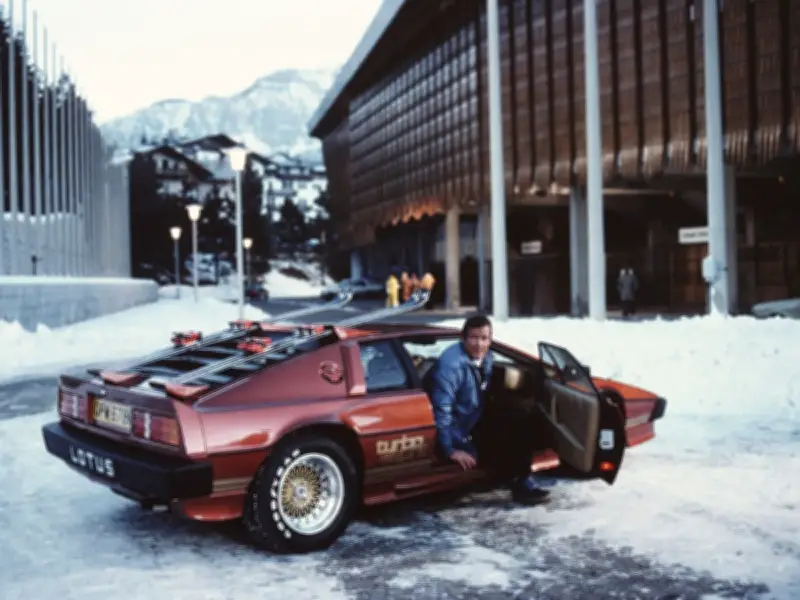
The Lotus Esprit, a car that redefined the supercar landscape without relying on massive horsepower, remained in production for an astonishing 27 years, from 1976 to 2004. Launched at around £8,000, the final edition sold for £60,000, and pristine early models now command up to £80,000.
A Chance Meeting Sparked a Legend
Colin Chapman, founder of Lotus, conceived the Esprit in 1971 after a fortuitous encounter with Italian car stylist Giorgetto Giugiaro. Chapman's Norfolk-based company had already produced the Lotus Europa, one of the first affordable mid-engined cars, leveraging technology from Lotus's successful Formula One cars, which won 13 World Championships.
Giugiaro designed a wedge-shaped body that gave the Esprit a futuristic look, complete with pop-up headlights. The prototype debuted in 1972, and the production car hit the roads four years later, marking a leap in glamour and luxury for Lotus.
Engineering Philosophy: Add Lightness
Chapman famously emphasized "adding lightness" rather than increasing power. The Esprit used a 2-litre four-cylinder engine from the Europa, avoiding the V8 or V12 engines of Italian rivals. With a backbone chassis and lightweight plastic body, the car weighed just over 1,000 kg, achieving 0-62 mph in 6.9 seconds and exceptional cornering.
Early Esprits had teething problems, including overheating and vibrations, and build quality was not always top-notch. To keep costs down, Lotus sourced parts from other cars, such as door handles from the Morris Marina and rear lights from the Rover 3500.
James Bond and Hollywood Stardom
Lotus couldn't afford a major advertising campaign, but a tie-in with James Bond producers solved that. The Esprit starred in the 1977 film The Spy Who Loved Me, with three special submarine mock-ups created for underwater scenes. For driving sequences, Lotus's chief development engineer Roger Becker, wearing a Roger Moore-style wig, performed as a stunt driver.
"It was seven weeks of shooting in Sardinia for about seven minutes of screen time," Becker recalled. "The cast ended up calling me 006-and-a-half." The Esprit's success led to a second appearance in For Your Eyes Only (1981) with the Esprit Turbo.
Evolution and Continued Film Appearances
Over the years, Lotus continually updated the Esprit. In 1996, a 350bhp V8 engine was fitted, pushing the top speed to 175 mph. The car also appeared in films such as Pretty Woman (1990), If Looks Could Kill (1991), and Basic Instinct (1992).
When production ended in 2004, approximately 10,500 Esprits had been sold. Towards the end, only 150 units were built annually, each requiring 570 manhours by 21 dedicated staff. In 1990, Lotus launched the X180R racing version in the USA, priced at $134,000; five were purchased by Microsoft executives, and actor Paul Newman raced one.
Enduring Design and Legacy
Giugiaro's design for the Esprit brought him worldwide fame, leading to iconic family cars like the Volkswagen Golf and Fiat Uno. The Esprit's celebrity owners spanned generations, from Noel Edmonds and Mark Thatcher to Nicolas Cage and chef Gary Rhodes.
Russell Carr, Lotus's current design director, who has shaped models like the Elise, Evija, and Emira, says: "The Esprit is incredibly important to Lotus and is undoubtedly one of our iconic road cars. You don’t have to be a Lotus aficionado to recognise the Esprit. It became a poster car for the '70s, '80s, and '90s because it ticked all the boxes."
Carr also praises the Esprit's interior, where the driver sits in a near-reclining position, and the use of tartan textiles. Working on later versions like the Sport 300, S4, and V8, he adds: "Like every schoolboy of my age, I had fallen in love with the car when it was launched."