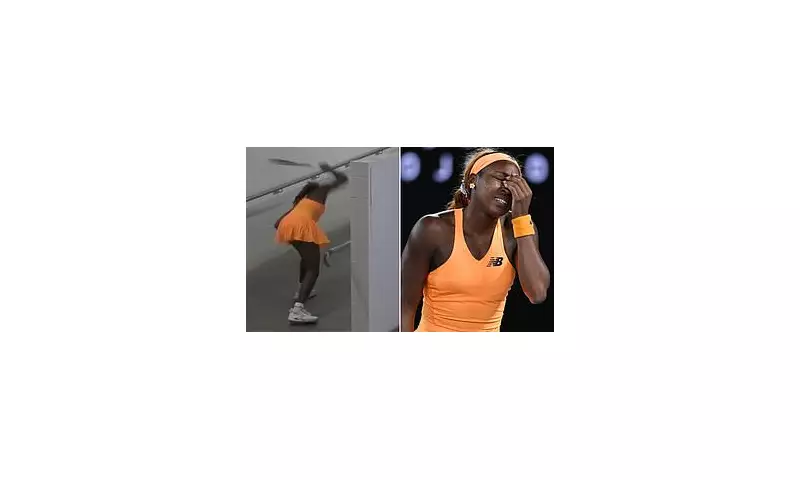
American tennis sensation Coco Gauff has delivered a scathing critique of the Australian Open and its apparent disregard for player privacy, following the broadcast of her emotional racket-smashing incident. The world number three, aged just 21, was eliminated from the tournament in under an hour by Ukraine's Elina Svitolina in a quarterfinal match, prompting a rare public display of frustration from the typically composed athlete.
Private Moment Broadcast to Millions
The incident occurred behind the scenes in the players' area, where Gauff believed she was away from cameras. However, footage of her repeatedly smashing her racket was broadcast globally, drawing criticism from the young star about the tournament's privacy standards. "I have a thing with the broadcast," Gauff stated in her post-match press conference. "I feel like certain moments - the same thing happened to Aryna Sabalenka after I played her in the final of the US Open - they don't need to be broadcast."
Gauff explained she deliberately sought a location she believed was camera-free, noting her previous commitment to avoid such displays on court. "I tried to go somewhere where I thought there wasn't a camera, because I don't like breaking rackets. I broke one racket at the French Open and I said I would never do it again on court, because I don't feel like that's a good representation," she revealed.

Questioning Tournament Privacy Policies
The American star expressed disappointment that her private moment was captured, suggesting tournament organisers need to reconsider their broadcasting approach. "I went somewhere where I thought they wouldn't broadcast it, but obviously they did. Maybe some conversations can be had, because I feel like at this tournament the only private place we have is the locker room," Gauff asserted, highlighting what she perceives as inadequate private spaces for players.
When questioned about the emotional release of racket-smashing, Gauff defended her actions as necessary for managing frustration before interacting with her team. "Yeah, definitely. I think for me, I know myself. I don't want to lash out on my team. They're good people. They don't deserve that. I know I'm emotional," she explained.
Managing Expectations and Emotions
Gauff continued: "I just took the minute to go and do that. I don't think it's a bad thing. I don't try to do it on court in front of kids and things like that. But I do know I need to let out that emotion... otherwise I'm just gonna be snappy with the people around me. I don't want to do that. Like I said they don't deserve it. They did their best. I did mine. Just need to let the frustration out."
The incident marked a departure from Gauff's typically calm public persona. Having carried American tennis expectations since her teenage years and winning her first Grand Slam title at the US Open aged 19, she has generally handled pressure with remarkable professionalism. Her unexpected quarterfinal loss to twelfth seed Svitolina, which prevented a potential semifinal clash with world number one Aryna Sabalenka, clearly triggered strong emotions.
Historical Context and Broader Concerns
Gauff referenced Sabalenka's similar experience after the 2023 US Open final, where the Belarusian star smashed a racket in the locker room following her loss to Gauff. That incident was also captured and broadcast, suggesting a pattern of intrusive filming at major tournaments. As Grand Slam events increasingly deploy cameras throughout players' areas in pursuit of compelling content, concerns about privacy boundaries continue to grow.
This controversy raises important questions about the balance between broadcast entertainment and athlete privacy in modern tennis. With players' private reactions becoming public spectacle, Gauff's comments may spark wider discussions about ethical broadcasting standards across the ATP and WTA tours. Whether the American star will pursue formal discussions about enhancing player privacy remains uncertain, but her vocal criticism has certainly brought the issue into sharp focus.
The tournament continues with Svitolina advancing to the semifinals, while Gauff's unexpected early exit and subsequent privacy concerns have become a significant talking point beyond the court action itself.