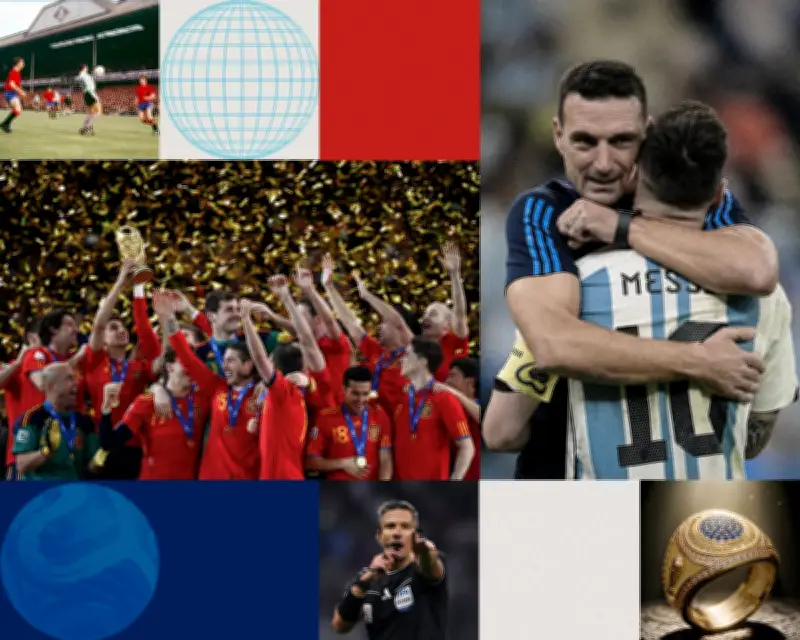
Spain and Argentina will contest the 2026 World Cup final in New Jersey on Sunday, with both teams seeking to add another chapter to their storied histories. The match brings together the top two teams in the FIFA rankings and offers a clash of styles, with Argentina's potent attack facing Spain's stingy defense.
Who is the referee?
Slavko Vincic will become the first Slovene to referee a World Cup final. The 46-year-old officiated the 2024 Champions League final, where Real Madrid beat Borussia Dortmund 2-0, and the Euro 2024 semi-final in which Spain defeated France 2-1. His first World Cup match was Argentina's opening loss to Saudi Arabia in 2022. At this tournament, Vincic showed Ecuador's Piero Hincapié a red card in the 95th minute against Mexico for covering his mouth. He has averaged 2.33 yellow cards per game.
Advantage Spain?
Thirteen of the past 14 World Cup and European Championship finals (men's and women's) have been won by the side that played their semi-final first. The only exception came when semi-finals were played on the same day. Spain's men started the streak by beating Italy 4-0 in the Euro 2012 final. Argentina also benefited from extra rest in 2022, having four days to France's three before the final. This time, Spain has an extra day's rest.
Staying away
No Argentine president has attended a national team World Cup match for 36 years, and current President Javier Milei will not break that streak. He has watched all seven games from his presidential residence, telling a Buenos Aires radio station there is "no way" he is traveling to New Jersey. The superstition dates back to 1990 when Carlos Menem visited the Argentina squad before their shock opening loss to Cameroon. Spain's Prime Minister Pedro Sánchez and King Felipe VI plan to attend.
History beckoning
An Argentina victory would make them the third country to win back-to-back World Cups, after Italy (1934, 1938) and Brazil (1958, 1962), and the first this century. If Spain triumphs, they would become the fourth men's side to hold both the Euros and the World Cup simultaneously, following West Germany (1972, 1974), France (1998, 2000), and Spain themselves (2008, 2010, 2012).
Attack vs defense?
Argentina have scored the most goals of any team (19), with Spain in fourth on 14. However, Spain have conceded the fewest goals (1), while Argentina have let in seven.
Rings for the winners
In a nod to American sports tradition, the winners will receive rings. Thirty rings will be available for the world champions, and 1,996 will be sold to the public. The design features a mini World Cup trophy on one side, while the other will "reflect the identity of the winning team," as per FIFA's website. Players and coaches will receive temporary rings initially, with bespoke rings to be presented later.
Cancelled Finalissima
The sides were scheduled to meet in the Finalissima in Qatar this year, but the match was called off due to the war in the Middle East. UEFA stated: "After much discussion between UEFA and the organising authorities in Qatar, we can announce that due to the current political situation in the region, the Finalissima cannot be played as hoped in Qatar on 27 March." The two teams could not agree on an alternative venue.
Who needs club coaching experience?
The final will feature two managers without top-division club experience. Spain's Luis de la Fuente, dismissed after 11 games at third-division Alavés, has coached Spain's youth teams since 2013. Argentina's Lionel Scaloni has only managed the national team, apart from six matches with the Under-20s. Both have already won the Euros, Copa América, and World Cup, proving elite club experience is not mandatory for international success.
Minutes on the pitch
Spain may be fresher, having finished all their games in 90 minutes. Argentina have played extra time twice and logged 794 minutes compared to Spain's 717. The South Americans faced similar circumstances in Qatar, where they played an extra 30 minutes in the quarter-final.
Rare outdoor match for Spain
Temperatures are not expected to be extreme, but the National Weather Service issued an air-quality alert due to wildfire smoke from Canada. The New York Office of Emergency Management reported "very unhealthy" air-quality levels on Thursday, but conditions have improved. Spain have played only one of their seven matches in a fully outdoor stadium, while Argentina have played three outdoor games, including two in 32°C heat.
World Cup history
The sides have met once in the World Cup, with Argentina winning 2-1 in 1966. Luis Artime scored both goals for the South Americans.