
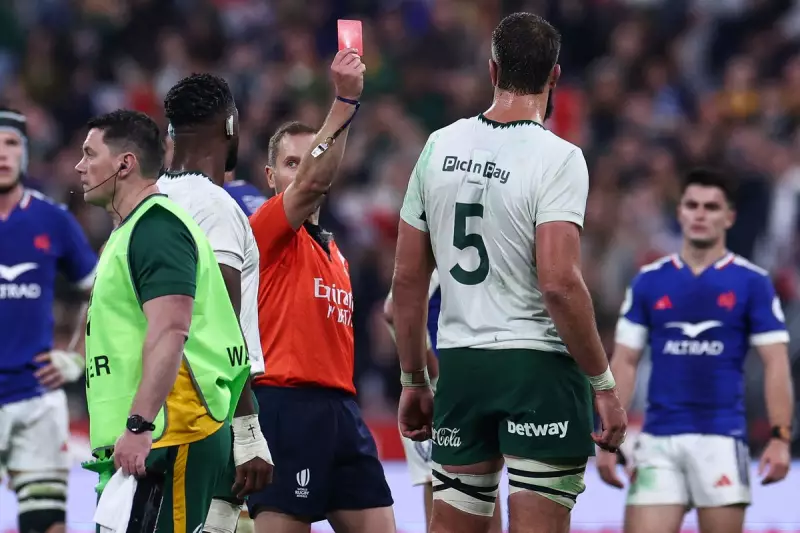
Springbok Lock Sees Red in Paris Clash
South African lock Lood de Jager was dramatically sent off just before half time during the Springboks' major Test match against France at the Stade de France. The incident occurred on Saturday 08 November 2025, with referee Angus Gardner showing the second row a straight red card following a dangerous tackle on French full-back Thomas Ramos.
The Incident That Led to Dismissal
De Jager made direct shoulder-to-head contact with Ramos, who had been lowered in height after being tackled by another South African player. Following consultation with television match official Ian Tempest, referee Gardner determined that De Jager's tucked arm made the action always illegal and intentional in nature.
This deliberate aspect of the challenge meant there was no mitigation available under World Rugby's head contact process guidelines. The decision resulted in a permanent red card, meaning the Springboks couldn't replace him and played the remainder of the match with 14 players.
Understanding World Rugby's Head Contact Laws
The laws governing such incidents fall under World Rugby's Law 9, which covers foul play. Specifically, Law 9.11 states that 'Players must not do anything that is reckless or dangerous to others', while Law 9.13 adds that 'A player must not tackle an opponent early, late or dangerously'.
World Rugby's guidelines emphasise player welfare as the driving force behind their zero-tolerance approach to foul play involving head contact. The focus remains on the actions of players rather than the resulting injury.
The Four-Step Head Contact Process
Referees follow a detailed four-step process when assessing head contact incidents:
- Head Contact Occurrence - Determining if contact was made with the head, face, neck or throat area
- Foul Play Assessment - Judging whether contact was intentional, reckless or avoidable
- Degree of Danger - Evaluating the danger level from high to low
- Mitigation Consideration - Assessing whether circumstances allow for reduced sanction
In De Jager's case, the deliberate nature of his challenge meant mitigation couldn't apply, and the high degree of danger warranted the straight red card.
Recent Developments in Rugby's Disciplinary System
The sport has introduced several new systems to handle such incidents more effectively. The Bunker review system, introduced ahead of the 2023 Rugby World Cup, allows referees to issue yellow cards that can be upgraded to red after video review by a Foul Play Review Officer.
Additionally, the 20-minute red card now applies to technical offences deemed not deliberate or intentional. However, for clearly deliberate and dangerous acts like De Jager's tackle, referees retain the ability to issue permanent red cards where the player cannot be replaced.
This comprehensive approach ensures player safety remains paramount while maintaining the game's competitive integrity through appropriate sanctions for dangerous play.