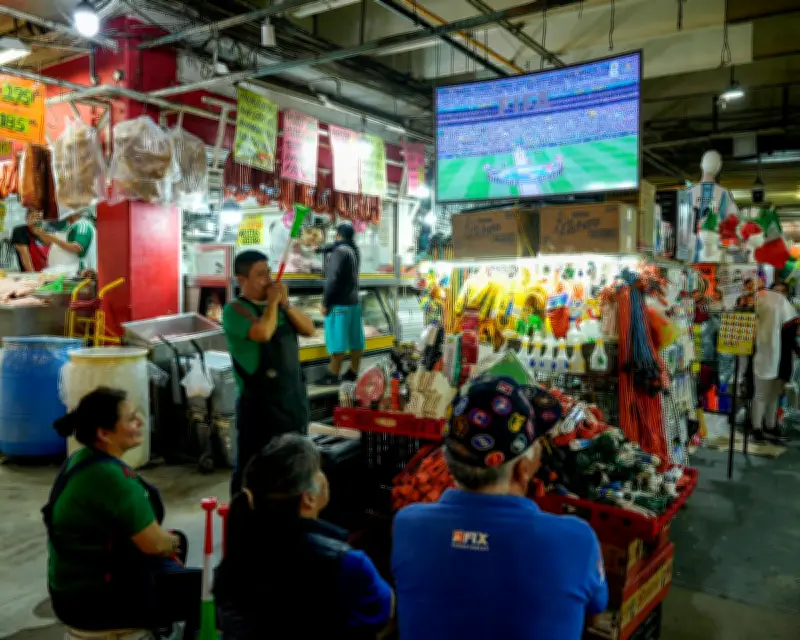
People at the Central de Abasto wholesale market in Mexico City catch some of the opening ceremony before Mexico v South Africa. Photograph: Armando Vega/Reuters
The World Cup viewed from afar is more like ambient noise – a far cry from working at it
Covering a tournament, my smartwatch showed my heart rate was 10-20 beats above normal. How luxurious to half-watch.
I fell asleep at some point during the Netherlands v Japan game. It had been a hot and drowsy day by the shores of Lake Annecy, a square and heavy heat, where the sun and the driving and the food and the boxed wine gently squeeze all the life from your body, like air being pressed out of a juice carton.
I remember Virgil van Dijk angling a header into the far corner, and when I came to it was 2-1, and everyone was heading to bed, drunk on tiredness, drunk on life, drunk on drink.
What happened on a historic night for Argentina? ‘Messi things’ | Pablo Iglesias MaurerRead more
Not all of my friends care for football in any case, and so the World Cup had become a kind of mood music, something to fill the silences in conversation. Through the long and meandering chat about home renovations and Andy Burnham, an indistinct French voice occasionally cut through from a different universe. Maeda. Gravenberch. The Low Countries tempted to attain the final for the first time since 2010. My French isn’t great. Someone prised open a bottle of Heineken. Bodies draped themselves over the couch, fingers scrolled through phones, the immaculate decadence of boredom.
I did manage to stay awake for Belgium v Egypt, albeit remembering very little beyond Romelu Lukaku forcing an own goal and the sight of Mohamed Salah sauntering regally around the place, like a PE teacher desperately willing himself not to get involved. But I do remember getting a couple of beers out of the fridge at the second hydration break and challenging Ed to a game of chess, which I lost. Lukaku, of Naples. The Belgians will take confidence from this and pursue the victory. An overwhelming knight‑and-queen attack down my a-file. Ssssake, Ed’s forgotten to tap his clock again. Not telling him next time.
Fans at a cafe in Utrecht watch the Netherlands’ group-stage game against Japan. Photograph: Georgios Kostomitsopoulos/NurPhoto/Shutterstock
You will read a lot about the World Cup from people who are actually there. This is probably for the best. It is, on balance, preferable to attend something in order to understand it, be it a major football tournament or a sentencing hearing. But I wanted to convey the sensation of the World Cup as most people around the world experience it: as an ambient noise, voices ghosting in from the next dimension, flickering shapes on a distant screen, an odour and a flavour on the breeze, vivid dreams of Steph Houghton talking about “the front-footedness of the press”. The sensation of waking up and feeling like you watched the entirety of Iran v New Zealand, even though you didn’t. The fragile way in which World Cups measure out our lives, some fragrant cocktail of collective and personal memory all swirling into one.
Everyone will have a story like this. I watched the 2006 final – Italy v France – at a seafood restaurant in Hvar, in the Croatian islands. It was one of those giant televisions on a stand, the kind they used to wheel into science lessons at school to show you videos about gametes. I missed Zinedine Zidane’s butt because the waiter was standing in front of the screen. And although I have watched the game in full many times since, if you ask me to pick out the overriding memory of that evening I am still more likely to recall the tenderness of the monkfish than anything that happened on the pitch.
Then I started covering World Cups for work, an entirely different and more immersive experience. Very quickly you fuse into the tournament, to the point where you are basically an extension of it, a slave to its rhythms and moods. From the moment you wake to the moment you go to bed (far too late), your entire nervous system is built around the game schedule, the reliable drumbeat of regimented kick-off times, ideas and angles, content and deadlines. You spend the rest of the time thinking about transport or food. When I get home my smartwatch will typically show that my resting heart rate has been about 10-20 beats above normal for an entire month. People visibly age during these things. It’s like going to war.
During the many breaks in play at this year’s tournament, the camera will inevitably pan across the crowd, and here the difference between World Cup football and regular football is perhaps at its most distinct. Everyone is dancing and putting their thumbs up. Nobody is having a bad time. Nobody is protesting or chanting about sacking the board or even hurling abuse at the referee except in the most performative way. Under most circumstances, to attend a football game – and what elevates this art form above, say, a gig or a blockbuster movie – is to submit willingly to the possibility of misery: your team can lose, the game can be terrible, your weekend can be ruined. But when you have paid £800 for a ticket, and probably many multiples of that on hotels and flights, is it remotely conceivable that you could allow yourself not to be entertained? How would you even admit it to yourself?
‘How luxurious it is to half-watch, and to rail at refreshment breaks and the decision not to award a penalty to Kylian Mbappé.’ Photograph: Dylan Martinez/Reuters
By contrast, television grants us the freedom to detach. The freedom to allow football to swim in and out of our consciousness, to fill the gaps in life, rather than life the gaps in football. The freedom to be bored, pleasantly bored, decadently bored. To go for a smoke, to get a round in, to go to bed. In Talloires, a little resort in the Haute-Savoie, the bars and restaurants advertise “Coupe de Monde” on wooden chalkboards, the greatest sporting event in the world as an accompaniment to dinner, in between cheese and dessert. The G7 summit is taking place just up the road in Évian and as the sun sets helicopters fly low over the lake, a reminder of football’s basic transigence, its mutability, the extent to which – for all its airs and graces – the world continues to spin around it.
How luxurious it is to drink boxed wine and half‑watch football as the world burns and blisters. To rail at refreshment breaks and the decision not to award a penalty to Kylian Mbappé, to see these 104 games spread out across the Americas like a lustrous map and not feel the need to watch all of them, or indeed any of them. To see this World Cup for what it truly is: utterly gripping at times, diverting at others, disposable for the most part. A kind of beautiful human-made slop, the flower arrangement at the gates of hell.