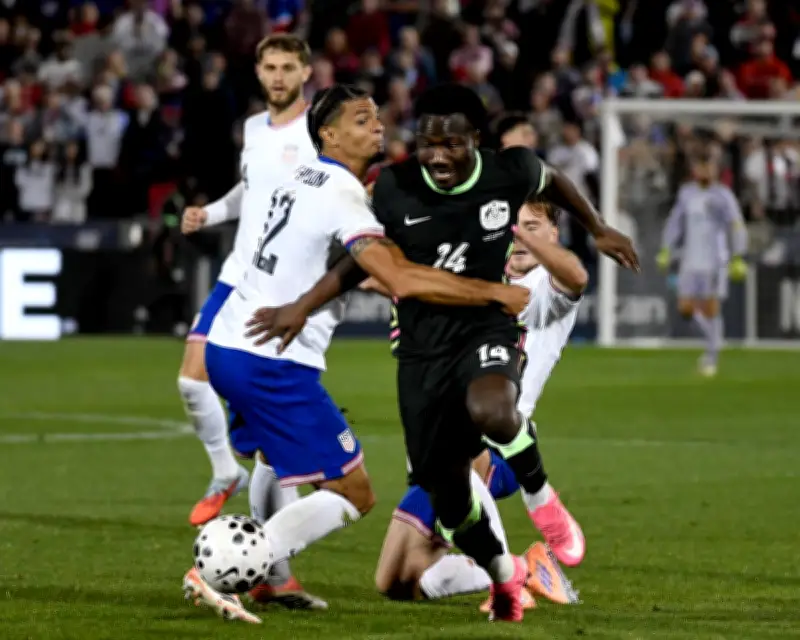
The Group D clash between the United States and the Socceroos has been hyped as the next step in a heated rivalry, but the nations are on similar football journeys. Forget the confected World Cup hostility; the US and Australia mirror each other.
Listen to the hyperbole spewed by the loudest voices, and the World Cup clash between co-hosts the United States and Australia in Seattle is the latest contest in a heated sporting rivalry streaked with disrespect and even downright hate. Indeed, the sometimes spiteful clash between the teams in a friendly last year serves as a preview for what is now one of the marquee matches in the pool stage, set to determine the winner of Group D.
But for each country’s football – or indeed, soccer – community, to hate the other is to hate oneself. While the match will be a compelling contest, it also serves as a mirror for two unusual footballing countries, where the world’s most popular sport sits on the periphery.
Similar Struggles for Soccer in Both Nations
This match is a lesson in empathy. Socceroos midfielder Aiden O’Neill, who plays for New York City FC, understands football in both countries does not have the same status it enjoys elsewhere in the world. “Soccer in the US is similar to Australia; it’s starting to change here in America,” he says. “You’ve got some massive other sports, but I think it’s starting to grow in popularity.”
While the AFL and NRL dominate the winter sporting discourse in Australia, with cricket the leader in summer, the dominant trio in the US are American football, basketball, and baseball. Both countries share another parallel. “It’s one of the great oddities in this country,” says longtime sports writer John Shea, who now works for the San Francisco Standard. “It’s the number one participation sport among boys and girls, yet in the high school ranks, it’s not as popular as football, basketball, and even baseball.”
According to the National Sporting Good Association, there were more than 7 million Americans aged between 7 and 17 playing soccer in 2025. The sport is second only to basketball, which has more participants in the same bracket but skews more towards recreational play, leaving soccer as the leader among organized sport. In Australia, football had about 850,000 participants among those aged 17 and under, about 300,000 more than basketball and behind only swimming in terms of activities, according to the government’s Ausplay survey.
Cultural Perceptions and Growth
Bernardo Ramallo, who works with non-profit Soccer Without Borders in the San Francisco Bay Area, says young US soccer players have historically faced taunts and insults from those who play other sports. “Growing up there’s been jokes saying, like, ‘soccer is weak, football’s a real sport’,” he says. “I grew up in Virginia, which is in the south – which is very different to California – it was always ‘soccer is a girls’ sport’, because of the success of the 1990s and Mia Hamm.”
Noelle Shaw, a soccer fan from Oakland and former junior goalkeeper, says she believes the sport does not receive the respect it deserves in the US. “Soccer is a hard sport, and I don’t think a lot of people realize that to run back and forth on that field for 90 minutes, no time-outs, no anything, that takes a different level of grit and drive.”
Ramallo works on social programs for recent migrants and refugees, and sees people engaged in US soccer tend to be younger and more diverse. “Soccer has always been the first sport that many children play,” he says. “But as well, now, it’s a lot of immigrants, people that come from Bolivia, Argentina, Chile, African countries, and they come here and they bring that love, that craziness, that support, so it’s a nice mix.”
Hope for the Future
Edreece Arghandiwal, co-founder of the Oakland Roots club in the second-tier USL competition, believes in the sport’s capacity for growth in the US. The club was only founded in 2018, and averages about 6,000 fans per home game. “America is a very diverse place, especially here in Oakland,” he says. “Soccer belongs here, it always has been here, it just needs the right vehicles, the right voices, the right stories to get to the minds and hearts of people and I think we’re trying to do that here at the club.”
Shea worked in sports media in the aftermath of USA ‘94. He is enjoying the current World Cup, but is not sure whether it will trigger structural change. “I’ve heard about that narrative every few years for decades, and it hasn’t changed to the point where soccer has emerged as a first or second or third sport nationwide in viewing, so I’m not sure it’ll be anything like that,” he says. He compares the current World Cup buzz with the Olympics, which might draw short-term interest in gymnastics or track and field, before Americans return to the established sporting habits. “Which is blasphemy when I hear from all these other countries where soccer is absolutely number one, you get a taxi or an Uber and all they do is talk about soccer,” he says. “And I just don’t get that here. I don’t think I ever will.”
The Match as a Reflection
The clash between the US and Australia on Friday local time is highly anticipated, given the teams’ victories in their respective World Cup openers last week. The fixture will also be a spark to reflect on the two countries’ close but complicated relationship: of the uncertainty of defense deal Aukus, the record of President Trump, and the retreat by many Americans from a global to a more domestic outlook.
Football media agitators like Alexi Lalas have claimed the spotlight with their less-than-respectful commentary about Australia’s Socceroos. Shaw, speaking at a tailgate with her colleagues outside the Roots game on Wednesday, says she hoped Australian football supporters would not hate Americans. “At the end of the day it’s all sports, and sports are meant to unify us and bring us all together,” she says. Ramallo says the similarities will be impossible to ignore. “Beer, drinking, laughs, jokes … so I think there shouldn’t be hatred. Instead, it should be a giant party.”