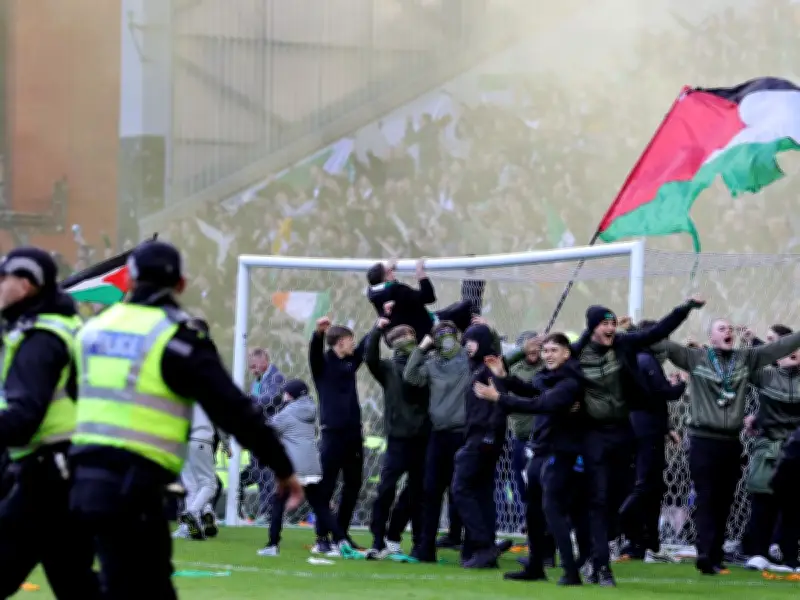
Scottish football's governing bodies have been ordered to lead a crackdown on ultras and thug fans as part of an independent review of last season's Old Firm Scottish Cup shame game at Ibrox.
A hard-hitting document was released on Tuesday afternoon following the investigation into the quarter-final clash at Ibrox on March 8, which was marred by a mass pitch invasion involving hundreds of masked yobs, sparking a massive, ongoing police probe.
A list of urgent recommendations has been issued, with beefed-up punishments ranging from immediate stadium closures to a mandatory massive hike in fines dished out by the authorities.
Recommendations for tougher sanctions
Independent lead Mark Blackbourne, who signed off on the 37-page report, has called for the SFA and SPFL to team up and sanction a far more aggressive and coordinated approach to dealing with unacceptable conduct inside Scotland's grounds. That includes an instant return to limited ticket allocation for future Scottish Cup matches, in line with the five per cent quota imposed for league games between the Glasgow pair and other high-risk ties.
The report compares ultra groups to organised criminals and calls for these sections of fans to be placed behind netting to prevent missile throwing and reduce the risk of future pitch invasions. It demands that any clubs found to be repeat offenders be hammered the hardest.
That will come as a clear warning to both Celtic and Rangers, with the probe highlighting disorder by rival militant groups – the Green Brigade and the Union Bears – before, during and after the cup showdown.
Criticism of current disciplinary frameworks
The report reads: “Scottish football is dealing with an upward trajectory of recorded unacceptable conduct by fan groups and individuals. The volume and variety of incidents documented across seasons 2024/25 and 2025/26 – pyrotechnics, objects thrown, pitch incursions, anti-social behaviour and targeted intimidation of players and officials – is not a statistical fluctuation. It is a trend. The disciplinary frameworks exist to reverse that trend. The evidence of this section is that, in their current form, they are not doing so. The sanctions are too modest, too deferred and too inconsistently applied to alter the behaviour of the clubs, groups and individuals they are designed to deter.”
Blackbourne added: “If lessons are to be learned, it is essential that this Report is received in a culture that permits frank acknowledgement of shortcomings and commits to change without equivocation. On that point, the Review is encouraged. There is clear evidence that the governing bodies, the clubs and Police Scotland understand the gravity of what occurred on 8 March and are genuinely committed to change. The task now is to translate that commitment into action.”
Blame for police and call for aligned punishments
As part of a list of recommendations, the report blames cops for failing to react to the potential of disruption ahead of the penalty shoot-out which sent Celtic through to the semis. It calls for more extensive pre-match security planning involving police, stewards and clubs.
It is highly critical of the SFA and SPFL for failing to tackle fan disorder robustly enough, while insisting the two governing bodies sign up to a new set of jointly agreed punishments rather than hide behind their own individual rulebooks. It demands that the worst offenders are locked out of their own grounds.
The report states: “Section closure, not ticket reduction, should be the standard first-response for confirmed unacceptable conduct. Suspended sanctions reserved for genuinely isolated first incidents. Seek alignment with SPFL on this matter. An escalating tariff of sanctions should be introduced, based on a rolling 3-year period, that includes section or stadium closure. Published in advance; no discretion. Seek alignment with SPFL on this matter. Where incidents are linked to Ultra groups, clubs must formally sanction those groups as a condition of continued stadium access. Failure to act should itself constitute a breach of rules regarding unacceptable conduct.”
It has also called for the current guide to ticket allocations for future ‘high risk’ Scottish Cup ties to be binned, saying: “Review 20% Scottish Cup rule; SPFL requires a ‘reasonable number’, around 5% has been judged reasonable. Scottish FA and SPFL must align to ‘appropriate, workable, safe to operate’, with safe to operate as a primary consideration for elevated-risk fixtures.”
Rangers and Celtic hit back
Rangers hit back at the SFA, insisting they got off lightly in the report. They seethed: “While we support some of the report’s recommendations, we do not accept every finding or factual assertion it contains. We have and will continue to raise concerns with the Scottish FA about significant aspects of the independent report. We are concerned about the description and limited examination of the decision to allocate around 8,000 tickets to Celtic, which materially changed the risk profile of the fixture. We raised safety concerns but were left in no doubt that the competition rule would be applied and the increased allocation was expected to proceed. The independent review should have scrutinised the Scottish FA’s actions as robustly as those of clubs and other organisations. This is a significant omission.”
Celtic also expressed dissatisfaction, firing a broadside at Police Scotland’s handling of the section of Rangers support that chose to go on the rampage. Interim Hoops chairman Brian Wilson said: “The actions by a section of the home support, some of them masked and carrying weapons, and subsequent attacks on our supporters and staff, were deeply concerning and we remain puzzled as to why the actions recommended by the Safety Advisory Group of Glasgow City Council were overturned at a senior level within Police Scotland. This has left a vacuum in the role previously understood by consent to be occupied by the Safety Advisory Group. Accordingly, we welcome the recommendation that the status of Safety Advisory Groups should be formalised and strengthened. While this was, of course, an away fixture for Celtic, we will seek to learn lessons of value to our own operations and co-operate fully with the authorities in doing so.”