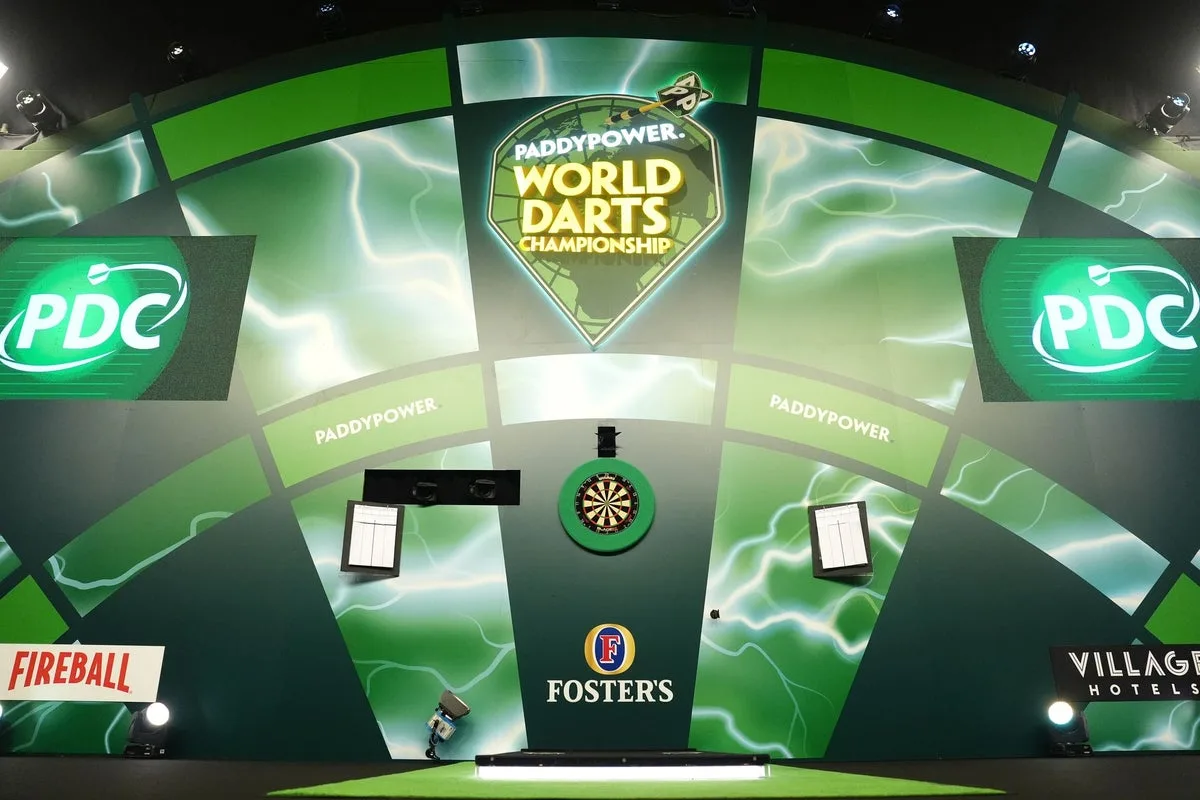
Televising the PDC World Darts Championship is a monstrous operation. Planning began 11 months ago, the day after Luke Littler won the world title last January. In total, there are 23 cameras, 56 microphones (including five hidden mics embedded in the board to deliver that iconic “thunk” sound), with 200 people deployed to broadcast every dart thrown across 144 hours of action.
It is an orchestra, and at its heart is the conductor, Sky Sports director Sean Randall, who I find hunkered down at the back of an expandable truck that sits in the middle of a warren of trailers and temporary structures backstage. After a few minutes in the dimly lit room, it quickly becomes apparent why his role is called “the hardest job in television”, as Brown manoeuvres our picture between the stage, the boisterous crowd and across the board for the six seconds each player visits the oche, on repeat.
Every orchestra needs someone in a darkened corner counting time, and that person at Alexandra Palace is known as the spotter. They are the reason our TV screens zoom in on treble 19 before the dart has left the player’s fingers, and it is the spotter’s predictive powers that ensure camera operators know which of the multiple checkout routes they will choose.
There are four rotating spotters at this year’s championship, and today I find Charlie Corstorphine in the hot seat behind the director. Costorphine is also a match referee; his mesmerising skill is to both work out the possible checkouts at double-quick speed and know the players’ preferred areas of the dartboard intimately. He can read out three different solutions to the question of how to get from 121 to zero faster than I can multiply three 16s. Or two, come to think of it.
Corstorphine guides the camera operators, producers and directors who hang on his every word. “OK, up first,” he says into his microphone, leading the wide-angle camera to the top half of the board as rising star Charlie Manby steps up to the oche needing 90 to win the leg. “Treble 20 for double 15. If he hits the single, 20 for bull or treble for double five...”
Deep in the bowels of Alexandra Palace is another darkened room where camera operators are listening intently to Corstorphine’s instructions beaming down from the truck above. One of those is Chris Pendlebury, who has his fingers hovering over a specially designed dartboard screen which, when he touches a number, fixes our TV picture automatically on that segment of the board. With one touch, he can select a preset zoom anywhere on the board for those clutch moments at the end of the leg.