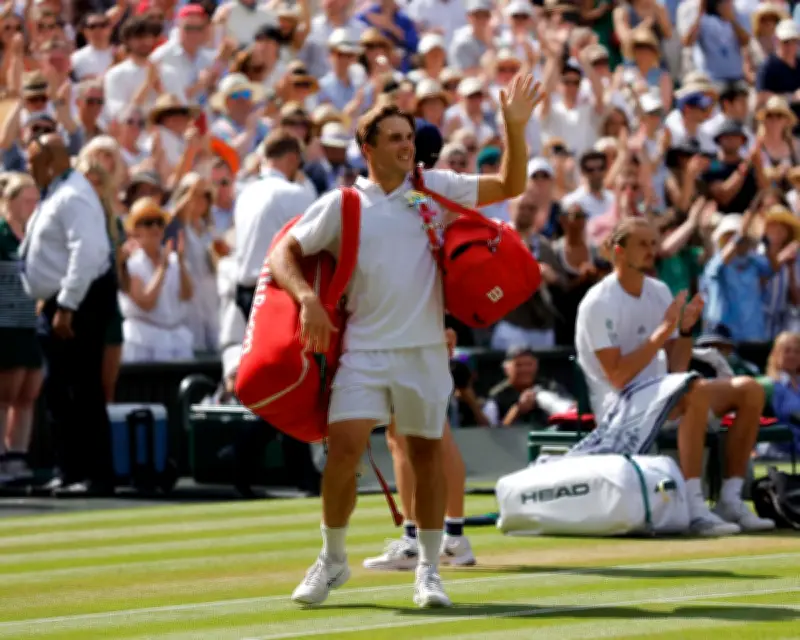
Arthur Fery's extraordinary Wimbledon journey came to an end on Friday as he was defeated 7-6 (7-0), 6-3, 6-2 by world No 2 Alexander Zverev in the semi-finals. The 22-year-old British wildcard, who had captured the nation's imagination with his run to the last four, was ultimately outclassed by the German's power and precision.
A Dream Run That Captivated the Nation
Fery's run to the semi-finals was nothing short of remarkable. Starting as an unseeded player ranked outside the top 100, he had beaten three seeded players, including defending champion Carlos Alcaraz in the quarter-finals. His journey had all the hallmarks of a fairy tale, with the British public embracing him as the unlikely hero.
However, against Zverev, the reality of the gap in class became apparent. The German, who won the French Open last month, landed 72% of his first serves and dominated the backhand-to-backhand exchanges. At 6ft 6in, Zverev towered over the 5ft 9in Fery, using his height to generate power and reach.
The Moment the Dream Faded
The first set tie-break proved decisive. Zverev won all seven points, leaving Fery with no answer. From that point, the belief that had carried Fery through the tournament began to ebb away. "I think the tie-break was the key moment," Fery said afterwards. "He was just too good today."
Spectators began to leave their seats after Zverev broke early in the second set. By the third set, the Royal Box had thinned out, with Virgil van Dijk and Sachin Tendulkar among those heading for the exits. Fery managed only one break point in the entire match, which he converted in the fifth game of the second set, but it was not enough to stem the tide.
What Fery's Run Means for British Tennis
Fery's success has sparked debate about the state of British tennis. While his talent is undeniable, his background—the son of a French multimillionaire and a member of the All England Club—has raised questions about privilege and access. "This is basically it: a mixture of privilege and connections, generational wealth and happy accidents of birth," noted one commentator.
Nevertheless, Fery's achievement is significant. He will become the new British No 1 and rise to No 36 in the world rankings from Monday. He can now enter almost any tournament he wants, and with few ranking points to defend, a seeding at the US Open is not out of reach.
The Hard Work Ahead
But the road ahead is challenging. Fery's opponents will no longer underestimate him. After their quarter-final, Flavio Cobolli admitted he had not watched any of Fery's matches. That will change. "There will be a target on his back, expectations to meet, a higher physical level for a player who has struggled with injuries," said an analyst.
Fery himself acknowledged the task ahead: "I need some time off, but then the real work starts. I have to get stronger, improve my game, and prove that this wasn't a one-off."
For now, the fairy tale is over. But for Arthur Fery, the real story is just beginning.