Jannik Sinner defeated Alexander Zverev in four sets to retain his Wimbledon title, overcoming a brief challenge from the German before dominating the Sinner Zone.
Match Overview
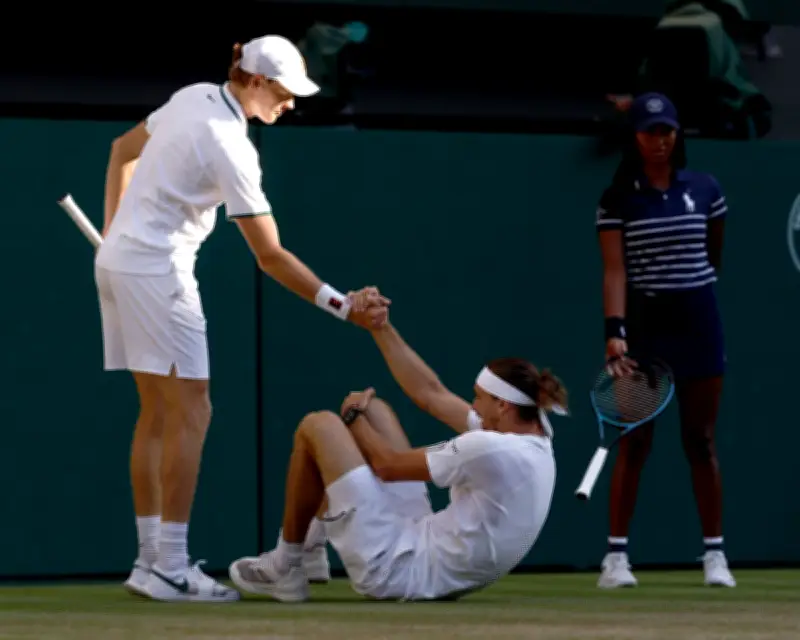
Shortly before 7pm, 162 minutes into the match, Alexander Zverev earned his first break point on Jannik Sinner's serve. With the score tied at one set apiece, it felt like a hinge point. Sinner faulted, offering a priceless second serve. But Sinner responded with a perfect backhand down the sideline followed by a drop shot that sent Zverev sprawling to the turf, clutching his knee. That moment encapsulated the futility of Zverev's task. Soon after, Zverev was broken for the first time, flinging his racket. By 7.07pm, he was down two sets to one; by 7.56pm, the match ended with handshakes and phone cameras. Zverev likely played his best match of the tournament, but he entered the Sinner Zone.
Key Statistics
Across the match, Zverev sent down 60 unreturned serves over 21 service games and two tie-breaks, averaging three per game. This meant that arguably the best returner in men's tennis was effectively starting every other game 40-0 down before putting a ball in play.
Sinner's Performance
This has not been a vintage Sinner fortnight, with his game uncharacteristically wasteful and his demeanour edgy. Yet the fundamentals remain: the ability to find four perfect serves at 0-30 down, to snuff out chances before they exist, and the problem-solving mind. He showed athleticism and showmanship, nailing a no-look angled backhand glider while serving for the title.
Zverev's Challenge
Zverev nicked the first set tie-break with only his second backhand winner of the match. He entered the match in the form of his life after his French Open triumph, suspecting it unlocked something feral and surgical. Until this year, he hadn't beaten a top-10 player on grass in a decade, never past the fourth round here, and hadn't beaten Sinner in nine attempts. As he stomped to his chair after the first set, he sensed this time might be different.
Context and Analysis
Ever since Sinner's implosion in Paris, his big weakness was heat and humidity. But a stiff breeze blew into Centre Court as the championships concluded, shadows darkening and dramatic possibilities winnowing. The match followed a rigid structure for two sets before loosening to let humanity in. It was played in the shadow of two monster-truck serves, a battle of bombs defined by minuscule errors.
This has not been a vintage Wimbledon, existing in the gaps around football, filled with drama and new folk heroes like Arthur Fery and Linda Noskova, old ones like Serena Williams and Stan Wawrinka, but feeling like a walled-off garden party. Until Carlos Alcaraz returns from injury, men's tennis is rich in talent but poor on genuine crossover stars. Sinner is brilliant, an all-time great, but served a three-month anti-doping suspension last year and is not beloved beyond his home country. Zverev has twice been accused of domestic violence by former partners, which he stringently denies. The younger generation—João Fonseca, Jakub Mensik, Learner Tien, Rafael Jódar—holds promise but must win something first.
None of this perturbs Sinner, whose grand slam title drought ends at a laughable three. There was none of the wild weeping from his first title here 12 months ago; he looked immensely satisfied, like a man who made and kept a solemn promise to himself.