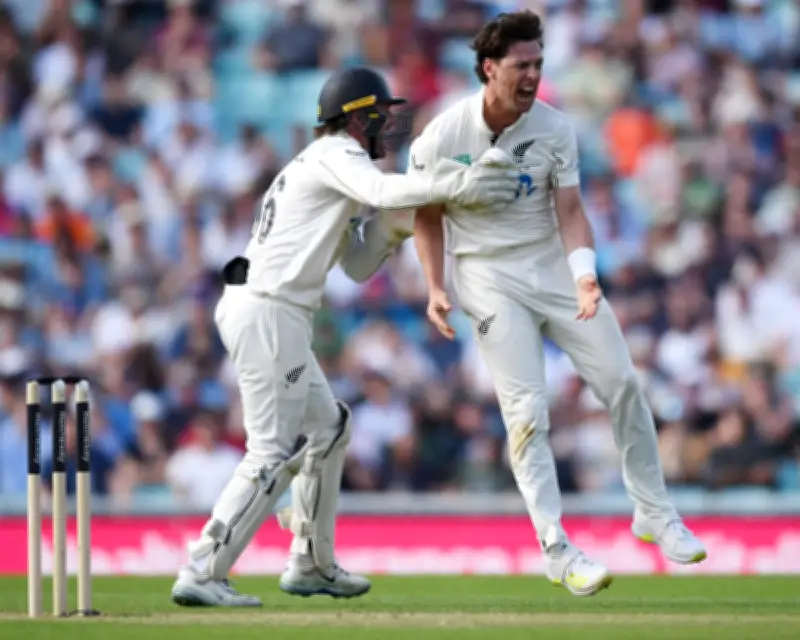
Tom Blundell's wicketkeeping masterclass at the Oval was a key factor in New Zealand's 253-run victory over England. Standing up to the stumps against opening bowler Matt Henry, Blundell's lightning-quick hands and immense courage were integral to the win, even as Henry's 11 for 109 and centuries from Glenn Phillips and Henry Nicholls grabbed the headlines.
Blundell's Impact on England's Batters
Coming up to the stumps, Blundell stole the pitch from England's batters. Joe Root and Harry Brook, who like to disrupt a seamer's length, were forced to play where they stood. As the geometry tightened, so did their approach. A ball on a nagging length became a threat to their front pad, off-stump, and outside edge. Balls that previously looked like appetising throw-downs suddenly carried menace.
Brook's dismissal in the second innings was a perfect example. Henry found his edge, and though Blundell couldn't grab it cleanly, his cushioned deflection made the job simple for Daryl Mitchell at slip. It might have looked scruffy, but it was a consequence of all the great work that had come before it. Blundell was close enough to make Brook think, brave enough to stay there, and skilful enough to keep the chance alive.
The Art of Standing Up
Ben Cox, Leicestershire's wicketkeeper and one of the best on the County Championship circuit, recalls an old lesson from Steve Rhodes: "You have to think like a tiger. Everything has to be relaxed, but your mind has to be like a predator." Cox would stand up to almost anyone, except Shoaib Akhtar, he laughs: "I wouldn't want a death wish." He sees the position as a stage: "Standing up to the stumps, in my opinion, is where I can show off. It's the platform where I can show that I am better than the other keeper that I'm playing against."
Alex Carey, like Blundell, warranted his own highlights package by standing up to Michael Neser and Scott Boland in the most recent Ashes. It was one of the rare occasions where a piece of cricket that usually exists in the margins was made visible. Carey's hands seemed to move only as far as they needed to: no snatch, no stab, just a soft little give and the ball disappearing into the webbing.
Challenges for Bowlers and Keepers
For keepers such as Cox, Carey, and Blundell, the toughest challenge comes not in the form of spitting deliveries from a length, but in the potentially bruised egos of fast bowlers. "I have to beg the bowlers to do it," Cox says. A keeper up to the stumps can look like an insult, a public announcement that the bowler is not as sharp as he imagines. At club level, the feeling is almost comic. At a professional level, with cameras, speeds, and clips waiting to be dissected, it can become a genuine barrier.
Vernon Philander, the South Africa seamer who claimed 224 Test wickets at 22.32, offers a view from the other end. "You simply have to park your pride," he says with a chuckle. "Whenever I felt a little insecure about it, I just reminded myself that this was a way for me to be more effective." Philander is clear that the tactic demands discipline from the bowler as much as bravery from the keeper. "Visually everything changes for you. I've seen so many times that when the keeper gets up, you almost see bowlers dragging it a touch shorter, then being hooked and cut. It's also a skill and an art to bowl with the keeper up."
The Blundell-Henry partnership worked so well because Blundell advanced, and Henry did not retreat. The keeper applied pressure in front of the batter's eyes, the bowler kept asking the same question at the top of off-stump.
Psychological Impact on Batters
For the batter, the intrusion is psychological before it is technical. Cox is not a sledger: "I've never sledged anyone in my life." His menace is positional. "It certainly gets inside the batter's plans." There is no need for verbals when the batter can feel the keeper's breath on his neck. Bowled and lbw come back into play. So, absurdly, does the stumping. "I've racked up a pretty good collection to seamers," Cox proclaims, guessing he's bagged about 35 in his career. "The ones down leg are particularly special."
Perhaps, thanks to a small but growing cohort of brave and agile keepers, the old adage needs a rethink. The best wicketkeeping performances aren't the ones that go unnoticed, but are the ones that hog the spotlight.
Women's Cricket Kit Evolution
As the Women's T20 World Cup rolls through England, the most visible markers of the women's game's growth are easy to spot: bigger crowds, primetime fixtures, Lord's waiting for the final. But another part of the game's expansion is happening further down the supply chain, in changing rooms, club shops, and kit bags. For decades, girls and women cricketers have often had to make do with clothing and equipment designed with boys and men in mind: whites that did not fit, pads that felt too heavy, bat handles made for larger hands.
That is now beginning to change. Lacuna Sports was founded in 2019 by Leigh Burns after watching her daughter wear poorly fitting men's kit. The company describes itself as the first brand globally dedicated solely to bespoke cricket clothing for women and girls, and has built its range around trousers cut for female proportions using fabrics that are not see-through. Maiden Cricket, founded by teenage sisters Cat and Honor Black, offers lighter pads and thinner bat handles. The former England spinner Alex Hartley has joined as an ambassador and is helping to set up a player advisory board for future designs.
Lacuna clothes are now worn by players in England, Scotland, and Switzerland, across 21 UK cricket counties, while Maiden's emergence has attracted interest from investors. "What's always mattered to us is the game first, kit second," says Burns. "Better kit is important, but only because it helps more women and girls feel comfortable, confident and able to play. Our mission has never been about selling clothing; it's about removing barriers to participation."
Stat of the Week
On Sunday, Harmanpreet Kaur became the first cricketer – male or female – to reach the milestone of 200 Twenty20 internationals during India's defeat by South Africa at Old Trafford. The India captain made her first T20i appearance against England at Taunton in the 2009 T20 World Cup.
Quote of the Week
"I had that sinking feeling when I found out where you just can't speak for a few minutes, then you've got to start. Then a range of emotions where I was incredibly angry, still am" – Rob Key is still fuming after Ben Stokes and Gus Atkinson broke England's curfew before the second Test against New Zealand.
Memory Lane
24 June 2014 | Sri Lanka beat England at Headingley with one ball to spare, Shaminda Eranga finally removing James Anderson after Moeen Ali had threatened to block out for the draw. It sealed Sri Lanka's first multi-Test series win in England and completed a spotless tour that also included victories in the 50-over and 20-over series.