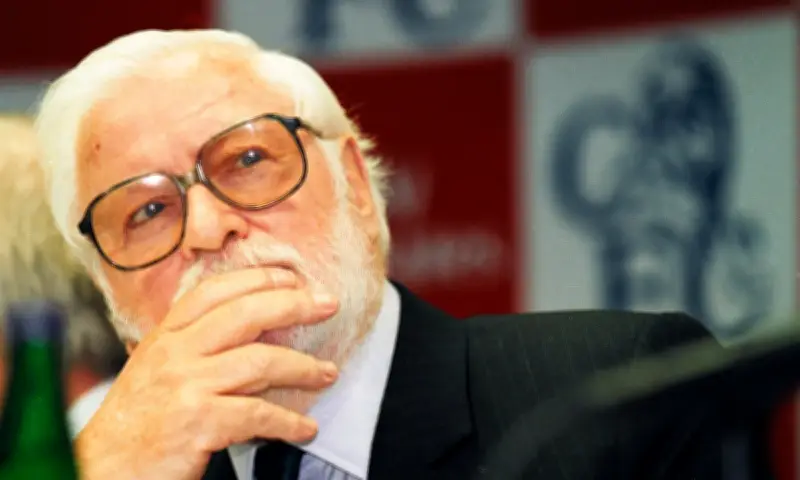
Ken Bates, one of the most colourful and controversial figures in English football, has died aged 94, Chelsea announced on Saturday. He died peacefully in Monaco, surrounded by his wife and family.
"It is with great sadness that we share the news of the loss of Ken Bates, former owner and chairman of Chelsea Football Club," the club said. "The club sends our heartfelt condolences to Ken's wife, Suzannah, the rest of his family and his friends. Ken's determination to fight for Chelsea when times were tough and drive the team on to winning trophies will never be forgotten."
Early life and business career
Born in December 1931, Bates endured a difficult childhood. His mother died soon after his birth, and his father absconded, leaving him to be raised by his grandparents in a council flat in Ealing, west London. He supported Queens Park Rangers and dreamed of playing for the club but was not good enough, partly due to a club foot that required multiple operations. Bates went into business, making a personal fortune in haulage, quarrying, ready-mix concrete, and dairy farming.
Football ownership before Chelsea
Bates bought Oldham in 1965, becoming chairman of the Third Division club, and later moved to Fourth Division Wigan in 1980 as vice-president, having bought the club with his business partner Freddie Pye. Both spells were largely successful, fuelling his desire to take on a bigger club.
Buying Chelsea for £1
In 1982, Bates bought Chelsea for £1. The knockdown price reflected the club's serious financial trouble and its status as a struggling Second Division side. He made money available to manager John Neal, leading to the arrival of players such as Kerry Dixon, Pat Nevin, Mickey Thomas, Nigel Spackman, and David Speedie, inspiring a return to the First Division in 1984.
Bates fought a successful legal battle with property developers Marler Estates, securing the freehold of Stamford Bridge for a supporters-led organisation, Chelsea Pitch Owners. In 1985, he installed a 12ft-high, 12-volt electric perimeter fence at the stadium to deter pitch invaders, but the Greater London Council blocked its activation on safety grounds.
The Abramovich era and Chelsea's rise
In the 1990s, Bates oversaw a hugely successful period, with Stamford Bridge renovated and a team led by Glenn Hoddle, Ruud Gullit, and Gianluca Vialli winning multiple honours, including the FA Cup, League Cup, and Cup Winners' Cup. However, by summer 2003, Chelsea was £80m in debt, and Bates accepted a £140m offer from Roman Abramovich. The takeover triggered a spending spree that transformed Chelsea into a major force and inflated transfer fees across football.
Leeds United and later years
Bates remained Chelsea chair until March 2004. Less than a year later, he bought a 50% stake in Leeds United, aiming to repeat his Chelsea success. However, Leeds fell into administration in 2007 with a £30m debt, including £7m owed to HMRC, leading to a 10-point deduction and relegation to League One, followed by a 15-point deduction. Leeds returned to the Championship in 2010 but never reached the Premier League under Bates. He sold the club to GFH Capital in November 2012 and retired to Monaco.
Controversy and legacy
In 2018, Bates faced criticism after youth-team players alleged racial abuse by coaches during his tenure. He questioned the victims' motives, saying: "The sniff of money is in the air. This is trial by smear." In 2022, Chelsea paid damages to eight former youth players in an out-of-court settlement. Bates also owned Partick Thistle in the mid-1980s and held an executive role at the Football Association until 2001. As he said in a 2024 interview: "I've made many enemies, but I've made a lot of my friends laugh: that'll be my epitaph."