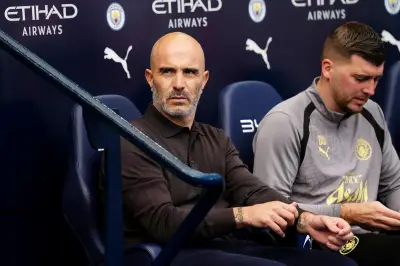
Matthias Jaissle has replaced Eddie Howe at Newcastle United, implementing a high-intensity zonal press and vertical style that has dramatically boosted the squad's athletic output.
Eddie Howe's departure in July 2026 marked the end of a defining, transformative era at St James' Park, one that began with the takeover five years ago. The appointment of Howe was critical. He took a disjointed squad and moulded them into a Champions League side built on relentless work ethic. It was a strategy that brought incredible progress and results - until it didn't.
Last season's 12th-place finish was Howe's swansong. A squad and manager that ran out of steam meant a full rebuild this summer - a new head coach and a new, fresh group of players.
Jaissle's mandate
Matthias Jaissle - fresh off back-to-back AFC Champions League Elite titles with Al-Ahli - was appointed head coach in his place. Rooted in the aggressive, fast-paced doctrines of the 'Red Bull' school and influenced heavily by the modern German coaching lineage, the 38-year-old tactician has demanded a revolution on Tyneside.
Jaissle's mandate is simple: verticality, organised chaos, and an unrelenting physical output. There hasn't been much time to implement his ideas fully but a three-week international break has allowed more time on the training ground for manager and players.
Howe's tactical stagnation
Before assessing Jaissle's impact, it's best to first look at the tactical stagnation that plagued the final 18 months of Howe's tenure. At his peak between 2022 and 2024, Howe deployed a fierce 4-3-3 system defined by a strict man-to-man high press.
However, by the 2025/26 season, the high press had lost its edge. Opponents increasingly found ways to bypass the initial wave of pressure, forcing Newcastle into a passive 4-5-1 mid-block.
The physical metrics from Howe's final season paint a picture of a fatigued squad - unsurprising in many senses given the volume of games on multiple fronts that campaign. Team-wide, sprint distance per 90 minutes dropped by 14% compared to their peak Champions League qualification year, and their Passes Per Defensive Action (PPDA) - a metric where a lower number indicates a more aggressive press - ballooned to 12.5. They were no longer hunting the ball; they were waiting for it.
The Red Bull blueprint
Jaissle is no fan of a passive mid-block. His entire tactical framework is built around winning the ball deep in opposition territory and punishing them before they can set their defensive shape.
Where Howe favoured methodical progression through wide overloads, Jaissle's approach is fiercely central and intensely vertical. The most jarring change, however, is out of possession. Jaissle has replaced Howe's man-to-man marking with a coordinated, zonal counter-press. The instant possession is lost, players do not retreat. Instead, they are instructed to swarm the immediate area, suffocating the ball carrier to force high turnovers. But it needs a radically high defensive line to keep the team highly compact, putting immense responsibility on the centre-backs.
Jaissle tried to explain the philosophy recently. "For sure you need intensity to make it work. First of all, you need to be intense out of possession that you're getting the ball back if the opposition have it.
"So, you need to be aggressive and intense. That's also our approach: that you have a good swarm behaviour. Ball-oriented, fully committed and then, if you win then the ball again [you go forward quickly]. Then we come into the vertical approach where you can use the chance against an unorganised opponent structure to be vertical and score [quickly] in the best scenario."
A stark athletic transformation
Implementing a system built on immediate counter-pressing and vertical sprints requires an elite physical baseline. Training sessions at The Knox have transformed into grueling gauntlets, and the early data from the 2026/27 Premier League season highlights the extreme athletic leap the squad has taken.
Under Howe's more structured wide play last season, Harvey Barnes averaged a respectable 9.8 km covered per 90 minutes, with a focus on explosive, short-distance sprints in the final third. Under Jaissle, Barnes has become the primary pressing trigger. He is currently averaging an immense 11.0 km per 90 minutes. His high-intensity sprint volume has skyrocketed by 22%, reflecting his new mandate to relentlessly close down opposition full-backs and centre-halves.
Lewis Hall's development has accelerated under the new regime. In 2025/26, Hall was largely tasked with traditional overlapping duties, covering 9.2 km per 90. Jaissle now utilises him in a highly demanding, inverted role where he frequently tucks into the midfield to sustain the second wave of the press (see below for the second goal vs Hull). This structural shift has pushed Hall's output to 10.8 km per 90, alongside a 30% increase in ground duels contested.
German international Malick Thiaw has been heavily impacted by the defensive changes. Last season, operating in Howe's deeper block, Thiaw averaged 8.9 km per 90. Now, forced to maintain Jaissle's high line, Thiaw is covering 9.8 km per 90. More critically, his recovery sprints and isolated 1v1 defensive duels have spiked.
Perhaps the most surprising transformation, though, is Sven Botman. Traditionally viewed as a physical, penalty-box defender who thrived in a deep block (covering 8.5 km per 90 last season), Botman is now functioning in a system that exposes his lack of elite recovery pace. To compensate, Botman has had to dramatically increase his physical exertion, covering 10.1 km per 90 this season to maintain the aggressive offside trap Jaissle demands.
Echoes of Howe's peak
While the shift from Howe's final season to Jaissle's current setup seems like a radical departure, a closer look at the underlying metrics reveals a fascinating truth: Jaissle's approach is actually recreating the statistical profile of Eddie Howe's peak Newcastle years.
During the 2022/23 campaign, when Newcastle stormed into the top four, they were defined by their suffocating intensity. Their PPDA that season hovered around 9.5, and they consistently led the league in high turnovers resulting in shots. By 2025/26, that intensity evaporated (12.5 PPDA).
Jaissle has forcefully resurrected that identity. Early this season, Newcastle's PPDA has plummeted to a ferocious 8.8. They are once again leading the division in possession won in the attacking third. The tactical methodology is completely different - Jaissle uses a narrow, zonal swarm, whereas Howe used a wide, man-to-man press - but the fundamental outcome is identical. Both managers, at their peak, realised that St James' Park thrives on a team that refuses to let the opposition breathe.
The tactical verdict
Matthias Jaissle's arrival has sent a jolt of electricity through Newcastle United. As his track record in Austria and Saudi Arabia proves, his philosophy relies entirely on togetherness, extreme hard work, and a passion to suffocate the opposition. The first two goals against Hull were the outcome of regaining the ball high, and they also won a penalty through a similar tactic.
It's risky, a high-wire act which sometimes sees a team fall. When the swarm fails to win the ball back, the high line can look disastrously exposed. In possession, teams are starting to look at how to counter the vertical football by winning second balls from the first thrust. There is also the thorny issue of the strain put on players' bodies with United experiencing a significant number of injuries in the early part of the season.
Yet, by pushing his players to unprecedented athletic limits, Jaissle isn't just erasing the lethargy of the 2025/26 season - he is actively looking to recapture the manic, overwhelming intensity that made Newcastle so terrifying to play against during their peak years with Eddie Howe. We have only just begun to see Jaissle's chaos theory.