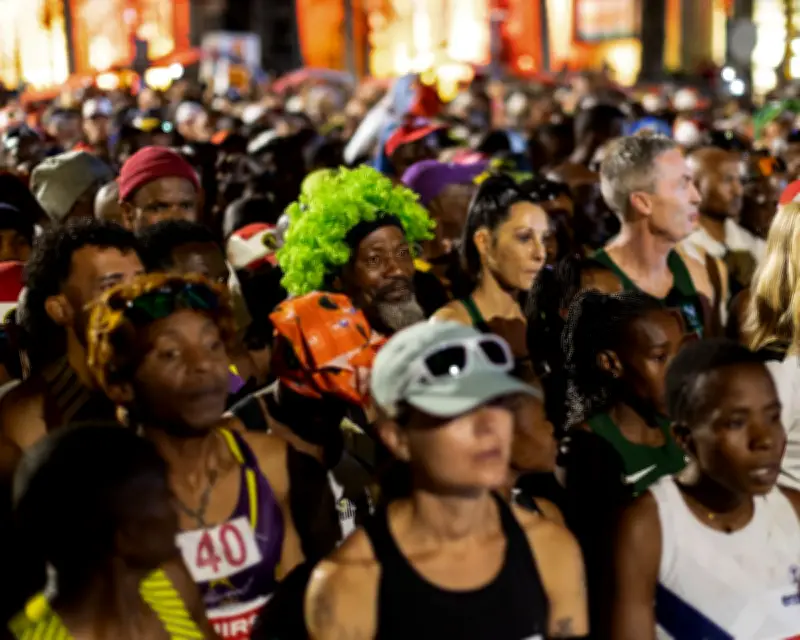
For one day every June, South Africa's searing racial inequality seems to melt away at the Comrades Marathon, the world's oldest and largest ultramarathon. On 14 June 2025, more than 20,000 runners gathered outside Durban city hall to run 88 kilometres (54.6 miles) uphill to Pietermaritzburg, with about 91% finishing within the 12-hour cutoff, according to The Running Mann blog.
History and Evolution
The first Comrades race in 1921 featured 34 runners, all white men, conceived by World War I veteran Vic Clapham to honour his fallen comrades. Only 16 finished. Over the years, it has grown into a national institution. In 1923, Frances Hayward became the first woman to start and finish; in 1935, Robert Mtshali was the first black man to complete the race. However, official competition remained restricted to white men until 1975, when the race was desegregated and opened to women, driven partly by a desire to counter South Africa's international sporting isolation due to apartheid.
Personal Stories of Triumph
William Seleka, a 38-year-old appliance repairman from Alexandra township, started running in March 2025 after a deep depression following his divorce. "I thought for me to stay alive, I had to keep myself busy," he said. He joined Run Alex, a local club, and within months completed a 50km ultramarathon. Despite never having run further than 10km before, he set his sights on Comrades. "I used to hear people saying, 'This is Comrades, you are running from Durban to Pietermaritzburg.' I said, 'It's insane, you can't do that.' But now we are facing reality – I'm doing that as well," he said. He finished the race in 10 hours, 30 minutes and 49 seconds, dedicating his run to his sister, whose kidneys failed in 2018. "At the start, everything changed," he said. "I said this pain today is for my younger sister."
Race Day Experience
The "up run" from Durban to Pietermaritzburg involves a climb of about 1,800 metres (5,900 feet). Runners started in three batches at 5am, 5.15am, and 5.30am. Spectators lined the route, braaing by the roadside, while running clubs set up aid stations. By halfway, most runners were walking up hills. Seleka struggled with blisters after changing shoes at the halfway point and had to distract himself by singing. "I'm not a person who goes to church," he said. "But on that day I started to sing. I don't know where those songs came from."
Community and Camaraderie
The Comrades is known for its unique "buses" – pacing groups where runners sing and chant led by a metronomic pacer. The final 12-hour bus driver, Shahieda Thungo, crossed the line at 11:56:34, carrying dozens of runners. The race also highlighted moments of unity: in the 1980s, scenes of white runners sharing water with black runners were powerful in a deeply divided society. "You would have these scenes in the 1980s of a white runner sharing a bottle of water with a black runner, which was such a small gesture, but such a huge thing in that society that was so divided," said journalist Ryan Lenora Brown.
The Finish and Beyond
As darkness fell, guns marked the 12-hour cutoffs. Some runners danced across the finish line; others collapsed. Seleka cried as he finished, already planning his next race. "If you're going through a lot, once you say why, then it's a mission," he said. "After Comrades is accomplished, it's a new chapter again." The Comrades Marathon remains a powerful symbol of endurance and unity in South Africa.