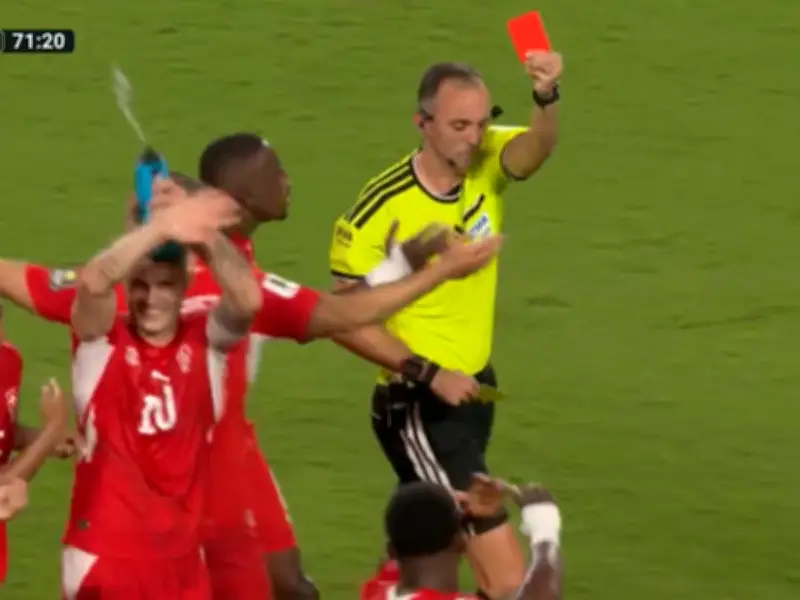
FIFA has released a new statement clarifying its stance on the mistaken identity VAR decision that sparked controversy at the World Cup. During the quarter-final clash between Switzerland and Argentina, Breel Embolo was sent off after a VAR review for simulation, a decision that prompted debate over the application of VAR protocols.
Controversial Decision
In the 72nd minute, with the match tied at 1-1, referee Joao Pinheiro initially awarded a foul to Switzerland after a challenge by Argentina midfielder Leandro Paredes on Embolo, showing Paredes a yellow card. However, VAR advised Pinheiro to review the pitch-side monitor under the umbrella of mistaken identity. After review, Pinheiro determined that Paredes had made no contact and that Embolo had dived. He overturned the foul, rescinded Paredes' yellow card, and booked Embolo for simulation. Since Embolo had already received a yellow card in the first half, the second yellow resulted in his dismissal, leaving Switzerland with 10 men. They eventually lost 3-1 in extra time.
IFAB's Response
After the tournament, the International Football Association Board (IFAB) released a statement clarifying that the decision stemmed from a misapplication of VAR's mistaken identity protocol. IFAB's ruling states: "A yellow card (caution) which is not a second yellow card can only be reviewed to identify the player who committed the offence that was penalised; the offence itself cannot be reviewed/changed." It added that use of the mistaken identity clause for simulation was "well received" but cannot be used until the VAR protocol review is concluded.
FIFA's Defence
FIFA has refused to accept IFAB's characterisation of the event as an officiating failure. A FIFA spokesperson issued a fresh statement defending the match official. The spokesperson said: "FIFA's interpretation of Mistaken Identity was consistently applied during the FIFA World Cup. There were two instances in which a player was mistakenly identified as having committed a yellow card offence and the VAR advised the referee to correct the factual error caused by the opponent's simulation." The spokesperson added: "The simulation itself cannot be disputed and it should not result in a disciplinary sanction against an opponent that may then lead to further consequences, such as a sending off for a second yellow card or a match suspension for accumulated cautions. We do not consider this to have been a referee or VAR error and the decision restored justice." FIFA noted it has been in contact with IFAB, who confirmed the interpretation is valid and will form part of discussions on VAR protocol revisions.