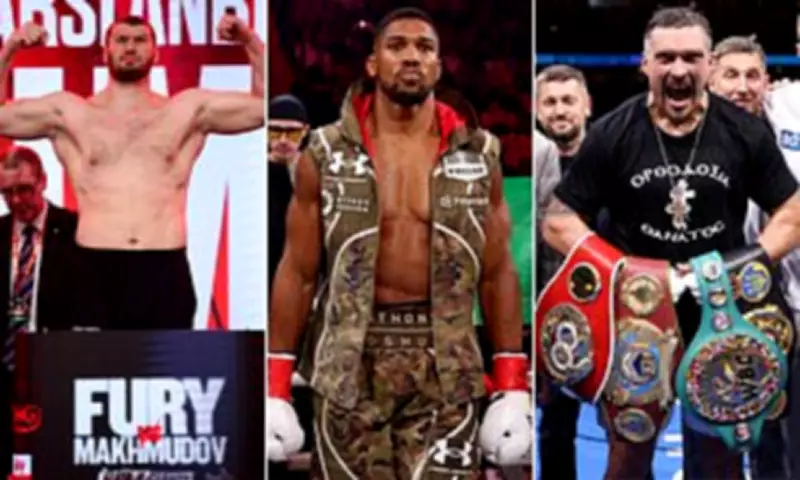
After multiple retirements and comebacks, Tyson Fury asserts that this return marks a definitive departure from past patterns. This is not a fleeting comeback or a temporary flash in the pan. Instead, Fury has charted a deliberate final chapter: three carefully selected fights, three definitive statements, and, if he achieves his objectives, a legacy firmly reasserted.
The Strategic Roadmap: From Rebirth to Redemption
The initial step in this ambitious plan unfolds against Arslanbek Makhmudov this Saturday. However, beyond this immediate challenge lies a far more compelling and intricate roadmap—one that could finally resolve heavyweight boxing's most persistent and unresolved rivalries.
Despite the chaos that has frequently surrounded Fury's career, this three-fight blueprint appears unusually clear and methodical. It comprises one dangerous return bout, one long-overdue domestic super fight, and one final attempt to rewrite history against the only man to have twice defeated him.

This sequence is constructed as much upon legacy considerations as it is on logical progression. Fury is no longer primarily pursuing championship belts or conventional validation. He is chasing narrative control, definitive closure on lingering rivalries, and the final shaping of his historical standing.
The Commercial Imperative Behind the Comeback
An unmistakable commercial reality underpins this entire endeavor. Having operated during an era of mega-deals—from Saudi-backed spectacles to global streaming platforms like Netflix—Fury's return is not designed for routine paydays. Every subsequent fight must carry substantial spectacle and scale, commanding purses deep into eight figures and beyond, matching the nine-figure territory he has grown accustomed to.
Whether Fury executes this plan remains an open question. However, if he delivers on his stated intentions, these next three contests will not merely shape the conclusion of his career; they could fundamentally define how his entire boxing journey is remembered.
Fight One: Arslanbek Makhmudov – The Hunter's Violent Return
Fury's immediate focus rests entirely on Arslanbek Makhmudov, a dangerous puncher with a record of 21 wins and 2 losses, including 19 knockouts. In Fury's strategic vision, Makhmudov represents the perfect foil for his violent rebirth.
After sixteen months away from competitive boxing, Fury has framed this comeback not as a cautious re-entry but as an aggressive reassertion of dominance. At Thursday's press conference, he leaned heavily into the narrative that has defined his most successful periods: that of the hunter rather than the hunted.
'For the first time in forever, I'm the hunter… and when I've been the hunter in the past, I've always messed people up,' Fury declared emphatically. The pair will clash at Tottenham Hotspur Stadium on Saturday evening in what Fury envisions as the explosive opening act of his final chapter.
Fight Two: Anthony Joshua – The Decade-Long Domestic Super Fight
Should Fury successfully navigate past Makhmudov, the next chapter almost writes itself: a long-awaited showdown with Anthony Joshua. Few fights in modern boxing history have been so relentlessly discussed yet so stubbornly unrealized. For nearly a decade, Fury versus Joshua has hovered perpetually on the brink—negotiated, announced, collapsed, revived, and abandoned repeatedly.
At various junctures, contracts were drafted and dates floated. In 2021, the fight came closest to materialization before arbitration forced Fury into a third bout with Deontay Wilder. In 2022, Fury publicly offered Joshua a short-notice deal following Joshua's second defeat to Oleksandr Usyk, but talks disintegrated once again.
Complex Obstacles and Renewed Momentum
The obstacles have proven complex and persistent: fractured promotional alliances, competing broadcast interests, ill-timed setbacks, rebuilding phases following defeats, and negotiations repeatedly derailed in public, with terms debated as extensively in media circles as behind closed doors.

Anthony Joshua's career trajectory has added further layers of uncertainty. His consecutive defeats to Usyk necessitated a period of reflection and rebuilding—not just technically within the ring, but mentally, as he sought to rediscover the authority and clarity that once defined his meteoric rise.
More recently, concerns regarding his wellbeing following a car accident have understandably shifted focus away from timelines and toward physical and emotional recovery. However, momentum is quietly building once more. Preliminary contracts for a Fury showdown have reportedly been discussed again, with locations tentatively explored—including the unlikely suggestion of Dublin—though the scale and significance of an all-British clash would almost certainly demand a home setting in England.
In the interim, Joshua is expected to undertake a high-profile tune-up fight, with Deontay Wilder emerging as a leading option—particularly after Wilder's diminished showing against Derek Chisora suggested he may no longer represent the destructive force of old. On paper, this represents a winnable yet meaningful preparatory bout for Joshua.
Fight Three: Oleksandr Usyk – Unfinished Business and Redemption
The final act in Fury's meticulously planned trilogy must involve Oleksandr Usyk. Their rivalry has already defined a heavyweight generation. In two fiercely contested fights, Usyk emerged victorious both times—outboxing, outthinking, and ultimately outlasting Fury. Yet Fury has never accepted those defeats in spirit.
Privately and publicly, he maintains he won—or at the very least, did enough not to lose. That conviction is central to why he cannot walk away from the sport without another attempt. For a fighter as driven by narrative as Fury, legacy transcends mere records; it encompasses perception. In his mind, an imbalance exists that demands correction.
A Rivalry That Remains Raw and Unresolved
The first encounter saw Usyk's movement and precision disrupt Fury's rhythm. The second reinforced that pattern, with Usyk proving once again the more disciplined and tactically consistent fighter. Fury experienced moments of dominance, flashes of brilliance, but never sustained control.
Yet the rivalry remains as raw as ever. When the prospect of a third fight was presented to Fury during fight week, his response was characteristically blunt: 'f*** Usyk'. This remark serves as a reminder that, beneath the business discussions and legacy talk, genuine competitive edge persists between the two champions.
The feeling is not one-sided. In an exclusive interview with The Daily Mail in Ukraine, Usyk made clear he still desires the Fury fight—not only as a competitive challenge but as the defining bout of this era and a major commercial draw on the global stage.
The Fourth Challenge: Paris Fury – The Negotiation Beyond the Ring
For all the talk of three fights, three opponents, and one final charge at heavyweight supremacy, Fury may face a fourth contest—the only one he cannot bulldoze, outbox, or talk his way through. Beyond Makhmudov, beyond Joshua, and even beyond Usyk, stands Paris Fury and the considerable matter of convincing her that these final three fights represent a sound idea.
By Fury's own admission, Paris has been prepared for him to hang up his gloves for years. When he broke the news of his latest comeback, the response was less a ringside roar and more a silent treatment, with Fury revealing she did not speak to him for days.
Balancing Family Life and Boxing Legacy
Then there is the small detail of a sixteen-week training camp. While Fury has been sharpening his skills for another run at heavyweight glory, he has also been largely absent from family life—exchanging school runs and dog walks for intensive sparring sessions and press conferences.
This situation culminates in perhaps the most delicate balancing act of his entire career. While Fury can meticulously map out strategies for Makhmudov, Joshua, and Usyk down to the finest detail, maintaining domestic harmony and keeping Paris content might prove the trickiest negotiation of them all.
Potential Wildcards and Dangerous Detours
Returning to the boxing landscape, even with a clearly articulated three-fight plan, the heavyweight division rarely adheres to predetermined scripts. Several potential wildcards could disrupt Fury's roadmap.
One significant possibility is the winner of the upcoming Fabio Wardley versus Daniel Dubois clash. Wardley, in particular, has already exchanged public words with Fury, teasing a future confrontation. This fight carries substantial domestic intrigue but also considerable risk. Wardley's rapid rise, unpredictability, and known punching power make him a dangerous opponent for a returning Fury.
Another name high in the heavyweight rankings is Agit Kabayel. Unbeaten, disciplined, and physically imposing, Kabayel represents precisely the kind of high-risk, low-reward opponent that established fighters often avoid.
Notably absent from Tyson Fury's calculations is Moses Itauma. The unbeaten young prospect may represent the division's future, but he is one risk Fury has demonstrated no appetite to entertain. When questioned about this possibility, Fury dismissed it with characteristic bluntness, insisting he is 'not mad'—a remark that underscores both the danger Itauma poses and the lack of incentive in facing a fast-rising, high-risk opponent at this advanced stage of his career.