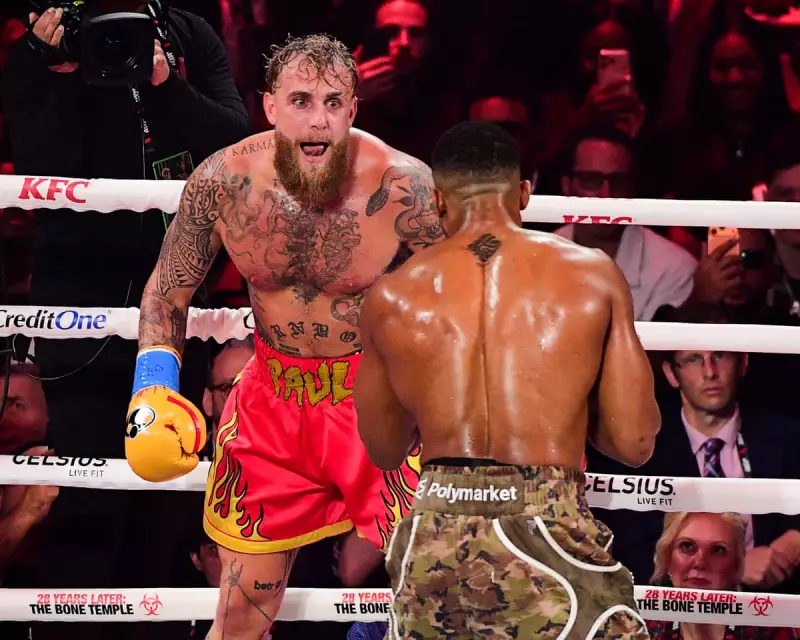
The neon-lit Kaseya Center in Miami, Florida, was nearly filled to its 20,000-seat capacity, but the atmosphere inside was less a traditional boxing crowd and more a modern content farm. The occasion was the heavily hyped clash between former unified world champion Anthony Joshua and social media sensation turned professional boxer Jake Paul. While the event was a commercial juggernaut, Paul's evasive, safety-first tactics drew boos from fans within 45 seconds of the first round, setting the tone for a contest that has left a complex legacy.
The $138 Million Question: Sport or Spectacle?
In the aftermath of Anthony Joshua delivering a brutal, jaw-fracturing knockout to Jake Paul, the boxing world is grappling with the implications. The fight, broadcast to Netflix's roughly 300 million global subscribers, reportedly generated a staggering $138 million (£103m) purse to be split between the two men. For many purists, the event represented a new nadir, a cynical cash-grab that leveraged Paul's notoriety rather than his pugilistic merit. Yet, its sheer financial and viewership scale forces an uncomfortable examination of modern sports entertainment.
Paul, a former YouTuber with just 13 professional fights, executed a game plan of perpetual retreat, circling the 22-foot ring while offering minimal engagement. He was visibly exhausted after nine minutes, throwing fewer than ten punches per round. The farcical low point saw a spent Paul repeatedly tumbling to the canvas without significant contact. Joshua, who secured the victory, performed his role professionally but appeared almost embarrassed by the spectacle during the post-fight formalities.

Paul's Paradox: Boxing's Stress Test
Jake Paul is less an anomaly in boxing and more a stress test of its inherent contradictions. His five-year journey in the sport, once dismissed as mere celebrity cosplay, has been legitimately impressive in a discipline where late starters rarely succeed. With limitless resources for training, Paul has dedicated himself to the craft. However, his business model is built on a calculated procession of fights against aged MMA legends, fellow internet personalities, and, most notably, a 58-year-old Mike Tyson.
Paul is a brilliant businessman who has identified a lane where spectacle converts notoriety into capital. Boxing, a sport ruthless in exposing frauds, has provided just enough legitimacy to make his enterprise scalable. He entered a trade knowing it would eventually expose his limits, seemingly making peace with that reality. In the end, he gave the global audience precisely what it wanted: to see the polarising figure knocked out. The clip of Joshua's final assault is destined to be among the year's most-viewed boxing videos.
A Democratic Dream or a Red-Light District?
Boxing has long sold a democratic dream—a sport with no barriers to entry, a refuge and potential ladder for the disenfranchised. Yet, it has equally always been the red-light district of professional sports, a haven for grift and corruption. The idea that a sport associated with figures like Don King could be further debased seems laughable, yet the Paul phenomenon prompts the question.
The event's environment highlighted this duality. Ticket prices plummeted to as low as $31, ensuring a near-sellout. Paul's ringwalk with the controversial rapper Tekashi 6ix9ine was a deliberate provocation, confirming that outrage still drives engagement. Meanwhile, the undercard, particularly the four women's title fights, delivered genuine quality. Amanda Serrano, an eight-division champion promoted by Paul's company, exemplifies a potential positive, having seen her purses skyrocket from $1,500 to seven figures by riding his slipstream.

The Streaming Wars and Boxing's New Arena
Critics suggest Netflix should be embarrassed for endorsing a fight that may not have passed stricter regulatory scrutiny in Las Vegas or the UK. However, the streaming giant did not stumble into this moment; it identified a strategic opportunity. In an era where live sports remain a last bastion of communal viewing, this was a proof of concept. The fight signifies a potential future where major sporting events migrate from traditional broadcast to streaming platforms, making Friday night less a bizarre sideshow and more a calculated investment in a new media landscape.
Boxing itself may emerge from the 'Jake Paul era' intact, even improved in areas like women's boxing visibility, because the ring ultimately demands authenticity, preparation, and consequence. The more troubling reflection is on the society that enabled a 13-fight novice to become a face of a merit-based sport. Paul's popularity, his likely $70m-plus payday, and his trajectory—he could feasibly be a major-party US presidential candidate within two decades—tell us where the cultural winds are blowing. The spectacle at the Kaseya Centre was not just about boxing; it was a mirror, and the reflection it showed was uncomfortably focused on our own consumption habits.