Australia could be in the midst of its greatest ever middle-distance era. The team bound for the Commonwealth Games in Glasgow boasts unprecedented depth and genuine medal prospects.
Myers leads the charge
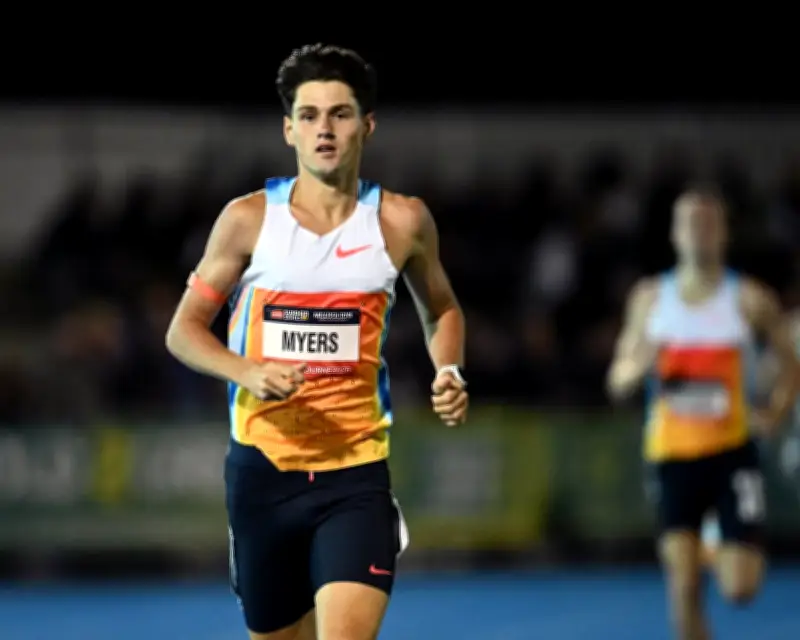
Young star Cameron Myers may be leading the charge this time, but looking back it was teammate Olli Hoare’s stunning 1500m win at Birmingham 2022 that marked a crucial inflection point for Australian athletics. Hoare’s victory ended a 64-year wait for an Australian man to win the Commonwealth 1500m or mile title, with Herb Elliott the last to achieve the feat during Australia’s original middle-distance “golden era”.
Myers has proven almost unbeatable this year and is now ranked world No 1 in the 1500m, making him one of the top contenders in the mile in Glasgow. The 20-year-old from Canberra has rewritten Australian records in the 3000m, 1500m and mile in 2026 so far. His national record-breaking 1500m run at the Paris Diamond League is the world-leading time this year and required beating former world champion Jake Wightman and world championships medallist Reynold Cheruiyot, who are both competing in Glasgow. But Myers’ biggest challenger will be Scotland’s Josh Kerr, who last week broke the longstanding mile world record in London.
Women’s middle-distance strength
The middle-distance contingent is just as strong in the women’s events, led by Hull as she, Abbey Caldwell and Claudia Hollingsworth race to become Australia’s first Commonwealth Games gold medallist over the mile. Hull will double in the mile and 5000m, in which she is the defending champion from Birmingham where Caldwell took bronze. In a boost to the Australian cohort, the current world record-holder in the 1500m and the mile, Faith Kipyegon, has not been named in the Kenya team.
Another athlete eyeing off the podium is Sarah Billings, who has broken through in the past two years after multiple injury setbacks. The 28-year-old was finally rewarded with an 800m Australian record at the Paris Diamond League. Birmingham silver medallist Peter Bol will compete in the men’s 800m, and is back in flying form, having added another Australian record to his name this year in the 1000m.
Broader track and field prospects
Beyond the middle-distance events, Ky Robinson is the newly crowned Australian record-holder in the 5000m, after breaking Craig Mottram’s longstanding record from 2004. He also became the first Australian man to break 27 minutes in the 10,000m at The Ten meet in California in March. Robinson will double in both events in Glasgow.
On the other end of the spectrum at the track, Australia’s sprinters are ready to tear out of the blocks. Torrie Lewis’s preparation could not be any better after the 21-year-old broke her own national record in Slovakia on Wednesday, beating Jamaican great Elaine Thompson-Herah in the process. Edward Nketia, who recently ran the fastest Australian all-conditions 100m time ever, will line up in the 100m alongside Lachlan Kennedy.
Recent results suggest the women’s field events may be a major source of Australian success. Olympic gold medallist pole-vaulter Nina Kennedy is in career best form, having soared to a new Australian record of 4.95m earlier in July. There are two standout medal hopefuls in the high jump – current world champion and Olympic medallist, Nicola Olyslagers, and former world champion and Olympic medallist Eleanor Patterson. Joining the list of contenders are Commonwealth Games silver medallists Brooke Buschkuehl (long jump) and Mackenzie Little (javelin).
Para Athletics and overall depth
Australia’s strength extends to its Para Athletics team, where Angela Ballard (T54 400m, T54 1500m) is poised to make history as the first Australian Para athlete to compete at five Commonwealth Games. Joining her is Rhiannon Clarke (T38 100m, T38 200m), who will be aiming to secure a third Commonwealth Games medal.
The Commonwealth Games may sit below the Olympics and World Athletics Championships in the sport’s hierarchy, but the middle-distance competition in Glasgow will be world-class. Any medal will be hard-earned, but perhaps the biggest takeaway will be the exceptional depth Australia now possesses across track and field – and the promise that holds as Los Angeles 2028 draws closer.