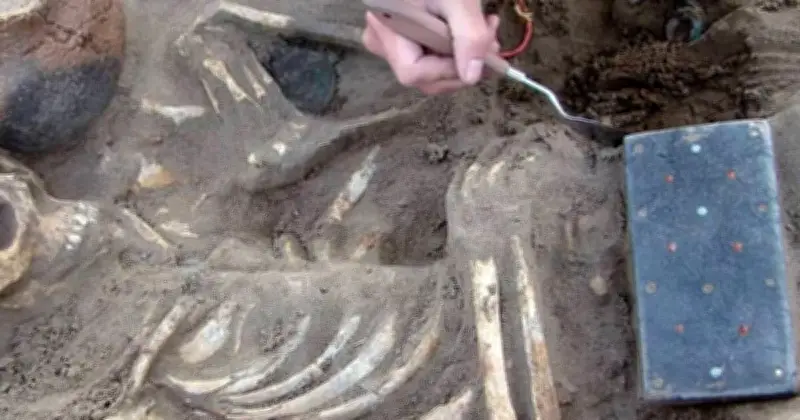
A 2,137-year-old woman was unearthed holding what resembles an iPhone in her tomb beneath Russia's equivalent to Atlantis. The discovery was made after the draining of the Ala-Tey necropolis, near the Sayano-Shushenskaya Dam, Russia's largest power station.
Burial of a Hunnu-era Woman
Experts believe the remains belonged to a stylish young woman from the Hunnu-era (Xiongnu) in rural southern Russia. The object, which looks like an iPhone, is crafted from black gemstone jet with inlays of semi-precious stones, and was likely worn as a belt buckle.
Dr. Pavel Leus, who headed the archaeological team in 2019, told Live Science: "Natasha's burial with a Hunnu-era (Xiongnu) iPhone remains one of the most interesting at this burial site. Hers was the only belt decorated with Chinese wuzhu coins, which helped us to date it."
Details of the Artifact
The buckle measures roughly seven by three and a half inches and features striking turquoise and red decorations. Archaeologists found similar jet buckles in three neighboring graves. The "massive" buckle has holes on the shorter sides, "with the two round holes on one side for fixing the buckle to the belt and one oval hole on the other side, probably for clasping," according to researchers.
Radiocarbon dating indicates the grave's contents date to between 92 B.C. and A.D. 71. The region is Tuva, a mountainous area known for its stunning landscape and a holiday destination regularly visited by Vladimir Putin.
Scientific Significance
Additional graves from ancient civilizations spanning the Bronze Age to the era of Genghis Khan are located nearby. Two other partly-mummified prehistoric individuals, buried with tools of their trade, were discovered in 2019.
Dr. Marina Kilunovskaya from the St. Petersburg Institute of Material History Culture, who heads the Tuva Archeological Expedition, said: "This site is a scientific sensation. We are incredibly lucky to have found these burials of rich Hun nomads that were not disturbed by (ancient) grave robbers."
Researchers are working against the clock to investigate the locations and preserve invaluable artifacts from water damage beneath Russia's Atlantis.