
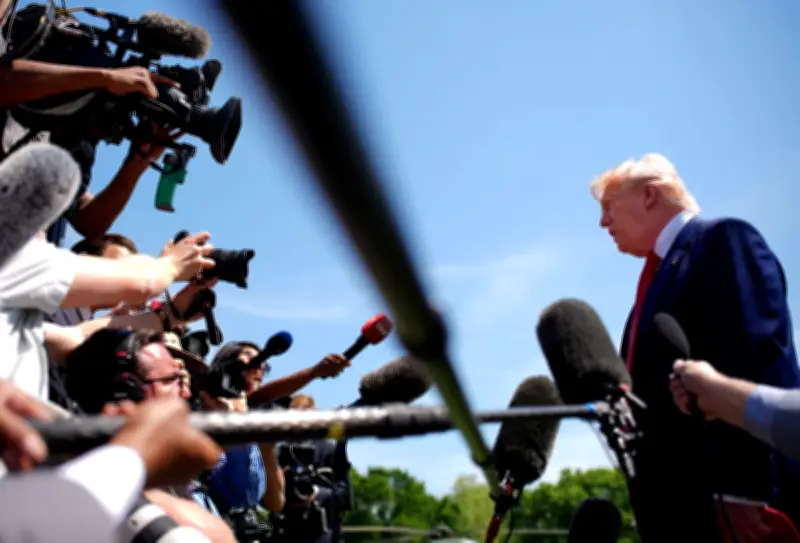
Donald Trump has escalated his attacks on the media to an unprecedented level in the first 17 months of his second presidency, employing a multifaceted strategy that includes lawsuits, regulatory pressure, access restrictions, and subpoenas. However, experts argue that the media continues to produce robust journalism despite these challenges.
Unprecedented Assault on Press Freedom
The Trump administration and its allies have launched numerous lawsuits against disfavored media companies. Networks like ABC have faced regulatory pressure from the Federal Communications Commission (FCC), which has targeted critical coverage. Press access has been curtailed at both the White House and the Pentagon. The administration has also used labor law to pressure the New York Times via an Equal Employment Opportunity Commission lawsuit, which the newspaper decried as “politically motivated.” Most alarmingly for First Amendment advocates, the federal government raided a Washington Post journalist’s home and issued subpoenas—later withdrawn—to Post and Wall Street Journal reporters over national security coverage.
In a significant escalation, the New York Times reported on Friday that five of its reporters received subpoenas to testify before a grand jury in New York. “This brazen act should be seen as nothing more than an attempt to prevent the public from knowing what is happening in their country by intimidating journalists from doing their jobs,” said Times lawyer David McCraw.
Dilution of the Press Corps
Chuck Todd, former anchor of NBC’s Meet the Press, noted that the Trump administration has “successfully infiltrated the press corps” by increasing the prominence of conservative influencers favorable to the president. “They’ve diluted the press corps so that there are essentially fan journalists there, pro-Trump influencers, or whatever you want to call them, who are participating in the pool,” he told the Guardian. “In that sense, I feel like they’ve done a good job of diluting the impact of accountability journalists.”
While networks like CBS News continue high-quality reporting on the administration, skepticism persists due to close ties between company executives and the Trump administration. Trump-aligned owners David Ellison and his father, Oracle billionaire Larry Ellison, have received Department of Justice approval to take over CNN, raising concerns that coverage may be softened to appease the president.
Resilience Amid Instability
Despite the instability, media industry leaders assert that journalism remains strong. Marty Baron, former executive editor of the Washington Post, said, “I think the greatest evidence that the media continues to do its job in holding the government accountable is the fact that this administration is completely obsessed by leaks. There’s been a tremendous amount of really good work even by media institutions that have been portrayed as having yielded to Trump.” He cited daily stories that outrage the administration, prompting extreme efforts to stop leaks.
The FBI raided Post reporter Hannah Natanson’s home in January after critical reporting on US involvement in Venezuela. Her work computer remains in federal custody while a magistrate judge searches for classified information allegedly leaked by a federal contractor. Trump also threatened to sue the Times and CNN over a leaked intelligence report on a bombing mission in Iran, and threatened to jail an unnamed reporter for not revealing a source.
Chilling Effects and Self-Censorship
Baron acknowledged the difficulty of measuring the “chilling effect” of Trump’s actions. ABC, in a July 6 legal filing against an FCC investigation into The View, argued that the commission’s “actions are already chilling speech ahead of the fast-approaching 2026 general election.” However, the company did not provide specific examples. “The question is: what are the stories that we’re not seeing?” Baron said. “We don’t know what stories perhaps have been held back for fear of reprisals by Donald Trump.”
A veteran television journalist, speaking anonymously, said some network executives are wary of attracting Trump’s ire. “It’s pretty clear that the bigger media companies just don’t want to be targets. So I can’t tell you they’re saying, ‘Stand down,’ but it’s pretty clear that they have ratcheted back. They’ve toned rhetoric down,” the journalist said. “I think some of it is just this fear of becoming a target, because the executives don’t want it, because all of these companies can get harassed by the government and Trump has proven that he will use government to punish companies.”
Standing Up to the Administration
Despite these pressures, numerous media companies have resisted. ABC has fiercely challenged the FCC’s investigation into The View and an unusual order requiring early license renewals for its eight local stations. Anna M Gomez, the lone Democrat on the FCC, said, “There’s no question we’ve seen cowardly capitulation, settlements signed under pressure, executives second-guessing their own newsrooms, and hosts pulled off the air to avoid a fight. That is a shameful period of American history with which we will have to spend some time reckoning. But I think the tide is turning. ABC and Disney’s willingness to fight rather than fold shows other broadcasters it’s time to grow a spine and find the courage to do the same.”
The New York Times, led by publisher AG Sulzberger, has shunned appeasement, filing multiple lawsuits to restore Pentagon access and fighting off legal actions. The company has also issued strong statements supporting its reporting when criticized by the administration. However, some media companies have refrained from suing due to cost or fear of appearing adversarial. “It’s a real expensive undertaking, and I think people are concerned about spending their resources,” one media industry lawyer said.
Baron concluded, “We have two and a half more years of this, and the pressure will only get greater. It’s already immense.”




