
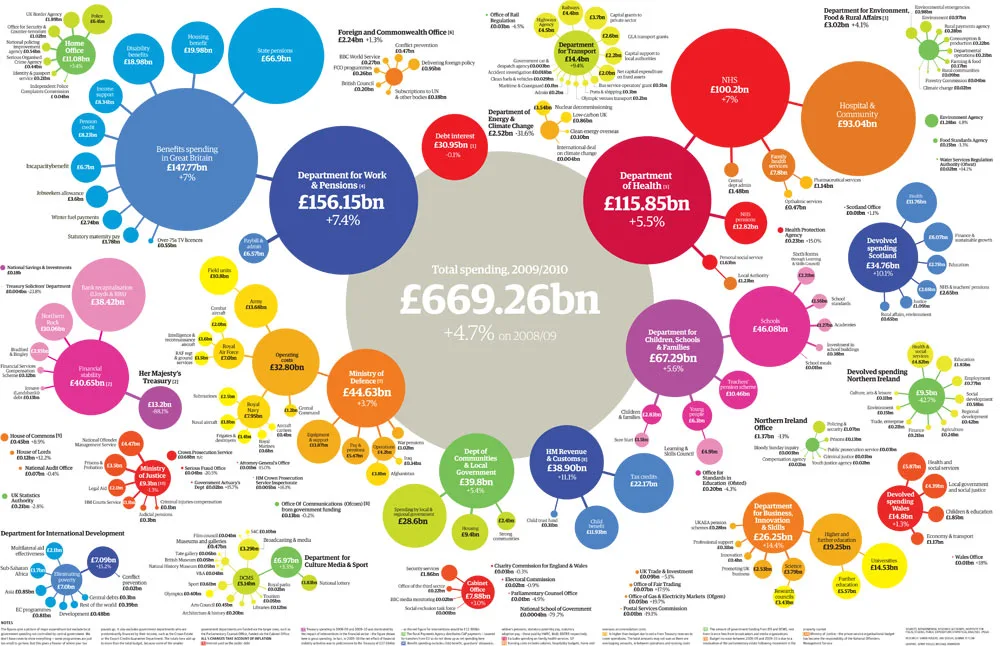
As George Osborne prepares to outline public spending plans in the Comprehensive Spending Review, the Guardian has compiled the most comprehensive atlas of government departmental spending yet, with assistance from the Institute for Fiscal Studies. The total spending by the British government for the financial year ending March 2010 reached £669.26bn, a real-terms increase of 4.7% on the previous year.
The figures, drawn from departmental annual reports and resource accounts, reveal stark variations. The Department for Environment and Climate Change saw its budget cut by a third, while the Treasury’s budget fell by over 80% as bank bailouts began to be repaid. However, more than half the gross bailout money was returned to the government during the year.
The largest spenders remain the Department for Work and Pensions, which administers benefits, and the Department of Health, which allocates around £100bn to the NHS. The data also highlights that for many departments, budgets are merely keeping pace with inflation. The budget deficit for 2010/11 is projected at £110bn.
To understand the figures, departmental spending is split into four categories: Departmental Expenditure Limits (DEL) for capital and resource, and Annually Managed Expenditure (AME) for capital and resource. Summing these gives total departmental spending. Real-terms changes can be calculated using the GDP deflator, as detailed by the IFS.




