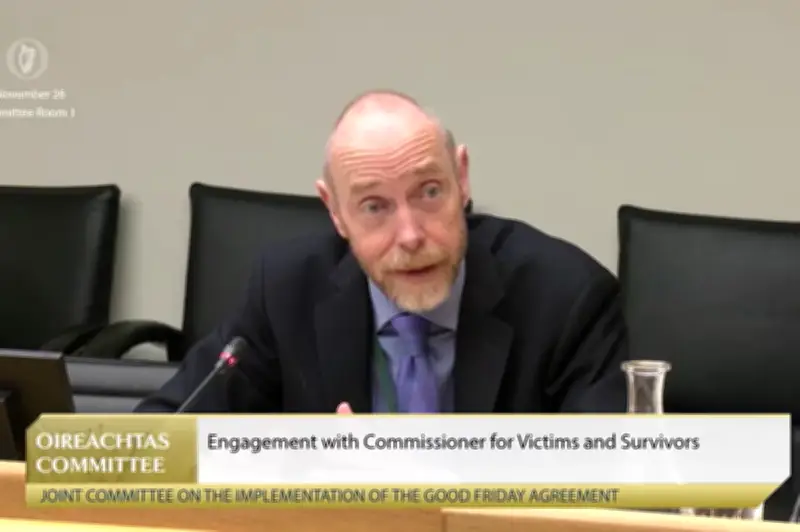
Northern Ireland's victims' commissioner Joe McVey has said people affected by the Troubles have been "betrayed" and "forgotten" by successive governments. He described the debate on the Troubles Bill in Westminster as "terrible" and "toxic" for "pitting veterans versus victims and survivors".
Mr McVey made the remarks before the Oireachtas Committee on the Good Friday Agreement in Dublin on Tuesday, two weeks after MPs in London voted in favour of the Northern Ireland Troubles Bill, which is to go for further scrutiny at the House of Lords.
Legacy framework concerns
Mr McVey described the previous UK Conservative government's 2023 legislation on legacy as "disastrous", adding the Commission had welcomed a new framework on legacy agreed between the Labour Government and Ireland. However, he said this came with a "very strong caveat".
He said: "We wanted to see what the detail was, what the amendments were, and also being very mindful if the Troubles Bill doesn't go ahead and the legislation doesn't progress here, where are we 30 years on? That's a big concern."
Mr McVey was responding to Sinn Féin senator Conor Murphy, who said the British Government's focus in the Troubles Bill "appears to be entirely in relation to veterans". Mr Murphy added: "Clearly and not surprisingly, there is significant disquiet from victims' organisations about the direction of travel. The British Government have not been hiding behind a rock in terms of telling you where their priorities are in relation to this."
Veterans as victims
Mr McVey said: "In our view, veterans can also be victims and survivors, and we also think the very well-funded lobby in Westminster to focus on certain veterans ignores the lived experience of veterans in Northern Ireland, and by that I mean people have served in the RUC, PSNI, and UDR, etc.
"Sometimes that whole argument I think gets completely overplayed, both at Westminster and in the British media. That's something we were very disappointed about. As the Bill has progressed, I have to say those concerns remain."
He added: "I think the 150-odd amendments which were proposed two weeks ago, I think caught people by surprise. One, because there were so many of them but secondly, I think the focus seemed to be in veterans."
Mr McVey said there needs to be "a recalibration that the debate focuses much more on clauses that are victim-centred and truly victim-centred that also gives protections and support to all victims and survivors, rather than unfortunately setting one group up against the other".
Prosecutions and future framework
Mr Murphy also criticised the proposed "imposition" of the UK Attorney General into deciding whether serious prosecutions related to the Troubles should go ahead. Mr McVey said many victims groups had raised concerns around the matter as potentially "contrary both to the spirit and to the law" of the Good Friday Agreement.
He said: "My reading of that and in conversations we've had with the Secretary of State was very much to say this might gain support from the veterans lobby, and I think in doing so the danger is that you then again appear to be creating a hierarchy, and that's not something we would approve of at all."
The commissioner said the next two years leading to the 30th anniversary of the signing of the Agreement are an opportunity to establish a legacy framework that is transformative for victims. However, he added: "It's also important to balance that optimism with the reality that victims and survivors have been let down, have been betrayed, ignored, and forgotten by successive governments. I think it's imperative on this Committee to ensure that that doesn't happen again."
Mr McVey said the "golden thread" that emerged through all discussions with victims and survivors is that they want mechanisms to be legal, independent, transparent, and fair.