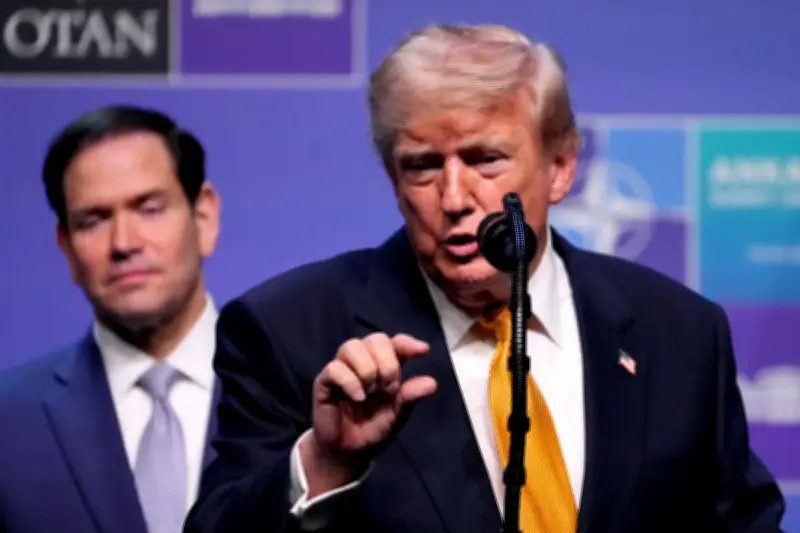
Deputy Prime Minister David Lammy has said Donald Trump’s renewed threats over Greenland feel “rhetorical rather than real”. The US president reignited a major diplomatic row on the eve of the Nato summit this week by insisting that the US should control Greenland, which belongs to Denmark, and suggesting America could pull all of its troops out of Europe in retaliation.
Trump's Conciliatory Tone at Summit
Mr Trump struck a conciliatory tone at the end of the summit in Ankara, Turkey, saying fellow alliance members were “answering the call” on military funding. He then said a “deal on Greenland” would play a key role in any decision about US troop numbers in Europe as he spoke to reporters on board the new Air Force One on his way back.
Mr Lammy told a conference on international affairs at Chatham House in London there has been “phenomenal co-ordination” across “middle power countries” such as Canada and Australia to press shared interests, referring particularly to the coalition of the willing on Ukraine and the multilateral mission for the Strait of Hormuz.
Lammy's Remarks on Middle Power Coordination
He said: “What you realise as a middle power is that if you are together you can become a superpower as it were… and so I think that was done to tremendous effect in relation to our views on Greenland and its sovereignty. And I think you did see the United States back off, although I think there has been, of course, a reassertion in the last 24 hours. But it feels rhetorical as opposed to real. And often I think we are making it clear to the United States that what we believe is in its own interest.”
Mr Trump has made conflicting comments on troop numbers in Europe, suggesting 5,000 would be sent to Poland weeks after saying a similar number would be removed from Europe. Speaking on Air Force One, he said: “I haven’t made that final determination. A lot’s going to depend on Greenland.” He said “a very good deal on Greenland” would play a key role in any decision on troops.
Positive Outcomes and Defence Spending
He also praised Spain, having earlier criticised the country’s refusal to commit spending of 5% of gross domestic product. Spain “came all the way back today” and was “very generous”, Mr Trump said, adding the country “honoured a request of lots of payment”. “The meeting today settled a lot of things,” said the president, rejecting suggestions that he would not attend further Nato summits.
As the summit concluded, he said fellow alliance members were “answering the call” on military funding while urging them to speed up planned rises in defence spending to meet a Nato target. Outgoing Prime Minister Sir Keir Starmer faced domestic criticism for failing to set out a clear path for reaching the goal in last week’s defence investment plan (Dip).
On progress being made by countries to reaching the 5% target, Mr Trump said: “Some have truly answered the call, and others are making big changes, and will be answering the call. I think I can say, in all cases, they’re going to be answering the call. I urge all nations to accelerate their plans to get the benchmark as quickly as possible.”
No Confrontation with Starmer
Suggestions that Mr Trump might confront Sir Keir about the absence of a clear path to reaching the target in last week’s Dip did not materialise, according to the Prime Minister. “I had no discussion with Donald Trump in which he made any issue with me in relation to the defence spending for the United Kingdom,” he said. He insisted he had “always got on” with the US president, even after facing repeated criticism from him.
The Prime Minister told reporters: “At the end, President Trump summed up and said that he was very pleased and welcomed the spirit of the meeting and the unity of the meeting. And therefore, in terms of what’s the outcome here, and answering that question, ‘Is Nato stronger and more united coming out this summit?, then the answer is yes to that.”