House Speaker Johnson Maintains No US Boots on Ground in Iran Despite Military Buildup
House Speaker Mike Johnson continues to assert that the United States is not engaged in a formal war with Iran, despite substantial military deployments that suggest otherwise. This stance comes as Republicans grapple with internal divisions over President Donald Trump's escalating military strategy in the region, creating significant political tension within the party.
Military Deployment Without Official War Declaration
While lacking an official declaration of war, President Trump's military operations in Iran are increasingly resembling a full-scale conflict. Recent reports confirm the Pentagon will dispatch members of the U.S. Army's 82nd Airborne Division to the region. White House Press Secretary Karoline Leavitt issued a stark warning, stating Trump was prepared to "unleash hell" if Tehran refused to negotiate.
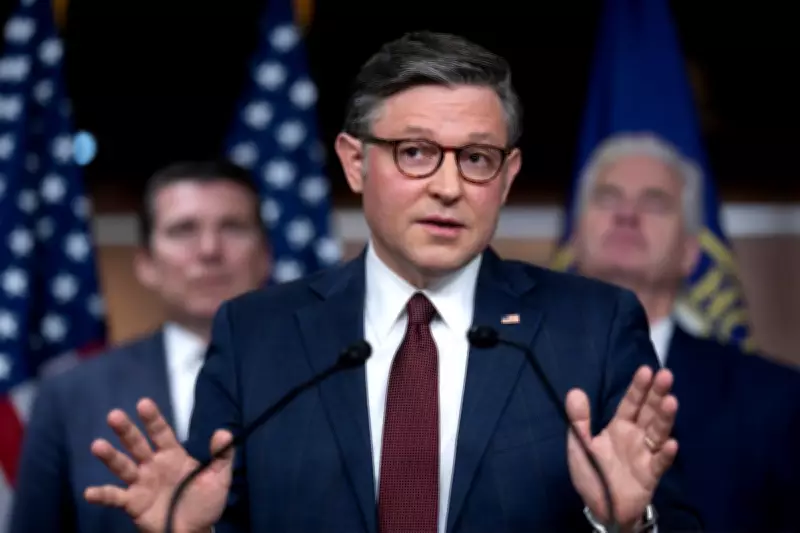
Despite these developments, Speaker Johnson and Senate Republicans maintain their position. The Senate recently voted down another War Powers Act resolution aimed at compelling Congress to restrain the Trump administration's actions in Iran. Johnson remained evasive when questioned about the situation during his weekly press conference.

"The build up of troops is very different than boots on the ground," Johnson told The Independent. "We don't have boots on the ground. I don't think that's the intention, but I think Iran should watch that build up, and they need to take note of that."
Growing Public Opposition and Republican Divisions
Public sentiment strongly opposes further military engagement in Iran. An Associated Press-NORC poll reveals that 59 percent of Americans believe the conflict has gone too far, with 63 percent of independents sharing this view. Additionally, 62 percent of Americans oppose deploying U.S. ground troops to Iran.
This public discontent is mirrored within Republican ranks. Representative Lauren Boebert of Colorado expressed skepticism about troop deployment reports, stating, "I'm told that that's not real, so I haven't been personally briefed on that. I don't want boots on the ground." Boebert represents the isolationist wing of the Republican Party, alongside former Representative Marjorie Taylor Greene.
Even as Johnson advocates for supplemental funding to support military operations and replenish armament stocks, Boebert has publicly opposed such spending packages, highlighting deepening internal rifts.
Congressional Criticism and Legislative Challenges
Representative Nancy Mace, a former Trump critic turned supporter now running for governor of South Carolina, voiced strong objections after a House Armed Services Committee hearing. "The justifications presented to the American public for the war in Iran were not the same military objectives we were briefed on today," she stated on social media. "This gap is deeply troubling. The longer this war continues, the faster it will lose the support of Congress and the American people."
Mace has also criticized Senator Lindsey Graham for his aggressive rhetoric, reviving longstanding political tensions between them. Both Republican women have occasionally broken with Trump while maintaining overall support, notably when they signed a discharge petition to release files related to Jeffrey Epstein.
Representatives Ro Khanna, a Democrat from California, and Thomas Massie, a Republican from Kentucky, are now pushing for another War Powers Act resolution. Khanna expressed confidence in gaining additional Republican support, noting, "I think we could get some Republicans, especially. President refuses to rule out ground troops. There are a number of Republicans made that clear, that's their red line."
Democratic Outrage and Political Consequences
Democrats have grown increasingly frustrated by the lack of open hearings regarding the Iran conflict. Representative Maggie Goodlander of New Hampshire, a former Navy Reserve intelligence officer, emphasized, "I think that this administration should be accountable and answering to the American people. War should not be conducted in secret. War should not be conducted with blank checks."

Senator Chris Murphy, a leading voice against the war, condemned Trump's approach, stating, "Trump is making this up on a day to day basis. It is costing Americans billions of dollars, and the costs are just going to continue to go up."
The conflict's growing unpopularity, combined with Johnson and Senate Majority Leader John Thune's reluctance to constrain Trump, may jeopardize the Republican majority. A Quinnipiac poll indicates Democrats hold an 11-point advantage in voter preference for House control. Johnson frames the 2026 midterms as a "Contrast for America," but the election may instead serve as a referendum on unchecked presidential power.