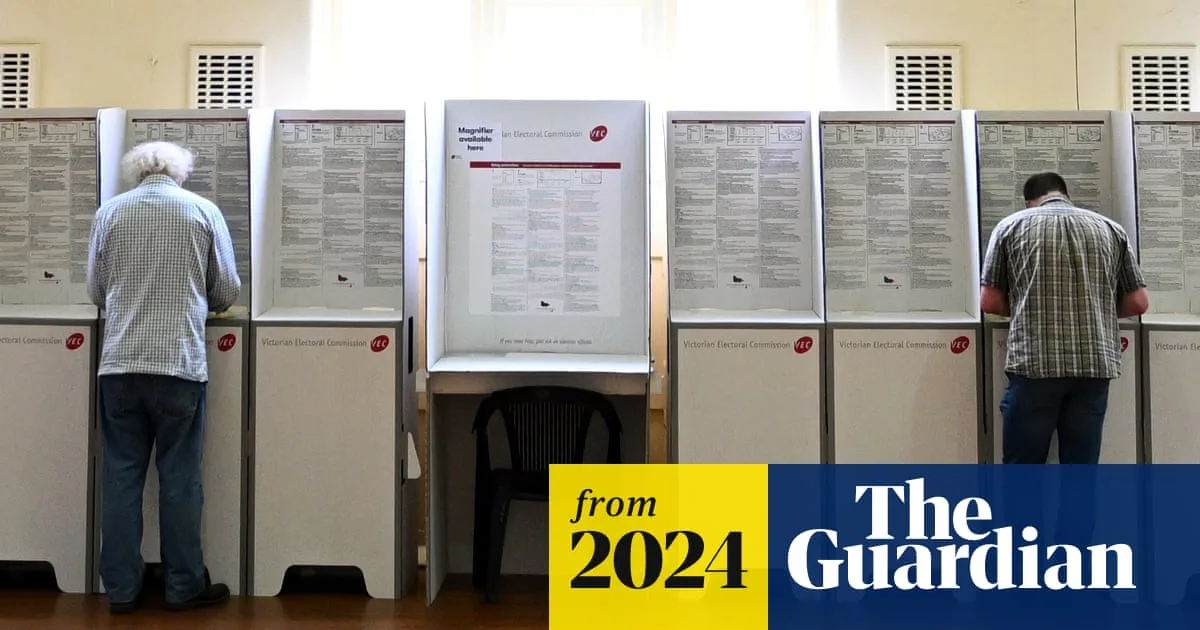
Victoria's Broken Voting System: How Group Voting Tickets Distort Democracy
Victoria's Flawed Voting System Faces Scrutiny

Victoria's electoral system for its upper house is broken, with a unique mechanism that allows candidates with tiny vote shares to leapfrog popular rivals and win seats. The state stands alone in Australia by retaining group voting tickets (GVTs) for its Legislative Council elections, a practice critics argue subverts the will of the people.

The Flawed Mechanics of Group Voting Tickets

Under the GVT system, voters can mark a single preference for a party above the line on their ballot paper. The critical flaw emerges if that party is eliminated during the count. The party itself, not the voter, then decides where those preferences flow. This is starkly different from voting below the line, where the voter directs their own preferences.

The counting process works in rounds. If no candidate reaches the required quota in a round, the candidate with the fewest votes is eliminated. Their votes are redistributed according to the voter's below-the-line preferences or, crucially, according to the party's predetermined ticket if the vote was cast above the line.

This system has long been exploited. Backroom preference deals, orchestrated by figures like political strategist Glenn Druery, have enabled little-known candidates to overtake rivals with ten times their initial support. The most egregious example came from the 2018 state election, where the system's distortions were laid bare.

The Consequences: A Parliament Not Reflecting the Vote

The central issue is that as smaller parties are eliminated, their preferences flow to each other through pre-arranged deals. This can quickly accumulate, allowing them to overtake candidates from major parties who received far more direct voter support. Consequently, major parties can win fewer seats than their vote totals suggest, while minor parties can secure seats from extraordinarily low primary votes.

Greens MP Tim Read, the party's integrity spokesperson, states that 20% of Victoria's upper house in 2018 was effectively chosen via a "financially arranged cartel system." He argues this had serious implications during the Covid-19 pandemic, with the balance of power held by members "more answerable to Glenn Druery than they are to Victorians."

David Davis, the Liberals' leader in the upper house, also opposes the exploitation of GVTs, warning of "perverse results" that do not reflect voter intention.

While counter-tactics by progressive parties blunted Druery's influence in the 2022 election, the GVT system remains in place, ready to be exploited again in 2026.

The Push for Reform and Political Roadblocks

Change may finally be on the horizon. A government-led electoral matters committee, in its review of the 2022 poll, has again called for GVTs to be scrapped. A separate inquiry, led by Labor MP Dylan Wight, has spent months considering six potential replacement models and is due to deliver its final report imminently.

However, significant hurdles remain. Almost all proposed changes would require a referendum, which key figures believe is unlikely before the November 2026 state election. Labor sources suggest the most likely scenario is legislation to scrap GVTs in early 2026 while keeping the current upper house structure.

This plan faces fierce opposition from crossbenchers whose power derives from the current system. Legalise Cannabis MP Rachel Payne calls scrapping GVTs without broader reform "self-serving," likely only saving Labor and Liberal MPs. She argues true proportional representation requires scrapping the upper house regions altogether.

Animal Justice Party MP Georgie Purcell agrees, warning that reform "in the wrong order" would be "fundamentally terrible for democracy." The government relies on these crossbenchers' votes, making reform a delicate political manoeuvre.

The government has added a parliamentary sitting week this year while scheduling fewer next year, potentially bracing for a frosty reception from the crossbench. Libertarian MP David Limbrick bluntly warned that if GVTs were removed simply, minor parties would "make the lives of the major parties as miserable as possible until November 2026."

The debate over Victoria's upper house voting system is ultimately a struggle over democratic legitimacy, pitting the simplicity of a single vote against the complex, and often hidden, machinery of preference distribution.




