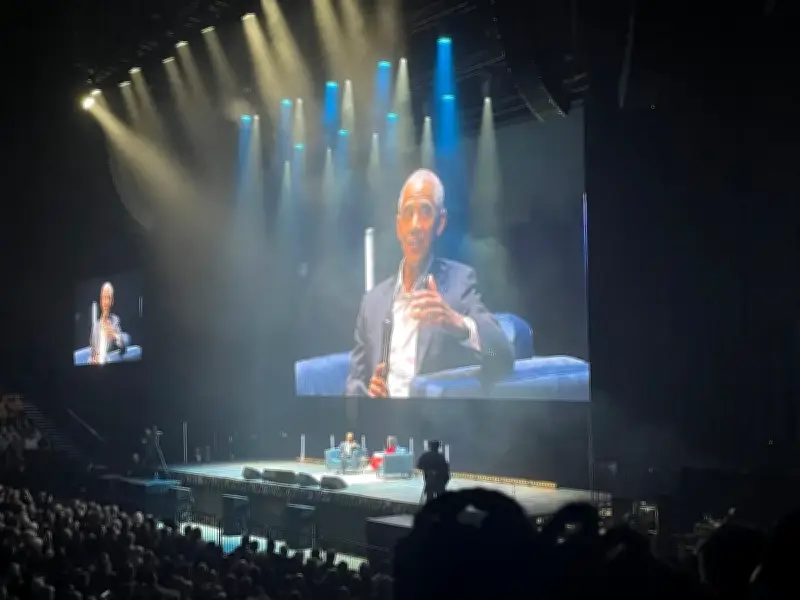
Barack Obama told a Manchester audience last night that while there are plenty of arguments we can have, arguing about facts cannot be one of them. The former US President spoke candidly about what he believes to be 'one of the biggest dangers of our time' – misinformation.
His speech covered cat videos, a breakdown in social trust and the challenges of solving a problem that is growing in the public consciousness. It also came with a few perhaps not so subtle digs at his successor in the White House, President Donald Trump.
Obama at Co-op Live
The former president was at Manchester's Co-op Live Arena for one night only as part of his A Conversation With tour, with yesterday's event hosted by writer and broadcaster Afua Hirsch. The discussion was witty, thought-provoking and incisive, delving into the difficulties facing the world today and the hope that perhaps tomorrow can be better.
'One of the biggest dangers we face'
Perhaps the most serious topic of the night was what the former President described as a 'splintering' of information, driven in a large part by social media. Mr Obama said this is 'one of the biggest dangers that we are facing right now', adding we 'have not figured it out'.
The problem, he believes, comes from a shifting of priorities among those in charge of the online world from speed and accuracy to the revenue they gained from ads, which in turn moved focus engagement.
“It turns out that a lot of what keeps you hooked is anger, resentment, fear, along with lust and cat videos,” Mr Obama said. “It's an interesting map of the human brain. So we all became trapped in our silos.”
He added: “It's a hard nut to crack because one solution is to control what is on the internet. Obviously China does that and now you have state control and that has its own dangers. So, the medicine may be worse than the disease.
“On the other hand, it is very hard to function in any kind of democracy if we don't have an agreement on the basic baseline of facts. We can have 1,000, 20,000, 100,000 opinions about stuff, but if we can't agree on basic facts like, you know, vaccines prevent diseases and have been really useful, or the planet is getting warmer…
“We can argue about how to respond [to these issues]. We can still have a lot of arguments, but we can't have arguments about facts, about what happened, about what's true and what's false.
“What ends up happening is that we can't debate each other if we are denying just basic things that are provable. What ends up happening is we think each other are all crazy, we lose social trust, we stop believing that the other person is operating in good faith. I think what we are going to have to do is find ways to rebuild social trust, validation, authority, belief in facts.”
Stories and social trust
During the hour-and-a-half event, Mr Obama touched on America's responsibilities as a global superpower, praised Andy Burnham's renewed commitment to Ukraine, and discussed his young age when he entered the White House which he said gave him a better ability to relate to the problems people were facing and them to him.
He also repeatedly returned to the theme of stories, saying he is a big believer in their power. He and Michelle Obama, whom the former president described as his 'better, funnier and cuter' half, frequently release lists of books they have enjoyed.
However, the former president said he believes one of society's current crises is 'a loss of faith in the stories that we're told', in stories that are 'unifying' and 'hopeful'.
He added: “I try to lift up stuff that tells a particular story that is close to me, that is a story that says we are wildly different and specific in our experiences and our traditions and our roots and our families and traumas, and we are deeply connected in so many ways.
“Stories that tell us that. Stories that remind us of that, that we pass on to our children so they can walk through Manchester with all its diversity and feel like 'you know what, I know that person and I understand them and I trust them and I'm not fearful because they are part of me in some way. I can relate.'”
“When I give advice now to younger politicians who are coming up and I tell them 'if all you are doing is reciting facts and 10 point plans, you are missing the point'. We need governments that can execute policy and 10 point plans, but we also need political leaders who can tell a story about why we should want to work together and why we should care for each other.”
Obama hails 'wonderful' Manchester stance
Mr Obama used his final words to pay homage to a small piece of Manchester's own history – the refusal of local cotton workers to touch US cotton picked by slaves during the American civil war.
Answering a question on his new initiative the Presidential Centre, he said: “We are reminding people of what's possible, how change gets made. It begins with the Declaration of Independence, and the suffragette movement, the civil rights movement, the abolitionist movement and what it does is it reminds us that we are part of this ongoing story.
“That is where you get hope from, it's just reminding ourselves that as frustrating as the moment feels now, we've been through worse. We've managed to get through it and not only get through it but make things better.
“I was reminded, being here in Manchester, of just this wonderful story of the cotton workers here in Manchester during the American Civil War. At a time when their livelihoods depended on cotton [...] a bunch of British, working class workers who are hungry and not sure if they are going to be able to hold things together, they sit there and they collectively say 'we are going to stand with those who are fighting for freedom, even though it is going to cost us'.”
He concluded: “I think if we can tell each other those stories and pass them to our children and our grandchildren, we'll get through these times too.”
The former President left the stage to thunderous applause and the refrains of Bruce Springsteen's Land of Hope and Dreams, waving goodbye to an audience that was perhaps a little more hopeful for the future and a little more thoughtful about how we might go about building a better one.