Inside Snooker's Chinese Match-Fixing Scandal: Threats, Bets and Guilty WhatsApps
Inside Snooker's Chinese Match-Fixing Scandal (01.05.2026)

At around 8am on 28 September 2022, just hours before his second-round match at the British Open, the talented 20-year-old Chang Bingyu received a phone call. It was experienced fellow player Liang Wenbo, warning that bad people had placed substantial bets on Chang to lose the game 4-1. Liang promised Chang £6,000 for the exact result and threatened consequences if he did not comply. Chang, who knew Liang well enough to be terrified, went along with the plot, though he never received any money. Welshman Jak Jones had no idea his 4-1 victory that night was orchestrated by his opponent.

Months later, as Liang's extensive web of deceit began to unravel, a man knocked on Chang's door. It was the day before Chang was due to be interviewed by investigators. The man claimed to be a friend of Liang and led Chang to a car to talk, where he warned him not to utter a word about match-fixing to snooker's authorities. Chang was unnerved by Liang's cue lying on the back seat. This was Liang's modus operandi: intimidating young targets into throwing frames and manipulating results. He had a reputation for violence, having been convicted of attacking a woman on the streets of Sheffield in 2021. On the surface, the Chinese match-fixing scandal might have seemed like a parable of greed. In reality, it was a story of fear.

A Perfect Breeding Ground for Sin

Sheffield's Chinese snooker community was the perfect breeding ground for such misconduct. The group consisted mostly of men in their early twenties who spoke little English and felt lonely and isolated when the Covid pandemic prevented them from returning to China to see friends and family for two years. Several trained at the renowned Ding Junhai and Victoria snooker academies, near the Crucible Theatre they dreamed of conquering. They would sit around sharing meals, playing cards, and gambling online. Most of the players caught in the scandal endured financial difficulties: during his interview with investigators, Chang revealed he had less than £100 in his bank account.

Wide Pickt banner — collaborative shopping lists app for Telegram, phone mockup with grocery list

Some players rejected Liang's approaches, like Cao Yupeng, who had already served a two-year ban for match-fixing and did not want to be lured back in. Cao resisted, and when his wife saw Liang's messages, she replied angrily, demanding he leave her husband alone. But others were swept up in the grift, enticed by money and too terrified to back out. Their fear was not only for their own safety but for their families at home in China. 'People in the West don’t understand,' Chang's childhood coach, Roger Leighton, recently told The Independent. Leighton has been living and working in China for 30 years. 'People can go missing off the streets here and nothing will be done about it.'

The Architect and His Right-Hand Man

If Liang, once ranked No 11 in the world, was the architect of the scam, Li Hang was his right-hand man. Li was a talented poker player and a compulsive gambler, and young players would often go to him to place bets on snooker. Li was like a big brother to many of the Chinese players arriving in the UK, and he exploited their trust to fix matches. Their scheme spread far and wide, involving middlemen as well as the players themselves. They targeted low-level ranking events and qualifiers, right up to a match at one of snooker's prestigious triple crown tournaments, the UK Championship.

But Li and Liang were not a very effective duo. Li wanted their crimes to be carried out with care and discretion, while Liang wanted to reap as much money as possible. They conducted planning on WhatsApp, and their four-figure wagers on specific outcomes of mostly obscure sporting events caused ripples in the betting markets. During the autumn of 2022, the data company Sportradar was alerted by suspicious betting patterns and contacted the World Professional Billiards and Snooker Association (WPBSA). At around the same time, the WPBSA also received information from an anonymous whistleblower.

Pickt after-article banner — collaborative shopping lists app with family illustration

As the WPBSA began investigating, Liang and Li tried to cover their tracks. They deleted messages on their phones and demanded the players they had recruited do the same. Liang sent his friend to intimidate the young Chang at his house. He failed to turn up to three interviews with investigators, refused to submit bank statements to their inquiry, and emailed them to claim he had been framed by Chang. But by now the scheme had been blown open, and they could not shut the box. The hearings were not straightforward: some witnesses spoke limited English and some were evasive. Li's lawyer effectively accused the entire commission of racism. However, several players quickly admitted their involvement, gave oral evidence, and handed over incriminating WhatsApp conversations, including one message from Liang explicitly asking Cao to lose three frames in his next match.

The Fallout and Aftermath

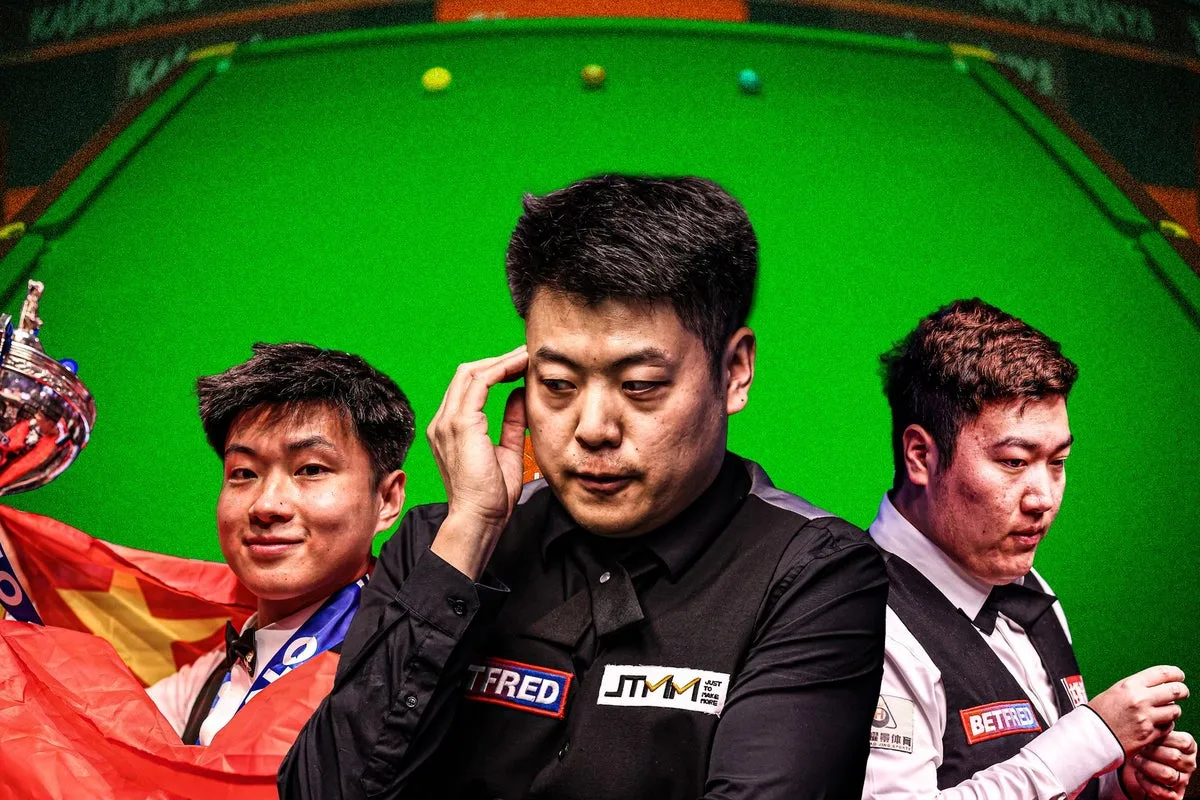
One of those was Zhao Xintong, the only player among the 10 sanctioned who did not fix a match. He placed bets for his close friend Yan Bingtao after trying to persuade Yan to walk away from the situation. Zhao was banned from snooker for 20 months, reduced from 30 months due to his early admission of guilt and 'genuine remorse'. He returned to snooker in September 2024 and won the World Championship at the Crucible eight months later. His friend Yan also had the snooker world at his feet after winning the 2021 Masters aged 20, becoming the youngest player to win the prestigious tournament since Ronnie O'Sullivan in 1995. Yan was banned for five years and cannot return until December 2027. Others, like Chen Zifan and Lu Ning, are also serving long bans.

Other players have done their time, such as Bai Langning, Zhang Jiankang, and Zhao Jianbo, who was the youngest of the group when he was sanctioned by the WPBSA aged 19. However, they have not returned to the professional game. Cao Yupeng, the player whose wife rejected Liang's advances, now makes a good living playing Chinese billiards.

Chang was the second youngest involved and, like world champion Zhao Xintong, he has made a successful return to snooker after admitting his mistakes. His ascent has been more gradual than Zhao's but he is closing in on the world's top 50, and he is about to land the biggest cheque of his life: although Chang did not make it through to this year's World Championship at the Crucible, he hit a 147 break in qualifying and stands to win £172,000 for the feat. He will not need to worry about having £100 in his bank account any more.

Liang and Li were each fined £43,000 and banned for life. The Independent has been told Liang is coaching kids at a club somewhere between Shanghai and Beijing. Liang was described in the commission's report as 'particularly disgraceful' for threatening a number of 'young and impressionable' players to fix matches for his own financial gain. Li's behaviour was described as 'utterly unacceptable'. Together, they were the rotten core at the heart of the biggest scandal in snooker history.