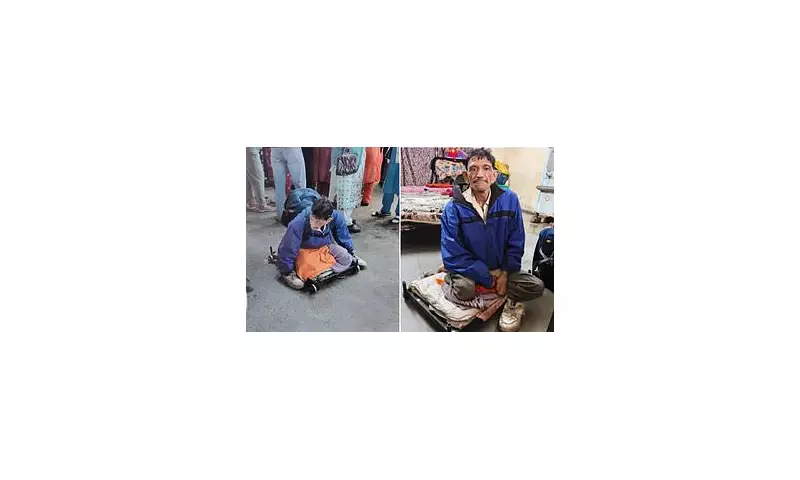
In a startling revelation from India, officials attempting to help a vulnerable beggar with leprosy off the streets uncovered that he is actually a property millionaire, owning multiple assets and running a lending business. The case has sparked significant controversy and raised serious questions about welfare fraud and the effectiveness of anti-begging campaigns.
The Familiar Face at Sarafa Bazaar
For years, a 50-year-old man known only as Mangilal has been a familiar sight at the Sarafa Bazaar in Indore. Unable to walk due to his condition, he would sit cross-legged on a small wooden platform fitted with wheels, using it to slowly manoeuvre himself around the area. To avoid scraping his hands on the pavement, Mangilal kept them tucked inside a pair of shoes as he moved.
Despite his apparent plight, he never approached passersby or held out his hand, instead remaining silent and still in the same spot. This behaviour made his situation appear more desperate and genuine to onlookers, contributing to his ability to collect alms without raising suspicion.

Intervention and Unravelling Truth
The image of a destitute beggar unravelled completely when local officials intervened as part of a drive to remove vulnerable people from the streets. After Mangilal was taken in, given a shower, and provided with clean clothes, routine checks revealed an astonishing reality.
Shivam Verma, the district magistrate of Indore, stated: 'My colleagues pushed him a bit and they found he owns a three-storey house, a second house, and a flat that was given to him by a government welfare programme, where he lives with his parents.'
Assets and Business Ventures
Further investigation uncovered that Mangilal also owns a car and several auto-rickshaws, all of which are hired out for regular income. During questioning, he admitted that the money collected from begging was not spent on survival but was instead invested back into the Sarafa area.
He operated a lending business, providing cash to local traders for a day or a week and charging interest that he personally collected every evening. This sophisticated financial activity placed him firmly in the millionaire bracket in Indian rupees, starkly contrasting with his public persona as a helpless beggar.
Legal and Welfare Implications
Verma emphasised the legal stance, noting: 'Both begging for alms and giving alms are a crime in Indore. Our purpose is to help them lead an honourable life.' Officials are now investigating how much money Mangilal has in bank accounts, with the first step being to strip him of the welfare flat provided by the government.
The discovery has added an unexpected chapter to Indore's anti-begging campaign, launched in February 2024. An official survey identified around 6,500 beggars in the city, with efforts so far resulting in 4,500 giving up begging after counselling, 1,600 being rescued and sent to rehabilitation centres, and 172 children enrolled in schools.
Family Reaction and Ongoing Scrutiny
As news of Mangilal's wealth spread, his family became alarmed. His nephew claimed: 'There has been some misunderstanding. False claims are being made about his properties.' However, officials remain firm in their findings, highlighting the need for thorough verification in welfare programmes.
This case underscores the complexities of addressing begging in urban areas, where genuine need can be obscured by individuals exploiting sympathy for personal gain. It also prompts a broader discussion on the mechanisms for detecting fraud and ensuring that aid reaches those truly in desperate circumstances.