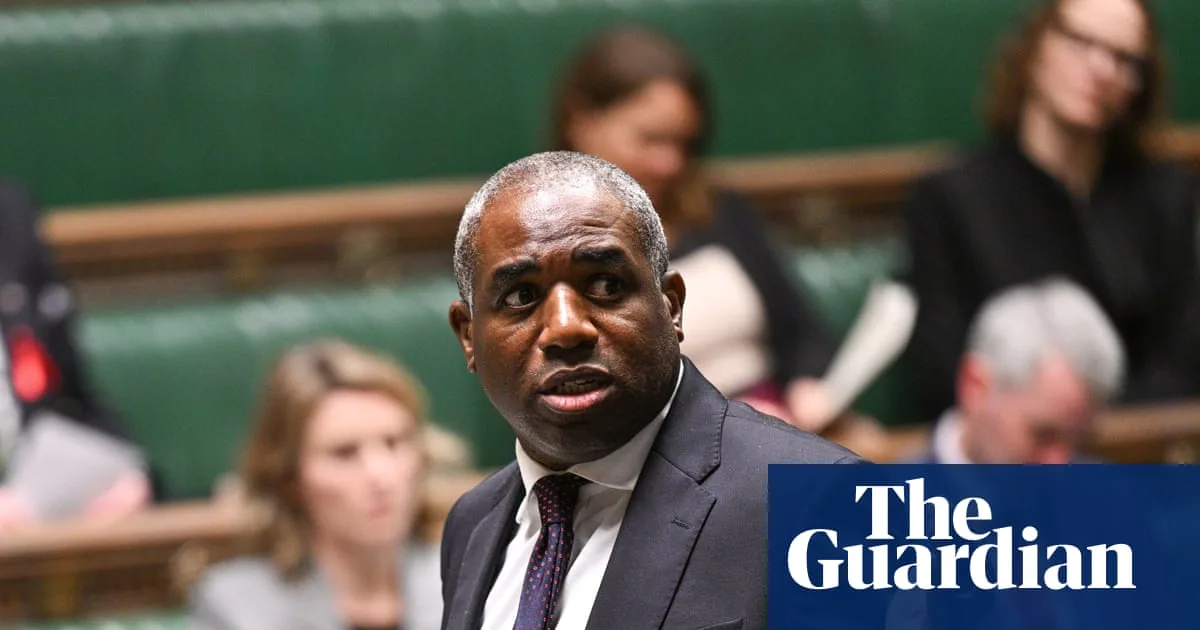
For the technicians in Downing Street, it was another day of malfunction and misfire. Their latest political projectile, the hypersonic 'Lammy', was fitted to the launch pad, fuelled, and the countdown began. At ignition, a roar and heavy vibrations promised a successful trajectory. Then, a sudden deviation, a puff of oily smoke, and a disastrous loop-the-loop before the entire apparatus spectacularly exploded.
A Policy Launch Goes Awry
Justice Secretary David Lammy's mission was to promote a significant and controversial brainwave: cutting back on jury trials to unclog the courts. His media tour on morning television and radio, however, was swiftly derailed. Presenters were more interested in the crisis in Britain's prisons, forcing a hapless Lammy to admit that two more convicts had escaped and remained at large.
Undeterred, Lammy proceeded to the House of Commons to deliver a parliamentary statement. The expectation that Labour MPs would rally behind the policy evaporated instantly. Instead of cheers, he faced a phalanx of opposition from his own benches. Several made their disdain abundantly clear, with one implying they would rather endure extreme personal discomfort than support the plan.
In a bid to bolster his case, Lammy claimed the Victims' Commissioner supported the proposal. This proved to be a catastrophic error. A Tory MP promptly rose on a point of order to inform the chamber, to audible shock, that the Victims' Commissioner had, in fact, passed away several weeks prior.
Opposition Attack and Internal Turbulence
Shadow Justice Secretary Robert Jenrick seized the moment. He highlighted Lammy's past as a 'proud defender of jury trials' and challenged him with the quip, 'Will the real David Lammy please stand up?' Jenrick, described as having lost some physical bulk, nonetheless delivered a combative performance, marvelling that 'the Lammy dodger' had finally appeared in person and comparing him to the infamous King John.
More problematic for the government than the opposition's jibes was the significant turbulence on its own side. Veteran MP Diane Abbott quoted the pro-jury principles of none other than Sir Keir Starmer himself, made before he became Prime Minister. Clive Efford expressed fear that entrusting more verdicts to 'posh judges' would foster damaging 'us and them' antipathy.
Richard Burgon delivered a pointed warning, noting that no government should assume perpetual power. He questioned what would happen if a party like Reform won office and changed the laws, asking whether Lammy might not then yearn for the protection of juries. A host of other Labour MPs raised further objections, though none suggested simply asking well-paid lawyers to stop wasting court time.
The Foundation of the Flawed Proposal
Lammy defended the plan, arguing that the trial of an alleged bicycle thief could take two days where two hours might suffice, and lauding Britain's 'world-beating judges'. This prompted fellow minister Sarah Sackman to nod vigorously, before observers noted she is married to a judge.
The proposals stem from a report by Sir Brian Leveson, hailed as 'one of the foremost judges of his generation'. The report is notably substantial, and Sir Brian is reportedly only halfway through his 'golden deliberations', though the cost to the taxpayer for his time was not disclosed.
The session concluded with a surreal moment as Debbie Abrahams announced a peace vigil for International Human Rights Day and invited Foreign Office ministers. Handsome junior minister Hamish Falconer gulped and promised to do his 'utmost' to attend, adding treacherously that he was sure other ministers would too—a commitment that earned him a filthy look from Home Secretary Yvette Cooper, underscoring a day of profound political discomfort for the government.