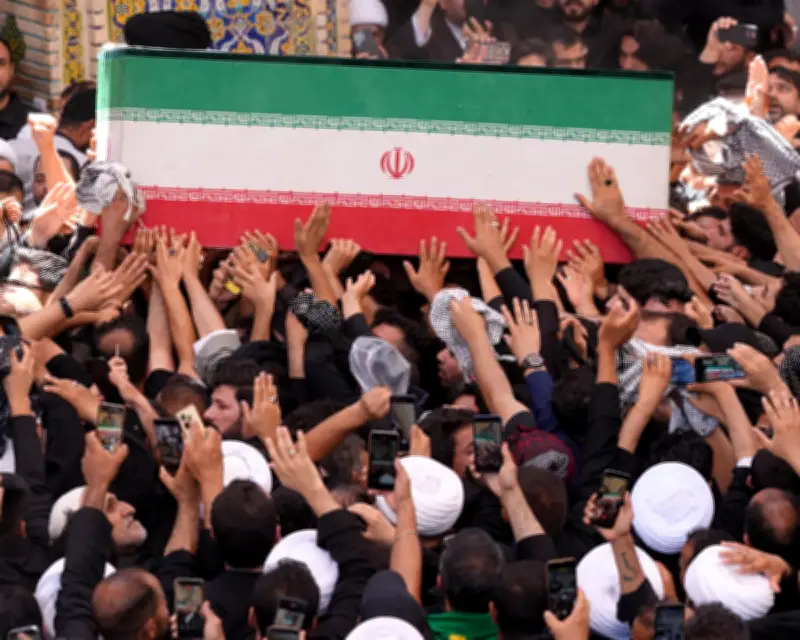
The funeral of Iran's slain supreme leader Ali Khamenei concluded with his burial in his hometown of Mashhad, capping a week of elaborate ceremonies across Iran and Iraq. The events unfolded as the United States launched renewed airstrikes on Iranian targets, with President Donald Trump declaring a fragile truce 'over' and claiming 170 targets were hit over two nights.
Khamenei's Death and the Transition of Power
Khamenei, 86, was killed along with much of his immediate family in US/Israeli airstrikes that began in February. His son, Mojtaba Khamenei, was appointed supreme leader in March but has yet to appear in public. Before his appointment, Mojtaba was a mid-ranking, elusive cleric, and his absence from the funeral has fueled speculation about his leadership style and intentions.
Mixed Reactions in Tehran
According to Patrick Wintour, the Guardian's Diplomatic Editor reporting from Tehran, the city presented a divided picture. 'Yes, the streets here are full, but so were the roads out. With an extended holiday in place for the funeral, plenty of Tehran's residents took the opportunity to head north to the sea and their holiday homes,' he said. Many who remained voiced anti-American sentiment, with one common refrain: 'Many people were only there because of how America attacked Iran. They're not supporters of the government, but couldn't stomach their leader being assassinated, and their country destroyed.'
The Supreme Leader's Unique Role
Dr. Evaleila Pesaran, a fellow at the University of Cambridge specializing in modern Iranian politics, explained the supreme leader's power. The position, held by only three individuals since the 1979 revolution, combines religious and political authority. The supreme leader controls the armed forces, state media, and has representatives in every ministry, effectively running a shadow government. The role was originally envisioned as a religious guide to prevent 'westoxification,' but has evolved into a hereditary position, with Mojtaba succeeding his father despite lacking the religious qualifications of his predecessors.
Economic and Social Context
Iran faces severe economic challenges, with inflation reaching 88.60% in June. 'People can't afford to buy a bag of rice – it's the same as a working person's monthly wages,' Pesaran noted. The funeral drew millions, but Pesaran cautioned that participation was driven by a mix of genuine support, anti-American sentiment, and cultural norms of mourning. 'The culture of grief within Iranian Shiism is far from the British stiff upper lip. At a funeral, you sob and wail,' she said.
Future Outlook
Mojtaba Khamenei's close ties to the Islamic Revolutionary Guard Corps (IRGC) suggest continuity, but Pesaran expects pragmatism. 'With total economic collapse, as and when peacetime returns, he will be forced to deviate from his father's approach if he hopes to maintain any sense of domestic legitimacy, or to create economic recovery. I would expect some pragmatism – he'll need to gain credibility.' For now, Iran's most powerful figure remains invisible, leaving the nation's future uncertain.