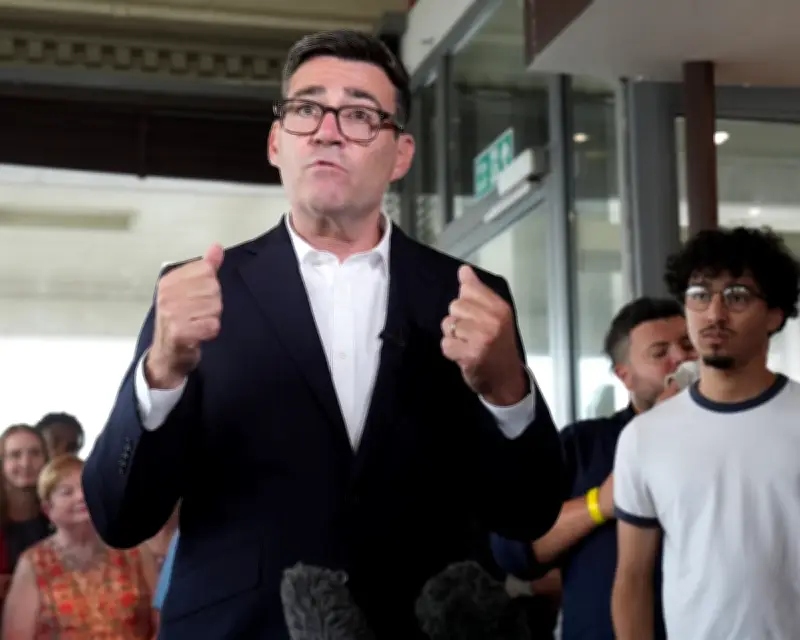
Andy Burnham has warned that the United Kingdom must face a series of 'honest challenges' as he prepares to become the next prime minister, signalling a break from what he describes as years of political evasion and short-term thinking.
Burnham's stark warning to the nation
In a speech delivered in Manchester, Burnham outlined what he sees as the critical issues that have been neglected by successive governments. 'We cannot go on pretending that everything is fine when it is not,' he said. 'The country is crying out for honesty about the state of our public services, the health of our economy, and the fractures in our union.'
The Greater Manchester mayor, who is widely expected to succeed Sir Keir Starmer as Labour leader later this year, used the address to set out a vision that prioritises long-term reform over electoral expediency. He pointed to the NHS, social care, housing, and regional inequality as areas where 'tough truths' must be acknowledged before meaningful progress can be made.

Key challenges identified
Burnham identified several specific challenges that he believes require urgent attention. On the NHS, he warned that 'the waiting lists are not just a statistic; they represent real people in pain'. He called for a 'radical rethink' of how health and social care are funded, suggesting that the current model is unsustainable without significant tax increases or service reductions.
On the economy, Burnham argued that 'too many people are working harder than ever but falling further behind'. He pointed to stagnant wages, insecure work, and a housing crisis that leaves young people unable to afford a home. 'We need an economy that works for everyone, not just those at the top,' he said.
Union and constitutional reform
The mayor also addressed the future of the United Kingdom, warning that the union is 'under greater strain than at any time in my lifetime'. He called for a 'new settlement' that devolves more power to the nations and regions, arguing that centralisation has failed. 'We cannot keep pretending that Westminster knows best,' he said. 'The answer to the threat of separation is not to cling to power but to share it.'
Burnham's comments come amid renewed debate about Scottish independence and growing discontent in Wales and Northern Ireland. He proposed a constitutional convention to redesign the UK's governance, with a focus on fiscal devolution and stronger local government.
Reaction and analysis
Political analysts have noted that Burnham's approach marks a significant departure from the cautious centrism of the Starmer era. 'He is taking a risk by being so upfront about the scale of the problems,' said Professor Jane Green of the University of Oxford. 'But it may also be what the public wants to hear after years of political spin.'
However, some within the Labour Party have expressed concern that Burnham's candour could be used against him by opponents. Conservative MPs were quick to seize on his remarks, with one describing them as 'a confession of failure' and 'an admission that Labour has no plan to fix the economy'. Burnham's team dismissed the criticism, insisting that 'honesty is the first step to recovery'.
Looking ahead
Burnham is expected to formally launch his leadership campaign in the coming weeks, with a focus on 'rebuilding the country from the ground up'. His speech was seen as the opening salvo in what promises to be a robust debate about the future direction of the Labour Party and the country.
As he prepares to take on the highest office in the land, Burnham's message is clear: the era of easy answers is over. 'We have to be honest with the British people about the challenges we face,' he said. 'Only then can we begin to build a better future.'