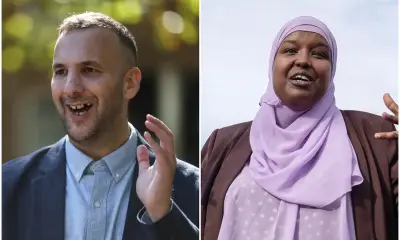
Helen Jenner is happy to chat, genuinely happy to chat. The usual way interviews with senior politicians happen includes lots of diary negotiations, sometimes a limit on topics or questions and, usually, a time restriction. So the 45 minutes Helen Jenner gave, no topic off limits, no restrictions, eight days after she was unveiled as leader, were a welcome change. Her predecessor, despite promising to have journalists round to his house for a cup of tea, and multiple - and I mean multiple - attempts, never took up the offer.
Jenner found herself catapulted into the national spotlight when, on Monday, September 21, she walked out onto the Senedd steps with Nigel Farage and unveiled as Reform UK's leader in Wales. It makes her the party's highest ranking figure in Wales and the official leader of the opposition to the Plaid Cymru government. Farage had hand selected Dan Thomas as leader the previous February and she made his deputy. But when Thomas was arrested, and subsequently quit as police continue to investigate allegations, she decided to put her name forward. It was a contested election, and within days of Thomas quitting, the Reform UK Senedd group picked her, not her challenger Jason O'Connell, to be their leader.
As she sits opposite me there are no obvious nerves. During the interview we cover bilingualism, politics, kids, music, even nails - hers are a very on-brand Reform teal - a colour the Friday before her colleagues cast their votes in the hope it would be a good luck omen. The Welsh language is something that is interwoven in many of the stories she tells of her life from her early friendships to choice of career, how she's raised her family, and her hopes for the future.
Early life and bilingual journey
Born in Neath, she is the middle child with one older and one younger brother. Her mum is from south Wales and her dad from Liverpool, but the pair met in the south. When she was a toddler the company her dad worked for - Redileads, an insulated cable manufacturer - offered him a choice to move to either Ynys Mon or Newcastle-upon-Lyme. Anglesey won. The family moved to Malltraeth and she, along with older brother Chris, her senior by 15 months, first went to Ysgol Bodedern but her mum, a teacher at Ysgol David Hughes, moved them to the Welsh-medium Ysgol Llanfairpwll because it was a feeder school to the high school where she taught. Her little brother, who she says was a surprise, followed eight years after her and he went to Ysgol Bodedern.
Her mum wasn't a fluent Welsh speaker despite her own dad being so. He didn't speak English until he was around eight. "But then his sister went off to university and the advice at the time was you need to focus on English so he thought he was doing the right thing with just English at home," she explains. His wife, from Monmouthshire, wasn't a Welsh speaker, and it followed they put their daughter - Helen's mum - into an English medium school where she learnt Welsh as a second language. But when the family moved to Ynys Mon the children's move to school in Llanfairpwll put her and her older brother on a bilingual journey.
Welsh has been part of her life since. She performed at the Eisteddfod, both in a choir and reciting, she says and recalls the joy learning Welsh gave her because it enabled her to speak Welsh to her Taid. "It's like it skipped a generation really. It was like as if we had that way of communicating that my mum had sort of missed out on, that me and him had that was quite nice." At the time her high school had a three-stream entry - English, Welsh or bilingual. "My school wanted to put me in the Welsh medium, but my mum just went, 'Oh, just go bilingual, a happy medium.'"
Politics and family influence
She was taught some languages in English and some in Welsh. "It was enriching for me, having that experience. It's such a massive advantage for me, having an English-speaking home, Welsh school, and to come out bilingual. Something that I've accepted in the last few years is this idea of a dual identity, and I think that fits into my view about Wales and being a unionist and everything as well. It's okay to be Welsh, but it's okay to be British, it's okay obviously to coexist through two languages, and it's something that I've really embraced. But first and foremost, Wales and Welshness is really important to me."
Her brothers, both in the armed forces, moved away, but they typically converse in English. "I think if they'd stayed they would have used it more often, but we typically spoke English at home. But if we'd go on holiday abroad or whatever and we didn't want people to listen to what we were saying, we'd switch to Welsh," she laughs. "I think they've lost a lot of their fluency from sort of moving away." And, despite her having Welsh from her early years, there were, for many years, friends who used English with her instead. "When I wanted to speak Welsh, I remember my friends sort of saying to me, 'Oh, that's weird for me, I've gotten to know you through English.' I think what my friends were trying to say is, and I think this is true, you get to know somebody through a language, and because my Welsh got more natural the older I got I sort of got better and better at it. I picked it up and understood it from an early age, but the fluency and the conversational came a bit later on, that's the final cog in really. Then I would make a point sometimes speaking Welsh to certain friends, and they'd say, 'Oh, this is weird, I can't speak Welsh to you, this is weird', but they'd be fluent and I was obviously fluent and wanting to become more fluent. But then I have got some friends now where we just flip between the language continuously."
Three months after her election to the Senedd the Eisteddfod happened to be in her home county and she was one of the many politicians posting videos from the Maes, but not all received the abuse she did. I put it to her that it's likely the first time that those until now distinct worlds - of the Eisteddfod and Reform UK - have collided. "It was quite shocking that myself, Louise Emery, and Cai Parry-Jones had put a video out filmed on the Maes in the Eisteddfod, speaking Welsh, and not only that, we were talking about how important it was to speak Welsh and where you could go and learn Welsh. Louise, fair play to her as a Welsh learner, stood there saying, 'Here are the resources, dewch i siarad Cymraeg.' We had a flurry of these people saying, 'Oh, the cheek of them being there.' Like, "Traitors not welcome." Then a few other kind of insulting expletives and stuff. I was like, 'Wow.' You talk about these things existing separately, I'd like to think that I'm trying to build bridges. The language is supposed to be used to build bridges and bring people together, and I'm very passionate that more people should be speaking Welsh, that we should be developing the language. I think what better way to do it than to depoliticise it and just have it used as a natural thing? It's really powerful when there's a debate going on in Welsh language where people come from all sides of the spectrum and it's just like, forget the language, we're using our language that brings us all together to debate politics."
Career and path to leadership
Looking back throughout her life, there are two men she credits with her interests in politics - Farage who she says has "always inspired me" and her dad "banging on about the EU, constantly, round the dinner table". Finally, she says, she asked what this thing he was so angry about was. Her dad was a Thatcher-supporting Conservative turned Ukipper, joining Ukip because "he had a real big bee in his bonnet". "He just really believed that Britain should be governing itself, and then he was really incensed that the EU at that point hadn't had their accounts signed off for years, and he was like, 'If that was a business they'd be thrown in prison for it, and they're corrupt and a waste of money', and immigration a bit - there was an element of that as well." Farage was someone she says she was immediately engaged by the first time she saw him on TV. "It can be politician, it can be a performer, it can be anybody in life, when you suddenly you get, 'Oh, that person, I believe in what they're saying and I suddenly believe it as well.' I felt he was really compelling, and he was a good speaker and he was really good at answering questions straight, and I just was like, 'Yeah, I'm interested in this now.' Then I got more and more involved and met all the other people."
Is Reform's politics something the whole family now share? "The family are Reform, definitely. My mum was brought up to be Labour, my grandad was a Labour miner, and teaching is very left-leaning typically with teachers and the literature that you teach and things, the moral messages and stuff like that, but she's very Reform now." The day she was named leader, her dad finally got to meet Farage in person when he came to the Senedd. "Dad said: 'It's been a long time coming.' It was quite emotional. He's wanted to meet Nigel for, gosh, it could easily be about 20 years, I reckon." The third man in her life for whom politics is everything is her husband, Emmett, who she met through the Ukip Young Independents. She joined Ukip herself in 2011 and became active the following year. After going to a branch meeting in 2012 she says within "five minutes" she was made secretary. There was, she describes, an active youth movement. "Then it was through a house party in London via the Young Independents that my husband turned up, and then that was it. We met in January, it was new year's going 2015 into 2016, so just before the Brexit referendum, and then we were married in the August," she says, adding she was pregnant with their first child. "We just got on with it."
Their wedding cake had a purple Union Jack on it, she admits, almost bashfully. When I say she sounds a little embarrassed by it, she responds: "Looking back now, it's a bit cringe." By the time they met, her A Levels from David Hughes in drama, English, and law had secured her a place at university in Bangor where she studied English Literature. Straight out of university she spent a spell living in Manchester, working at the Trafford Centre selling shoes and volunteering at a school in Moss Side, one of the more disadvantaged areas in Manchester. "I often make the joke that the things that I saw in the Trafford Centre, Moss Side was a doddle by comparison," she says. At the time, aged 21, she says PCGE applications were so competitive and she needed to gain experience for her application so she began volunteering with a literacy programme in a primary school. The Welsh language comes back into the story. She decided she wanted to study her PGCE bilingually and got a place at Bangor, moving in with her parents, but at the end of the year she couldn't find a job locally. She first did supply work, teaching at Ysgol Friars and Ysgol Llangefni, and it was during a visit from her tutor that it was suggested her style was better suited to secondary than primary. She wanted to return to the north west, where her partner was, and got a maternity cover job at Eaton Bank Academy in Congleton.
There is plenty in common between the north and Wales so it wasn't, she admits, the biggest culture shock, but urban life definitely appealed. "When you grow up somewhere like Anglesey, somewhere quite rural, and you feel like as a teenager there's not much going on, you do sort of look for something else and something different. So I did think, 'Oh, this is great, there's more going on, I'm near to Manchester, I'm near all that.'" Her next job was three years at Weaverham High School in Northwich where she taught English. When she met Emmett she owned a house in Warrington, he had a flat in London, and they had to decide what to do. They opted to live in London where her son was born. Then she got a job at the BRIT school; a state school, with funding via the music industry too, it is described as the leading performing and creative arts school in the UK. Students would arrive in year 10 and up to foundation college level before university. It combined two of her loves - teaching and music.
At university, she had been in a band called Mephistophelean Engines of Pleasure, The Mephs for short. The name was already set when she joined and she isn't entirely sure of how or why they picked that. "I think the guitarist had done a degree in philosophy," she ponders, seemingly still unsure of its origins. "I always liked singing and performing and things from school, and then that band was advertising for a new singer, they were just like a little band, just local lads, and then I just went for this audition in this guy's garage and I loved it, it was good fun." The music was, she says, "a weird mishmash, like a sort of punky, rocky, sort of classic rock mixture". "I wrote a couple of songs and I was more like the emo-y sort of vibe, so that's why one of the songs is a bit screechy," she smiles. She has an EP of their records, and there is a clip floating around online, she says. The sort of venues they performed at were Varsity in Bangor or local pubs, but they did travel to Bridgend for a gig where they stayed with her gran and grandad. "My gran loved it, she was like, "Oh, the boys, they ate and they ate," and they loved it, they were such sweeties, the lads. We had a lot of fun with that. I kept it from my parents initially because I thought they'd think it was a distraction, they were worried about it, and then they met the boys and loved them. The boys were always coming round for dinner at mum and dad's. It just then it tailed off towards the end of my third year and then I moved away, and I'm not massively in touch with any of them anymore."
She still sings, a bit, mainly karaoke - she has no one number, and says she has an "eclectic taste". But now her hobbies are swimming, something that her own parents made a "non-negotiable", and beach trips. She says she still tutors online - something her Senedd record of interests says pays between £2,501 - £5,000 a year - but admits she may need to phase it out given her new role.
Teaching and political awakening
Teaching at the BRIT school, she says, was a "mad" job. "It was all own clothes and very college feel, and then you get these people, they'd just come off the stage and they'd come barrelling into your lesson and you'd have to try and settle them down to teach them English. But what I found was in terms of the discipline there, it was controlled chaos. There were performers, the kids are all very, very confident and very familiar with staff, but in a nice way, it was just that ethos. They were also quite focused as well, and they knew they'd auditioned to be there, they knew they wanted to keep their place." The famous names she taught include Harrison Pettman, a runner-up in Britain's Got Talent. "He used to come in in the morning, I'd be trying to prep a lesson, he'd come in like, 'Miss, can I perform for you?' I'm going, 'With a song? Okay, Harrison, sit on the desk and sing.' It was mad working there but I loved it." She worked there for two years, then having her second baby, a daughter. "I was so desperate to go back but we knew we wanted to move back to Wales. I thought: 'Can I go back on the train two days a week? I really want to still work there.' But we'd decided at that point it was the right time because I didn't want to raise my family in London. I was so sad about leaving that school but then I came back [to Wales] and then I stood for election, because what else would you do on maternity leave?" she laughs. Her daughter was eight months and son almost three when she was the Brexit Party candidate for Ynys Mon. How did she juggle campaigning? "It was insane, I was just crazy," she admits.
Her motivation was that she was "just fuming about Brexit". "I was just thinking that's not getting done," she said. "I remember going to the assessment centre in London [for Brexit Party selection] with the baby in the pram and then Emmett having to be outside because I was breastfeeding as well, and saying: 'I've got an hour on the clock now because I've got to get back and feed the baby.' Her attempt to be elected for Ynys Mon in the 2019 general election was unsuccessful - but her 6% vote share meant she kept her deposit, she still says proudly. "It was a bit of profile building exercise, it was good experience." When she speaks of politics, she often describes a "duty" she felt to be involved. When Boris Johnson became prime minister she thought that "duty" to get Brexit done was over. "Because that was his ticket, to get Brexit done. I thought, 'Right, thank goodness.'"
With that happening at Westminster, and Farage himself stepping away from the limelight, and she too stepped back, returning to teaching three days a week and with two young kids. She stayed involved with politics, doing some translation behind the scenes, but she was firmly just a supporter. There was a "bubbling" under the surface, she says, and when Rishi Sunak replaced Johnson she felt let down. In 2024 her husband told her he was going to stand for election in the general election - he got 9.9% of the vote share on Ynys Mon, coming fourth - but the party had its first elected MPs, and clear aims for the Senedd election then just under two years away. She says people were asking her if she would stand, but she was enjoying her teaching job. She put her name forward and says "it's just sort of gone from there". By that she means being selected as the party's top candidate for Bangor Conwy Mon and being named deputy leader to Dan Thomas during the campaign. She was the party's representative at S4C's election debate in April, just before the election in 2026, and says: "I think my profile just went a bit next level when I did that TV debate. I think that's when people started going, 'Who is this person?' It's just been a bit of a whirlwind since then, really, but it was always running along. It was in the background with teaching, and obviously I kept it very, very separate. I was very keen to say teachers shouldn't be pushing their views."
Her colleagues knew her experience, and she was asked to run the debate club, for example. "I would always play devil's advocate for these things. You'd hear some kids say certain things, and I'd say, 'Why do you think that is that? Where have you heard that from?' A lot of the new curriculum for Wales was about critical thinking and I just took it very, very seriously." When she was selected as the lead candidate, and given the polling showed she was highly likely to be elected, she had to make a call - teaching or politics. "It was only fair to the party to throw myself into it full time", she says, so she left her teaching job at Easter with the blessing of her headteacher who told her "the door's always open if you want to come back". By then the pupils too had begun seeing her name online. She'd told them she was going to do something "different" but they were starting to work it out. Two kids who didn't need to Google her political beliefs were her own. Her kids, like many of those in families involved in politics, have more awareness than most of their classmates and her two are no exception.
Farage is, she said, a "household name" for them, with GB News on. "I said, 'You don't need to talk about Reform and stuff in school.' I explained to them Reform is politics, some people like Reform, some people don't, and my daughter said the other day, she said, 'Don't worry, I've checked, everyone in my class likes Reform.'" The new role will be a readjustment for all of them. Her son, now 10, had questions about her leadership attempt. "I had to say to him, 'Dan Thomas isn't going to be leader anymore and mummy's going to have to maybe do that, how do you feel about that?' And he was like, 'Yeah, fine, that sounds good.' Then he was like, 'Are you going to have to be in Cardiff?' 'Maybe a bit more.' 'Oh, not so good.' So, I have to try and balance it, like we plan for the school holidays, plan to go away and do stuff with them, and when I'm back, I'm full on, doing the school run and everything. My daughter, because she's a bit younger, she's seven, she just kind of goes, 'When I'm older I want to work for Nigel Farage.' She's got this weird thing at the moment with table manners where, because we've said to them about eating nicely at the table, we used to say things like, 'You won't be getting to go to dinner with Nigel Farage,' or, you know, mention anybody that's a little bit in authority. So now she's got this thing where she's like, "When am I going to dinner with Nigel Farage so I can show my table manners?' Nigel doesn't know this, she's desperate to have him say what nice table manners she has."
Leading Reform UK in Wales
The school run has changed too as people recognise her but nothing major has changed, she's pleased to say. She isn't fazed, she says, by the weekly First Minister's Questions, seen as the headline item of the Welsh political week. She stepped in for Thomas with very little notice after his arrest, but says her spell as deputy has been "really advantageous". "It has felt in some ways like stepping up is a natural thing to do," she says. "Generally speaking, because I'm quite a confident speaker, and [if you've had] year 11 last lesson on Friday, come on! The chamber doesn't scare me. I think the gravity of, 'Oh okay, I'm representing the group and stuff', does hit me, but I'm just there to do as good a job as I can, and I feel like I'm speaking for a lot of people in Wales when I do it, so I do recognise the responsibility. But once I've got the first line done I do enjoy it."
That whirlwind, she says, means she hasn't really "caught up with" the change that being leader will mean. "There's that real sense of purpose and drive in terms of what we're trying to do as a group, and it was almost like as if I'm quite, to be honest, I'm quite proud of the way that we kind of got it done quickly, because it's so important what we're trying to do here, so important what we're trying to do for Wales." There was no vote of the wider membership on who leader should be, and there doesn't seem to have been any kickback to that, she says. "I just think it's so much bigger. We're the figureheads for it, but what we're trying to achieve in Wales, what we're trying to do, is so much bigger. There's just so much to do." How they work with Reform UK more widely, and whether Farage has overall control, is a longstanding question. "I've had some really positive meetings with people like Suella Braverman regarding the education brief and things like that. I think we like to check in to make sure we're fundamentally aligned on some things but, ultimately, some things are going to depart slightly because it's different, isn't it? We can only go so far with talking curriculum in comparison to the UK because we've had this bilingual system, but I think broadly I'm very, very happy to say that we're we're joined up in all our thinking anyway. I don't recognise that there's any sort of headbutting over any fundamentals, anything ideological, anything like that, so we're really lucky in that respect. But ultimately Nigel's been clear about this, when Dan was leading, the same here, over to you, we're in Wales. They're there if we need them and policy meetings are good in terms of the overall direction, but they're very happy to leave us to it and I think that's a really good thing as well."
When Farage came to Wales he spoke of fielding a full slate of candidates - more than 1,200 - in the council elections coming in May. That election cycle will be relentless as leader but she says she is glad she had eight months as deputy and time to adjust to being a Senedd member before getting the top job. Being leader was never, she said, the ultimate goal. "The goal was always being involved, doing what I can, where I can, what can I do to be helpful, go and put myself forward and people have decided then along the way, 'You'd be good,' and I've said 'Great, let's go for it.' It's not that chess pieces have been moving and now, 'Oh, I'm in the top job.' It's always been the goal to support the cause and it's just ended up that this is this the best way I can do it."
She admits she is still getting to know the Reform UK group. "A leader is as good as the team that they've got around them, and I've worked in places over the years, and I'm not going to say where, where I've seen people who purport to be leaders, who see other people as threats, who see other people's successes as undermining them. I'm the opposite. I think when the team is doing well everybody does well. If I'm listening to Francesca [O'Brien] contributing in the chamber or somebody giving a good contribution, I'm smiling away because I want everybody to do well. We're a team at the end of the day, so I try and bring people together. The teacher comes out all the time in terms of, 'What does everyone want to contribute to this?' Or, 'Let's fill out a form about what we want to do,' and I'll look at it and see where we can find the common ground. I want to develop people and recognise people's strengths and recognise the differences in people, and how that can be a strength as well. If that person's good on that topic, that person's good at delivering perhaps more of a controversial thing, that person's really good with the nitty gritty on their legislation, I just think it's a huge strength. I like to bring everyone together, I like to listen, I like to learn, and I think I generally I keep quite a cool head. Maybe coming from the teaching, kids come in with disasters, a fight's broken out, and you've got to be the adult in the situation, you've got to be the calm head but ultimately as well, I do think I'm capable of making tough decisions, I do think I've got that in me, and there is the look, as you know, so there is the warning shot. But I haven't had to use that yet," she laughs. "It's duty. It's just a real sense there's a big thing going on here, we've got the last chance to kind of sort things out and my idea has always been I've trusted the party, trusted the system to put me where they think I'm best placed. I think they've got that faith in me, and I don't want to let them down, and I just really feel I've always wanted to do the right thing to further the cause, and if the feeling is me being in one of the leading positions will further that cause then I will do it and I'll give it a hundred million percent, like I give everything else. I haven't had time to feel scared about it. It's been such a whirlwind."